

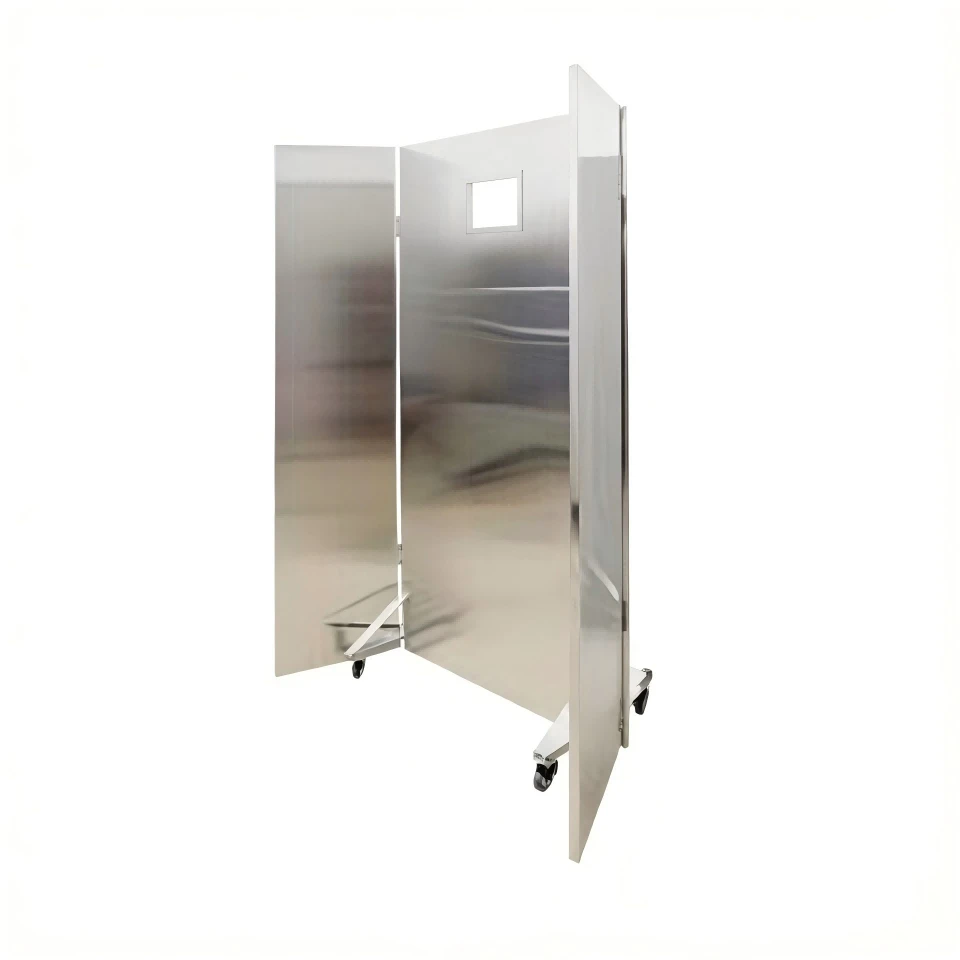
Products overview
Flexible Radiation Shielding for Medical Imaging Environments
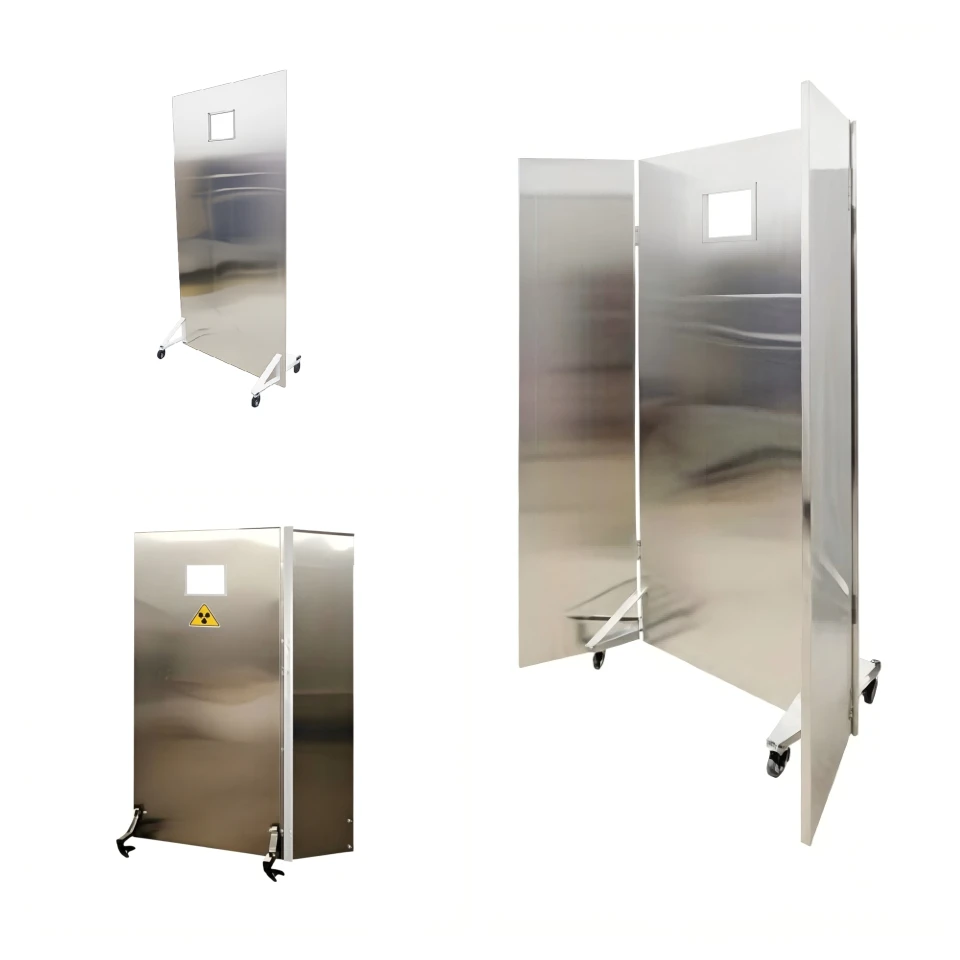
The Stainless Steel Lead Screen is designed to provide mobile radiation protection for healthcare professionals working in X-ray environments. Constructed with a durable stainless steel frame and 2.0mmPb lead equivalency, it helps reduce exposure to scattered radiation while allowing users to create temporary protective barriers wherever they are needed.
Available in single-panel, double-panel, and triple-panel configurations, the screen can be selected according to different workspace layouts and shielding requirements.
Why Single, Double and Triple Panel Configurations Exist
Radiation shielding requirements are not the same in every imaging room. Some work areas only need a compact barrier in one fixed direction, while others require wider frontal coverage or additional shielding along the sides of the operator position. This is why a 2.0mmPb stainless steel lead screen is available in single, double, and triple panel configurations.
The number of panels changes more than the overall width. It also changes the shape of the protective boundary and how the mobile X-ray shield fits into the available workspace.
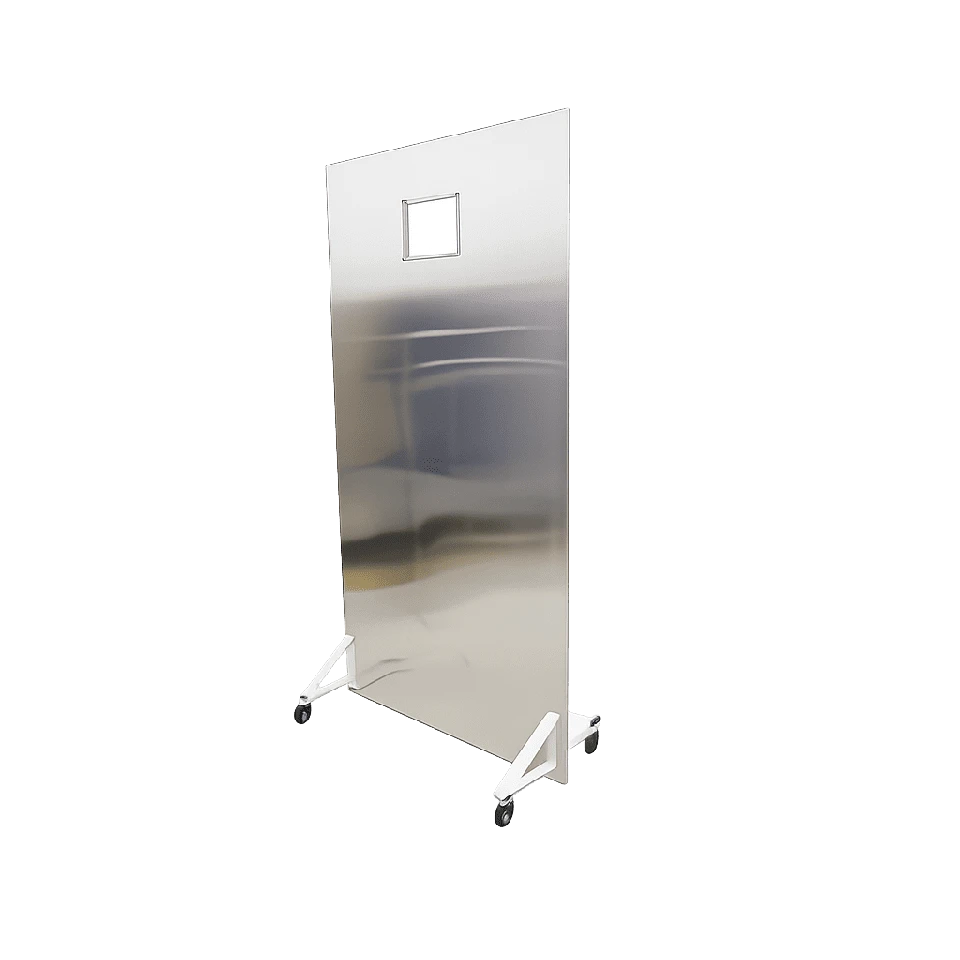
Single Panel Lead Screen for Compact Shielding
A single panel lead screen creates one straight shielding plane and is the simplest configuration for locations where the operator position is clearly defined.
It is suitable when:
- available floor space is limited
- one main direction requires shielding
- a compact mobile radiation barrier is preferred
- the shield needs to be repositioned as one complete unit
For smaller imaging areas or dedicated operator positions, a single panel configuration can provide the required shielding without occupying more floor space than necessary.
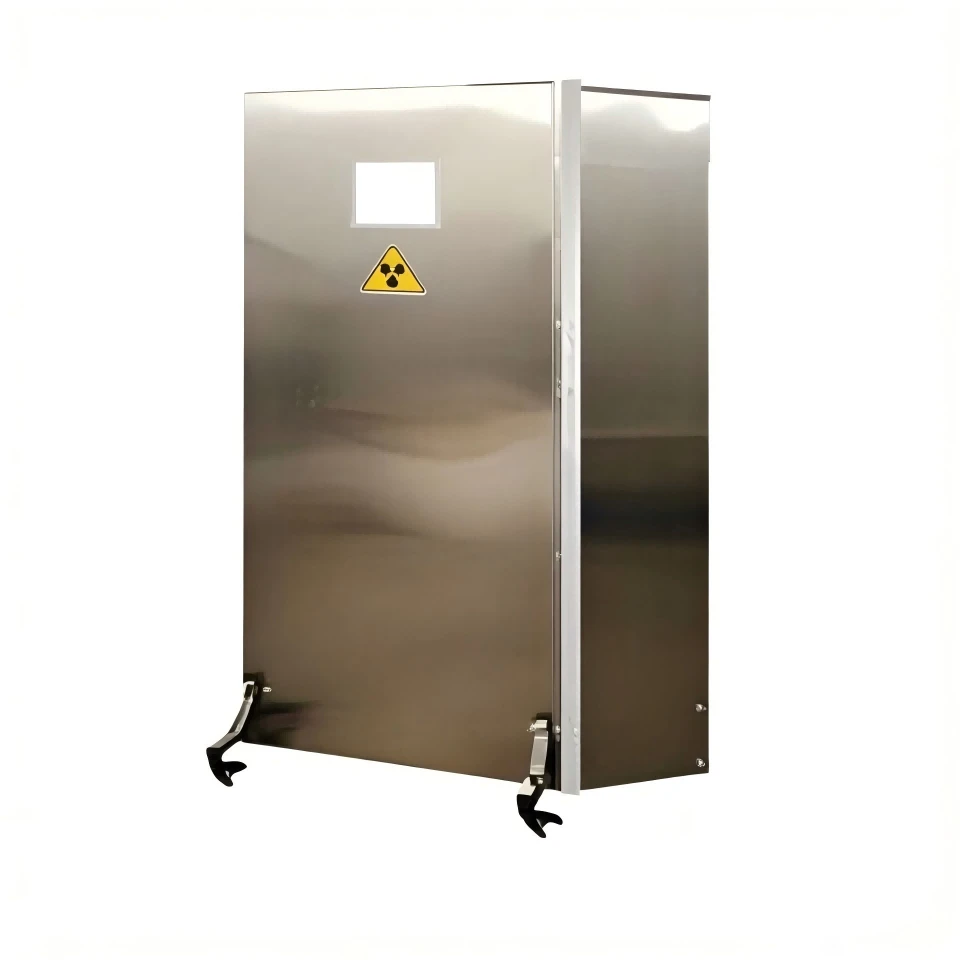
Double Panel Radiation Shield for Wider Coverage
A double panel radiation shield extends the protected area beyond a single straight screen. Depending on the panel connection and positioning, the second section can increase overall shielding width or help adapt the barrier to the shape of the working area.
This configuration is useful when:
- wider frontal radiation protection is required
- one oversized rigid panel would be difficult to move
- the protected working area is larger
- the shield needs more flexible positioning around equipment
A double panel mobile X-ray shield can therefore provide more coverage while still allowing the barrier to be handled as a modular system.
Triple Panel X-ray Shield for Extended Protection
A triple panel X-ray shield provides the largest configurable shielding area within the product series. A central section can form the main protective barrier, while the additional panels extend coverage to the sides where required.
This configuration is particularly useful when:
- a wider protected zone is needed
- partial lateral shielding is beneficial
- the operator workstation covers a larger area
- room layout requires a broader or angled shielding boundary
For facilities that need more than a simple straight barrier, the triple panel configuration can create a more extended multi-panel radiation shielding zone.
Panel Quantity Should Match the Required Shielding Geometry
Choosing between single, double, and triple panels should not be based only on which model provides the largest size.
The correct configuration depends on:
- required shielding width
- operator position
- direction of scatter radiation
- available floor space
- equipment location
- need for lateral coverage
- movement and storage requirements
A single panel may be sufficient for a compact operator position, while double or triple panel configurations can provide a wider or more adaptable protective boundary.
One Shielding Specification, Different Coverage Options
Across the product range, each panel can be manufactured according to the specified 2.0mmPb radiation shielding configuration, while the total protected area changes according to the number, size, and arrangement of the panels.
This allows hospitals, imaging facilities, and radiation protection contractors to select a stainless steel mobile X-ray shield based not only on lead equivalency, but also on the shielding geometry required by the actual workspace.
In this way, single, double, and triple panel configurations are not simply different product sizes. They provide different ways to shape and extend the radiation protection boundary around the operator and imaging environment.
Why Stainless Steel Matters in a Heavy-Duty Radiation Shield
A 2.0mmPb stainless steel lead screen is designed for applications where radiation protection, structural durability, and long-term usability are all important considerations. Unlike lightweight shielding materials that focus only on radiation attenuation, a stainless steel radiation shield combines a high-strength external structure with a defined lead shielding layer to create a more robust mobile protection solution.
For hospitals, imaging facilities, and radiation protection projects with frequent equipment movement, the external construction of a heavy-duty mobile X-ray shield can directly affect its service life, maintenance requirements, and daily handling experience.
Protecting the Internal Shielding Structure
The lead shielding layer is the core component responsible for radiation attenuation, but it requires a protective structure to maintain its position and integrity during regular use.
A stainless steel outer construction helps provide:
- rigid panel support
- protection of the internal shielding material
- improved resistance to repeated handling
- stable long-term panel shape
- a more durable enclosure for mobile applications
This makes a stainless steel X-ray protection barrier suitable for environments where the radiation shield may be moved, positioned, cleaned, and used repeatedly.
Designed for High-Use Clinical Environments
Mobile radiation shields are often used in busy imaging areas where equipment and personnel movement occur regularly. Compared with softer external coverings, stainless steel provides a stronger surface that is suitable for repeated operational use.
The smooth metal surface can also support routine cleaning and inspection procedures required in many healthcare environments.
For applications requiring a durable radiation shielding panel, stainless steel construction provides a balance between shielding performance and practical daily operation.
Structural Stability for Multi-Panel Shielding Systems
A single, double, or triple panel radiation shield requires a stable structure to maintain alignment between connected sections. This becomes increasingly important as the total shielding coverage increases.
The stainless steel framework helps support:
- panel rigidity
- connection accuracy
- stable positioning
- long-term structural performance
- compatibility with mobile caster systems
For larger multi-panel radiation barriers, the external structure is not only a protective surface but also part of the overall mechanical design.
Supporting Heavy-Duty Mobile Radiation Protection
A heavy-duty mobile X-ray shield must combine several requirements:
- specified lead equivalency
- stable construction
- safe movement
- reliable positioning
- practical maintenance
The stainless steel structure helps create a more robust radiation protection solution for facilities that need a reusable barrier rather than a temporary lightweight shield.
Stainless Steel as Part of a Complete Shielding Solution
The purpose of stainless steel is not to replace the lead shielding layer. Instead, it supports the complete radiation protection system by protecting the internal shielding material and providing a durable outer structure.
For a 2.0mmPb stainless steel lead screen, the final performance depends on the complete design, including the lead equivalency, panel construction, viewing window specification, mobility system, and manufacturing quality.
By combining a defined 2.0mmPb radiation shielding specification with stainless steel construction, the product provides a durable mobile barrier solution for demanding X-ray protection environments where long-term reliability and heavy-duty performance are required.


Applications
General X-ray Rooms
In general diagnostic X-ray rooms, staff may require an additional protective barrier between the operator position and the examination area, especially where the room layout does not provide a fixed control booth or where temporary shielding needs to be repositioned according to the workflow.
A 2.0mmPb stainless steel lead screen provides a durable mobile radiation barrier for these environments. The stainless steel construction protects the internal shielding structure, while the single, double, or triple panel configurations allow facilities to select the shielding width and geometry that best match the available space.
For general X-ray room radiation protection, the screen can be used to create:
- a temporary operator shielding position
- a movable protective boundary between staff and the imaging area
- wider frontal coverage with double or triple panel configurations
- additional lateral protection where a multi-panel layout is required
- a durable shielding solution for frequently used diagnostic rooms
The stainless steel mobile X-ray shield is particularly useful where a fixed lead-lined barrier is not practical or where the protective screen needs to be repositioned between different examination setups.
Depending on the room layout, buyers can select a single panel lead screen for compact operator protection or a double or triple panel radiation shield where wider coverage is required.
DR Rooms
Digital radiography rooms often contain an X-ray system, detector equipment, patient positioning area, workstation, and other supporting devices within the same clinical space. The arrangement of this equipment can affect where a mobile radiation barrier can be positioned and how much shielding coverage is required.
A 2.0mmPb mobile X-ray shield for DR rooms provides a configurable solution for protecting operator or staff positions without permanently changing the imaging room layout.
The multi-panel design is especially useful where the required shielding area changes according to equipment position or room geometry.
Typical uses include:
- operator radiation protection in DR imaging rooms
- additional shielding near workstation areas
- temporary separation of staff and examination zones
- wider protection using double panel radiation shields
- extended or partially angled coverage using triple panel X-ray shields
For compact DR rooms, a single panel stainless steel lead screen can provide a straightforward protective boundary while occupying less floor space. In larger digital radiography rooms, double or triple panel configurations can create a wider mobile radiation shielding zone around the operator position.
Because the screen is mounted on a mobile heavy-duty base, it can be repositioned when the imaging workflow or equipment layout changes. This makes a stainless steel radiation shield for DR rooms suitable for facilities that need durable, reusable, and configurable X-ray protection rather than a permanent fixed barrier.

Technical Specifications
| Item | Details |
|---|---|
| Product Name | Stainless Steel Lead Screen |
| Material | Stainless Steel |
| Lead Equivalency | 2.0mmPb |
| Configurations | Single Panel / Double Panel / Triple Panel |
| Viewing Window | Lead Glass |
| Mobility | Movable |
| Installation | Freestanding |
Choosing Single, Double or Triple Panel Radiation Shields
Choosing between a single, double, or triple panel radiation shield should be based on the required shielding width, operator position, room layout, and the direction from which scatter radiation protection is needed.
Although each configuration can use the same specified 2.0mmPb radiation shielding structure, the number of panels changes the overall protected area and how the barrier fits into the imaging environment.
Choose a Single Panel Radiation Shield for Compact Operator Protection
A single panel radiation shield is usually the most practical option when one straight protective boundary is sufficient.
It is suitable for:
- compact X-ray or DR rooms
- clearly defined operator positions
- limited available floor space
- applications where the shield needs to move as one complete unit
- temporary frontal radiation protection
A single panel stainless steel lead screen provides a simple shielding layout without adding unnecessary width or side sections.
Choose a Double Panel X-ray Shield for Wider Coverage
A double panel X-ray shield is better suited to applications where the required protective area is wider than one standard panel can provide.
The second panel can extend the shielding boundary and, depending on the product design, may also allow the screen to fit more effectively around equipment or operator work areas.
A double panel configuration may be preferred when:
- wider frontal coverage is required
- the operator station extends beyond one panel width
- a large single rigid screen would be difficult to position
- the room layout benefits from a two-section shielding arrangement
For hospitals and imaging facilities that need more coverage without moving to a full three-panel system, a double panel radiation barrier provides a useful middle option.
Choose a Triple Panel Lead Screen for Extended or Angled Shielding
A triple panel lead screen provides the largest configurable shielding area within the product range.
With a central section and two additional panels, the barrier can create a broader protected zone and, where the panel structure allows, extend protection toward the sides of the operator position.
A triple panel configuration is particularly useful when:
- wide radiation shielding coverage is required
- partial lateral protection is needed
- the operator works within a larger protected area
- equipment or room geometry requires a wider shielding boundary
- one straight mobile screen does not provide enough coverage
For larger imaging environments, a triple panel X-ray shield can provide a more flexible multi-directional protective layout.
Compare the Panel Options by Shielding Requirement
| Selection Factor | Single Panel | Double Panel | Triple Panel |
|---|---|---|---|
| Main Use | Compact operator shielding | Wider frontal protection | Extended or partially lateral shielding |
| Floor Space | Lowest | Medium | Highest |
| Shielding Width | Standard | Extended | Maximum |
| Positioning | Simple straight barrier | Wider two-section barrier | Broad multi-panel barrier |
| Best For | Small rooms and fixed operator positions | Medium-size imaging areas | Larger or more complex layouts |
| Mobility | Easiest to reposition | Moderate | Depends on total size and weight |
| Customization | Width, height, Pb | Panel size, width, Pb | Panel size, geometry, Pb |
Select the Shield by Coverage, Not Panel Count Alone
More panels do not automatically mean a better radiation protection solution.
A single panel mobile X-ray shield may be the right choice if it fully covers the required operator position. In other rooms, a double or triple panel radiation screen may be necessary because the protected area is wider or the shielding boundary needs to extend around part of the workspace.
Before selecting a configuration, buyers should consider:
- required lead equivalency
- total shielding width
- operator location
- equipment position
- available floor area
- need for lateral protection
- product weight
- caster and base dimensions
- storage and repositioning requirements
For custom projects, a 2.0mmPb stainless steel mobile radiation shield can be configured with single, double, or triple panels according to the actual dimensions and shielding geometry of the room.
How Panel Geometry Changes the Protected Area
The performance of a mobile radiation barrier is determined not only by lead equivalency, but also by the shape and position of the shielding panels. Two screens manufactured with the same 2.0mmPb radiation shielding specification can create very different protected areas if their panel geometry is different.
For this reason, panel width, number of sections, and panel angle should be considered together when selecting a stainless steel mobile X-ray shield.
Single Panel: One Straight Protective Boundary
A single panel lead screen creates a simple straight shielding plane between the radiation source and the operator position.
This configuration works well when:
- the operator remains mainly in one position
- scatter radiation protection is required from one primary direction
- available floor space is limited
- a compact mobile radiation barrier is preferred
The protected area is mainly determined by the panel width, height, and the position of the shield relative to the operator and imaging equipment.
Double Panel: Extending the Shielding Boundary
Adding a second panel increases more than the total width of the barrier.
A double panel radiation shield can extend the protective boundary across a wider workstation or, where the connection allows angled positioning, change the direction of the shielding surface.
Instead of one straight line, the two sections can create a broader protected zone around the working position.
This can be useful where:
- the operator area is wider than one panel
- equipment occupies part of the available shielding line
- additional side coverage is required
- room geometry makes one oversized straight barrier impractical
Triple Panel: Creating a Broader Shielding Envelope
A triple panel X-ray shield provides additional flexibility in shaping the protected area.
The center panel can form the main frontal radiation barrier, while the two additional sections extend the shielding boundary toward the sides. Where adjustable panel angles are available, this configuration can create a partially enclosed operator protection zone rather than a simple flat screen.
This makes a triple panel radiation barrier useful where the shielding requirement involves both frontal and lateral coverage.
Panel Angle Can Matter as Much as Panel Width
A wider barrier does not always need to remain completely straight.
Where the product structure allows panel adjustment, changing the angle between sections can alter the footprint and direction of the protected zone.
For example:
- a flatter configuration provides wider frontal coverage
- partially angled panels can extend shielding toward the sides
- a more compact configuration may reduce the floor footprint in limited spaces
This is why multi-panel radiation shield geometry should be evaluated according to the actual operator position and room layout rather than total screen width alone.
More Panels Do Not Automatically Mean Better Protection
A triple panel screen is not necessarily the correct choice for every X-ray room.
If a single panel 2.0mmPb lead screen already provides adequate coverage for the required operator position, additional panels may simply increase product weight and floor space.
Likewise, a double or triple panel configuration may be more practical where one straight shield leaves part of the working area outside the intended protective boundary.
The correct configuration depends on:
- required shielding width
- operator position
- scatter radiation direction
- room dimensions
- equipment location
- desired lateral coverage
- available floor space
- mobility requirements
Configure the Barrier Around the Workspace
For custom projects, the number and dimensions of the panels can be selected according to the required shielding geometry.
A custom multi-panel radiation barrier may therefore use different center and side panel widths to create the required coverage without unnecessarily increasing the total size of the shield.
By combining defined 2.0mmPb lead equivalency with the appropriate single, double, or triple panel geometry, a stainless steel radiation shield can be configured around the actual protected working area rather than selected only by overall product dimensions.
In-House Manufacturing of Heavy-Duty Lead Screens
As a manufacturer with our own production facility, we control the fabrication of heavy-duty lead screens from raw material preparation and stainless steel processing through shielding assembly, panel fitting, caster installation, final inspection, and packing.
For a 2.0mmPb stainless steel lead screen, in-house manufacturing allows important project details such as panel dimensions, lead shielding configuration, viewing window size, frame structure, caster system, and single, double, or triple panel layout to be checked throughout production.
Stainless Steel Frame Fabrication
The outer structure of a heavy-duty radiation shield must support the weight of the internal lead shielding, viewing window, connected panels, and mobile base.
Our manufacturing process includes stainless steel cutting, forming, welding, and dimensional inspection according to the confirmed product specification.
Key points checked during fabrication include:
- overall frame dimensions
- panel squareness
- connection accuracy
- weld quality
- surface condition
- base alignment
- panel-to-panel fit
This helps provide a stable structure for both single-panel and multi-panel radiation barriers.
Lead Shielding Installation and Panel Assembly
The internal shielding material is installed according to the required product configuration. For a 2.0mmPb mobile X-ray shield, the shielding layer, panel dimensions, and connection areas are checked against the approved specification.
For double and triple panel models, additional attention is given to the transition between panels so that the complete barrier follows the intended shielding layout.
Where a lead glass viewing window is included, its size, position, shielding specification, and frame fit are also checked during assembly.
Multi-Panel Manufacturing for Different Coverage Requirements
Single, double, and triple panel radiation shields require different structural layouts and weight distributions.
Because these products are manufactured in-house, we can adjust:
- individual panel width
- overall shield height
- total shielding width
- number of panels
- connection structure
- viewing window dimensions
- mobile base configuration
- caster selection
This allows the stainless steel radiation shield to be configured around the actual room layout and required protective coverage rather than forcing the buyer to use one fixed standard model.
Heavy-Duty Caster and Base Assembly
A large lead screen can carry substantial weight, so mobility depends on more than simply adding wheels.
During assembly, the mobile base and caster system are checked for:
- secure mounting
- movement
- locking function
- load support
- alignment
- overall shield stability
For a heavy-duty mobile radiation barrier, these mechanical details are important for controlled repositioning during daily use.
Final Inspection Before Shipment
Before packing, the completed 2.0mmPb stainless steel mobile X-ray shield is checked against the confirmed customer specification.
Final inspection may include:
- overall dimensions
- lead shielding configuration
- single, double, or triple panel arrangement
- viewing window size and position
- panel alignment
- stainless steel surface finish
- caster movement and locking
- base stability
- customized components
- product labeling and packaging
For project-based and B2B orders, technical drawings, product specifications, material information, and available radiation shielding documentation can also be prepared for customer review.
By combining in-house stainless steel fabrication, shielding assembly, multi-panel manufacturing, and final quality control, we can provide custom heavy-duty lead screens that match the dimensions, panel configuration, and radiation shielding requirements confirmed before production.
How Shielding Continuity Is Maintained Between Panels
For a multi-panel radiation shield, the connection between individual sections is an important part of the overall shielding design. A double panel X-ray shield or triple panel lead screen is not simply multiple separate barriers placed next to each other. The panel arrangement must work together to create a continuous protective boundary.
For a 2.0mmPb stainless steel radiation shield, maintaining shielding continuity between panels helps ensure that the complete mobile radiation barrier performs as one integrated shielding system.
Panel Connections Are Part of the Radiation Shielding Design
When multiple panels are used, the area where two sections meet requires careful consideration. If panels are positioned incorrectly or if the connection design does not match the shielding requirement, unnecessary gaps may appear between sections.
The panel connection should consider:
- panel alignment
- connection structure
- overlap or edge design
- panel positioning
- required shielding width
- movement during daily operation
This is especially important for larger multi-panel radiation barriers, where the protected area is created by combining several shielding sections.
Maintaining Coverage Across Double and Triple Panel Configurations
A single panel lead screen provides a continuous shielding surface by itself. However, when wider coverage is required, additional panels are introduced to extend the protected area.
For double panel radiation shields, the two sections should maintain a coordinated shielding boundary when positioned together.
For triple panel X-ray shields, the center and side panels should work as one system to create a wider protective zone while maintaining appropriate coverage between adjoining sections.
The goal is not only to increase total width, but to ensure that the complete panel arrangement provides consistent protection across the intended operator area.
Panel Geometry Influences Shielding Continuity
The relationship between panel width, panel position, and panel angle can affect the final shielding boundary.
A properly configured multi-panel system considers:
- how panels meet when deployed
- whether additional lateral coverage is required
- how the shield fits around equipment or workstations
- how the barrier is stored and repositioned
For this reason, selecting a triple panel radiation shield is not only a decision about size. It is also a decision about how the shielding sections create the required protective geometry.
Maintaining Stability During Movement
Because a mobile radiation barrier is frequently repositioned, panel alignment must remain stable during normal handling.
A heavy-duty stainless steel mobile X-ray shield should maintain its intended configuration while being moved between locations.
Important mechanical considerations include:
- rigid panel construction
- secure panel connection
- stable base design
- caster performance
- controlled positioning
These factors help maintain the designed shielding relationship between panels during everyday use.
Configuring Panel Connections for Custom Projects
Different imaging environments may require different panel arrangements. A small DR room may need a compact double-panel configuration, while a larger fluoroscopy or diagnostic imaging area may require a wider triple-panel radiation barrier.
For custom projects, the following factors can be reviewed:
- required 2.0mmPb shielding level
- number of panels
- individual panel dimensions
- total shielding width
- operator position
- room layout
- required lateral coverage
- mobility requirements
This allows the custom multi-panel radiation shield to be manufactured according to the actual protected area rather than using a standard panel arrangement.
A Complete Shielding System, Not Separate Panels
The purpose of a multi-panel design is to provide greater flexibility while maintaining a reliable shielding boundary. The panels, connections, structure, and mobile base should therefore be considered together.
By combining accurate panel configuration with a stable stainless steel construction, a 2.0mmPb mobile radiation barrier can provide consistent protection across single, double, and triple panel configurations while adapting to different X-ray room layouts.
Custom Multi-Panel Radiation Shielding Configurations
Radiation shielding requirements vary with room size, operator position, equipment layout, and the area that needs to be protected. A standard single-panel screen may be sufficient for one imaging room, while another project may require wider frontal coverage or additional lateral shielding.
For this reason, we provide custom multi-panel radiation shielding configurations based on the actual workspace rather than limiting buyers to one fixed screen size.
A 2.0mmPb stainless steel lead screen can be configured as a single, double, or triple panel system according to the required shielding width, panel geometry, viewing requirements, and available floor space.
Configure the Panel Layout Around the Protected Area
The first step is to determine how the radiation barrier needs to cover the operator or working zone.
Depending on the application, the configuration may include:
- a single straight shielding panel
- two connected panels for wider coverage
- a triple-panel arrangement for extended protection
- customized individual panel widths
- adjusted overall shield height
- additional lateral coverage where required
This allows the custom mobile radiation barrier to follow the actual shielding geometry of the room instead of forcing the workspace to adapt to a standard product.
Customize Individual Panel Dimensions
For double and triple panel radiation shields, each section does not necessarily need to use the same width.
Where the product structure allows, the center and side panels can be configured according to the required protective area, equipment clearance, and operator position.
Custom dimensions may include:
- center panel width
- side panel width
- overall shielding width
- overall height
- panel thickness
- base depth
- ground clearance
- viewing window size and position
This is particularly useful for projects where a standard multi-panel X-ray shield would be too wide, too narrow, or difficult to position around existing equipment.
Match the Lead Equivalency to the Project Requirement
The shielding configuration should also match the Pb specification required by the project.
For a 2.0mmPb stainless steel radiation shield, the lead equivalency of the solid panels and any lead glass viewing window should be clearly confirmed before production.
Where different shielding levels or material configurations are available, they can be reviewed according to the project specification, radiation protection assessment, and applicable local requirements.
Configure Mobility for the Total Shield Weight
As the number and size of shielding panels increase, the total weight of the radiation barrier also increases.
For this reason, the mobile base and caster system should be selected together with the panel configuration.
A custom setup may consider:
- total product weight
- number of panels
- base width and depth
- caster diameter
- caster load capacity
- locking arrangement
- required turning space
- frequency of repositioning
This helps ensure that the heavy-duty mobile X-ray shield remains practical to position after the shielding coverage has been increased.
Add a Viewing Window Where Observation Is Required
Where operators need visual access to the patient or imaging area, a lead glass viewing window can be incorporated into the selected panel configuration.
The viewing window can be specified according to:
- required viewing height
- operator standing position
- window width and height
- lead equivalency
- panel location
For this stainless steel lead screen, the viewing window is treated as a functional observation component within the larger heavy-duty shielding system rather than as the primary feature of the product.
Technical Confirmation Before Manufacturing
For custom B2B projects, customers can provide room dimensions, shielding requirements, equipment layout, or project drawings for review.
Useful information includes:
- required Pb equivalency
- desired total shielding width
- required shield height
- preferred single, double, or triple panel configuration
- operator position
- need for lateral coverage
- viewing window requirement
- available floor space
- doorway or transport clearance
- required quantity
Based on this information, we can prepare a suitable custom radiation shielding configuration and confirm key dimensions before manufacturing.
With in-house production, panel dimensions, stainless steel structure, lead shielding, viewing window, base, and caster configuration can be manufactured according to the approved project specification.
This project-based approach allows hospitals, imaging facilities, distributors, and radiation shielding contractors to source a custom 2.0mmPb multi-panel lead screen that matches the actual protected area instead of selecting a standard barrier based only on overall size.
Hot Tags: 2.0mmPb Stainless Steel Mobile X-ray Shield | Multi-Panel Lead Screen, China, manufacturers, suppliers, factory, customized, wholesale, best, cheap, professional, for sale, near me