



News
-
08
Apr
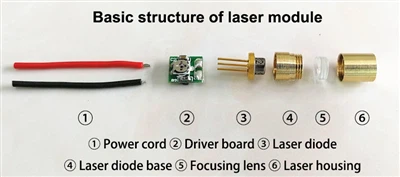
What Is The Role Of The Circuit Board in A Laser Module?Among the components of laser modules, the circuit board is an easily overlooked but crucial core part, serving as the "brain" and "heart" that ensures stable, efficient and safe operation, and con...
Read More -

07
Apr
How Standards Ensure Accurate Lead Equivalence Measurements?In the field of medical radiation protection, traditional lead aprons, while reliable in protective effectiveness, are heavy (0.5 mmPb aprons typically weigh 6-8 kg). Long-term wear can cause healt...
Read More -

02
Apr
Is A TTL-modulated Laser Module A Power-adjustable Laser Module?If you’ve worked with laser modules for engraving, cutting, or DIY projects, you’ve likely seen terms like TTL modulation and power adjustable. Many assume these mean the same thing—but do they?
Read More -

01
Apr
Lead Equivalence Standards And Selection Guide For X-Ray Protective EquipmentIn medical, industrial, security, and veterinary settings where ionizing radiation is used, X-ray protective equipment—such as lead aprons, lead glass, thyroid shields, and mobile barriers—is essen...
Read More -

31
Mar
Application Of 650nm 5mw Laser Line Module in RobotsAs robot technology moves towards precision, miniaturization and intelligence, laser line modules have become key sensing components. The 650nm 5mw laser line module stands out for its low power co...
Read More -

30
Mar
Medical X-Ray Protective PPE Kits: Components, Configuration, And Best PracticesIn clinical settings involving medical X-ray equipment—such as radiology departments, interventional catheterization labs, dental clinics, operating rooms with mobile C-arms, and CT-guided procedur...
Read More -

26
Mar
Applications Of 532nm Picosecond Green LasersCompared with 355nm ultraviolet lasers and 1064nm infrared lasers, the 532nm picosecond green laser is visible to the naked eye, making it easier to operate and debug. Its picosecond-level pulse wi...
Read More -

25
Mar
The Protective Mechanism Of Lead Glasses For The Eye LensWhen working in environments with ionizing radiation—such as interventional radiology, cardiac catheterization labs, dental imaging, or veterinary X-ray suites—your eyes are at risk. Specifically, ...
Read More -

24
Mar
Applications Of 355nm UV Nanosecond LasersCompared with ordinary visible light and infrared lasers, this laser has three obvious advantages: short wavelength, high photon energy and "cold processing" characteristics. These advantages make ...
Read More -

23
Mar
Introduction To X-Ray Personal Protective Equipment (PPE)When working with or near X-ray equipment—whether in a hospital, dental clinic, veterinary practice, airport security checkpoint, or industrial testing facility—radiation exposure is an invisible b...
Read More -

18
Mar
X-Ray Protective Glass: The Invisible Shield You See ThroughWhat is X-Ray Protective Glass? X-ray protective glass (also called lead glass or radiation-shielding glass) is a special type of glass engineered to block harmful X-rays while staying clear for v...
Read More -

16
Mar
The Invisible Threat: Why Nd:YAG And Nd:YVO₄ Lasers Demand Dual-Wavelength Ey...While 532 nm green lasers are widely used for alignment, engraving, and medical procedures, their 1064 nm infrared (IR) leakage poses a silent, high-risk hazard—especially in Nd:YVO₄ systems. This ...
Read More