



Introduction
As laser rangefinders, LiDAR and remote sensing systems move toward longer detection ranges, engineers must balance several key requirements: pulse energy, ranging accuracy, compact size and laser safety.
For many short- and medium-range systems, 905nm laser diodes remain a practical and cost-effective solution. However, when longer range and greater eye-safety margin become important, 1535nm Er pulsed lasers offer significant advantages.
With nanosecond pulse widths, relatively high pulse energy and favorable ocular-safety characteristics, 1535nm lasers are increasingly used in professional long-range ranging and sensing systems.
Why Is 1535nm Considered Eye-Safer?
The difference mainly comes from how infrared light interacts with the human eye.
| Wavelength | Main Ocular Risk | Typical Characteristic |
|---|---|---|
| 905nm | Retina | Widely used, but lower permissible exposure |
| 1064nm | Retina | Retinal hazard remains significant |
| 1535nm | Mainly cornea and anterior eye structures | Higher permissible exposure under defined conditions |
At 905nm and 1064nm, infrared radiation can pass through the eye and be focused onto the retina.
At approximately 1535nm, much more optical energy is absorbed by the anterior structures of the eye before reaching the retina.
This does not mean every 1535nm laser is automatically safe. Final laser classification still depends on pulse energy, pulse width, repetition rate, beam characteristics and the complete system design according to standards such as IEC 60825-1.
However, under defined conditions, the permissible exposure level around 1.5 μm can be orders of magnitude higher than at 905nm.
Key Advantages of JTBYShield 1535nm Laser Modules
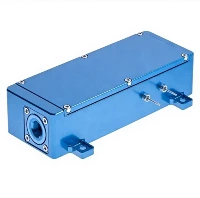
JTBYShield develops compact 1535nm Er pulsed laser modules for rangefinding, LiDAR and other electro-optical systems.
High Pulse Energy and Short Pulse Width
Available configurations include pulse energies such as:
20 μJ
400 μJ
500 μJ
2 mJ
Up to 8 mJ
Typical pulse widths range from approximately 3 ns to 13 ns.
Short nanosecond pulses help produce sharp return signals, while higher pulse energy improves signal strength from distant or low-reflectivity targets.
Flexible Repetition Rate
Different applications require different pulse repetition frequencies.
JTBYShield configurations can cover approximately 1 Hz to 2 kHz, supporting applications from single-shot rangefinding to high-speed tracking and scanning systems.
Compact OEM Integration
Depending on the model, modules can support:
- Integrated PIN photodiode synchronization
- Beam divergence down to approximately ≤4 mrad
- Compact OEM housings
- Custom electrical interfaces
- Customized mechanical dimensions
Integrated synchronization can simplify timing, calibration and receiver gating in time-of-flight systems.
Wide-Temperature Operation
Standard configurations can support operating temperatures of approximately:
-40°C to +60°C
This makes them suitable for outdoor, vehicle-mounted and other demanding environments.
1535nm vs. 905nm
1535nm Er lasers are not a universal replacement for 905nm laser diodes.
| Factor | 905nm Laser Diode | 1535nm Er |
|---|---|---|
| Cost | Lower | Higher |
| Eye-safety margin | More limited | More favorable |
| Pulse energy | Typically lower | Higher-energy options available |
| Power consumption | Lower | Higher |
| Long-range performance | Good | Stronger for demanding applications |
| Typical use | Consumer and cost-sensitive LRF | Professional long-range systems |
For short-range consumer products, 905nm may still be the better choice.
For systems where long detection range, higher pulse energy and eye-safety margin are priorities, 1535nm becomes more attractive.
Typical Applications
1535nm pulsed lasers can be used in:
- Handheld laser rangefinders
- Vehicle-mounted and airborne ranging systems
- Long-range LiDAR
- Atmospheric and meteorological LiDAR
- Terrain mapping
- Remote sensing
- Specialized electro-optical systems
Actual performance depends on the complete system, including target reflectivity, receiver aperture, detector sensitivity, beam divergence and atmospheric conditions.
Typical JTBYShield Configuration Range
| Parameter | Typical Range |
|---|---|
| Wavelength | Approx. 1535nm |
| Pulse Energy | 20 μJ to 8 mJ |
| Pulse Width | Approx. 3 ns to 13 ns |
| Repetition Rate | Approx. 1 Hz to 2 kHz |
| Beam Divergence | Down to approx. ≤4 mrad |
| Operating Temperature | Approx. -40°C to +60°C |
| Customization | Energy, PRF, housing and electrical interface |
Note: These specifications represent different module configurations. Not all maximum values are available simultaneously in a single product.
FAQ
Why is 1535nm safer than 905nm?
1535nm radiation is absorbed more strongly by the anterior structures of the eye, reducing retinal exposure. This allows a higher permissible emission level under applicable safety conditions.
How far can a 1535nm laser rangefinder measure?
Range depends on pulse energy, beam divergence, target reflectivity, receiver aperture, detector sensitivity and atmospheric conditions.
Low- to medium-energy modules can support applications from hundreds of meters to several kilometers, while multi-millijoule configurations can be used in systems designed for much longer ranges.
Can JTBYShield customize the laser module?
Yes. OEM and ODM customization can include:
- Pulse energy
- Repetition rate
- Pulse width
- Beam divergence
- Housing dimensions
- Electrical interfaces
- Synchronization output
Are evaluation samples available?
Yes. Evaluation samples are available for qualified projects. Typical standard sample lead time is approximately 2–4 weeks, depending on the required configuration.
Conclusion
1535nm Er lasers provide an effective combination of nanosecond pulse energy, long-range performance and favorable eye-safety characteristics.
While 905nm remains suitable for many short-range and cost-sensitive applications, 1535nm is increasingly attractive for professional systems where longer range and greater safety margin are required.
JTBYShield Laser Technology provides 1535nm pulsed laser modules from microjoule to multi-millijoule energy levels, with OEM customization available for different ranging and sensing platforms.
Need Help Selecting a 1535nm Laser Module?
Send us your required:
Detection range
Pulse energy or PRF
Module size
Operating temperature
Optical and electrical interface requirements
Our engineering team can recommend a suitable standard module or evaluate a customized solution.
Evaluation samples and technical support are available.