




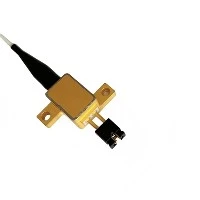
What Is a TTL Modulated Laser Module?
TTL Defined
TTL stands for Transistor-Transistor Logic. In practical terms, it refers to a digital signal with two states:
Low (0V) → Laser OFF
High (usually 5V) → Laser ON
What Modulation Means Here
Modulation means the laser turns on and off according to an external square wave signal. The laser does not produce any intermediate brightness-it is either fully on or fully off.
Key Characteristic
When the laser is on, it runs at 100% of its rated power. There is no analog "dimmer" inside a basic TTL laser module.

What Does "Power Adjustable" Really Mean?
In laser technology, true power adjustment means changing the continuous output power of the laser, typically by varying the drive current.
Common Methods
Analog adjustment: Using a potentiometer or a 0–5V analog voltage to linearly control power (10%, 50%, 90%, etc.)
Digital potentiometer: Controlled via software or a knob
In a truly power‑adjustable module, you can get stable, constant low‑power output-for example, a steady 30% power beam without pulsing.
Can TTL Modulation Achieve Adjustable Power?
Yes, but only in an average sense-not instantaneously.
How TTL Mimics Power Adjustment
By changing the duty cycle of the TTL signal, you can control the ratio of on‑time to off‑time:
100% duty cycle → laser always on (full power)
50% duty cycle → on half the time, off half the time
10% duty cycle → on 10% of the time, off 90%
Because of thermal and optical integration effects (human eye, material heating), a 50% duty cycle behaves like 50% average power.
Important Distinction
Physically: Instantaneous power is always 100% when the laser is on
Effectively: Average output power is adjustable
This works well for many applications, but it is not true continuous power control.
TTL Modulation vs. True Analog Power Adjustment
| Feature | TTL Modulation | Analog Power Adjustment |
|---|---|---|
| Output form | High‑frequency pulses (ON/OFF) | Continuous wave (CW) |
| Power control method | Duty cycle (software) | Drive current (hardware) |
| Instantaneous power | Always 100% of rated power | Varies (e.g., 30%, 70%) |
| Low‑power continuous beam | ❌ No | ✅ Yes |
| Beam stability during low power | Pulsing | Constant |
| Typical application | Engraving, marking | Cutting, welding, medical |
| Cost | Lower | Higher |
Practical Application Guide
When TTL Modulation Is Sufficient
Laser engraving: Duty cycle controls burn depth and grayscale shading
Budget projects: Many low‑cost controllers output TTL only
High‑speed marking: Fast on/off switching is advantageous
When You Need True Analog Power Adjustment
Focusing and alignment: You need a stable, low‑power continuous beam for safety and precision
Thin material cutting: Uniform heat input prevents rough edges
Medical or sensitive material processing: Requires linear, flicker‑free power control
Laser welding or soldering: Needs consistent energy delivery without pulsing
Common Misconceptions and Safety Notes
Misconception 1
"My laser module supports TTL, so I can adjust power continuously."
Correction: You can adjust average power, but the instantaneous power remains 100%. This is not the same as analog dimming.
Misconception 2
"Analog power adjustment is always better."
Correction: TTL is lower cost and can be better for high‑speed scanning applications where pulsed operation is acceptable or even desired.
⚠️ Important Safety Warning
Even at 1% duty cycle, the laser still emits 100% peak power during each pulse.
Never look directly into the beam
Never point it at flammable materials
Always use appropriate laser safety glasses
Summary
| Question | Answer |
|---|---|
| Is a TTL laser module truly power‑adjustable? | No, not in the continuous analog sense. |
| Can it produce variable power effects? | Yes, via duty cycle (average power control). |
| What type of output does it give? | Pulsed (ON/OFF), not continuous. |
| When should I choose analog over TTL? | When you need stable low‑power continuous output. |
One‑sentence takeaway
A TTL laser module is not a true continuous power‑adjustable module, but using PWM (duty cycle control), it can effectively simulate adjustable average power-an important distinction for choosing the right tool.
Appendix (Optional)
Visualizing the Difference
TTL signal: Square wave (ON/OFF) with varying pulse widths
Analog signal: Smooth, variable voltage (e.g., 1V = 20% power, 5V = 100% power)
Common Controller Support
LaserGRBL / LightBurn: Support TTL via PWM pins
Analog laser drivers: Require a DAC (Digital‑to‑Analog Converter) or dedicated analog control interface
Contact information:
If you have any ideas, feel free to talk to us. No matter where our customers are and what our requirements are, we will follow our goal to provide our customers with high quality, low prices, and the best service.
 Email:info@loshield.com; laser@loshield.com
 Tel:0086-18092277517; 0086-17392801246
 Fax: 86-29-81323155
 Wechat:0086-18092277517; 0086-17392801246


