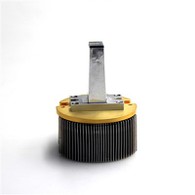
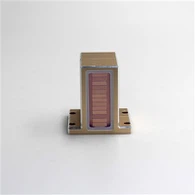
Inside the XPL-D: 24-Bar Double-Row Architecture
The XPL-D is built around a 24-bar double-row laser diode architecture designed for high-power OEM hair-removal handpieces. Instead of arranging all 24 diode bars in one long linear stack, the bars are distributed across two parallel rows, creating a more compact optical and mechanical layout for the 2400W laser diode stack.
12 + 12 Bar Double-Row Layout
In the standard double-row configuration, the 24 laser diode bars are arranged as:
12 bars in the first row + 12 bars in the second row = 24 bars total
This physical arrangement allows the XPL-D to integrate a large number of diode bars within a relatively compact handpiece structure while maintaining the required optical output area.
For OEM designers, this is especially useful when the available space inside the laser handpiece is limited but a 2400W high-power diode laser source is required.
More Optical Power Within a Compact Footprint
A double-row architecture allows more laser bars to be packaged into a shorter assembly than a comparable single-row 24-bar structure.
The main engineering advantage is not simply "more power," but a better balance between:
24-bar optical output
Compact mechanical dimensions
Optical coupling area
Water-cooling structure
Handpiece installation space
This makes the XPL-D particularly suitable for high-power laser hair-removal systems where the diode stack, cooling channels and optical components must all fit within a restricted mechanical envelope.
Controlled Bar Pitch for Optical Alignment
The spacing between adjacent diode bars-commonly referred to as bar pitch-is an important part of the stack design.
Consistent bar positioning helps maintain a predictable optical arrangement before the emitted light enters the downstream collimation or light-guide system.
For OEM integration, bar pitch can affect:
Overall emitting-area dimensions
Alignment with the light guide
Optical collection efficiency
Mechanical stack height
Cooling-channel arrangement
Where bar pitch or optical aperture dimensions are critical, they should be confirmed against the XPL-D mechanical drawing before handpiece design or replacement.
Designed Around the Optical Input Area
The double-row arrangement is closely related to the optical system that follows the diode bars.
Rather than treating the diode stack as an isolated power source, the XPL-D is intended to work as part of a complete optical path:
24 diode bars → double-row emitting area → optical collection/collimation → light guide → treatment handpiece output
This makes the physical arrangement of the bars especially important when matching the stack to an existing light guide or developing a new OEM handpiece.
Why the Double-Row Structure Matters for OEM Integration
For an OEM manufacturer or replacement buyer, the key question is not only whether the stack can produce 2400W, but whether its 24-bar geometry can match the available optical and mechanical interface.
The XPL-D double-row platform is therefore most relevant when the project requires:
A 24-bar 2400W laser diode stack
Compact packaging for a high-power handpiece
Double-row optical output
Integration with a light-guide or optical coupling structure
Water-cooled high-power operation
Custom mechanical or optical matching for an existing system
For replacement projects, we recommend providing the existing stack drawing, bar arrangement, emitting-area dimensions and light-guide interface so the compatibility of the XPL-D can be evaluated before production.

Integrated Light Guide Design for Hair Removal Handpieces
The XPL-D is designed as a 24-bar 2400W laser diode stack with integrated light-guide interface for high-power hair removal handpieces. Its double-row diode structure is arranged to work with the downstream optical coupling system, allowing the laser output to be collected and transferred toward the handpiece treatment window.
Rather than treating the diode stack and optical components as completely separate parts, the XPL-D platform is designed around the relationship between the 24-bar emitting area, optical coupling section and light guide.
Optical Integration from Diode Bars to Light Guide
The optical path of a hair-removal handpiece typically involves several stages:
24-bar diode stack → optical collection/collimation → light-guide interface → handpiece output
The XPL-D double-row structure provides a compact emitting area that can be matched with the optical components positioned in front of the laser bars.
For OEM manufacturers, this helps simplify the integration of a high-power laser diode stack for hair removal equipment, especially when the available space inside the handpiece is limited.
Designed to Match the Double-Row Emitting Area
Because the XPL-D uses a 24-bar double-row architecture, the geometry of the optical input area is an important part of the handpiece design.
The light-guide or optical coupling structure should be matched to parameters such as:
Double-row emitting-area dimensions
Bar arrangement and pitch
Optical input aperture
Distance between the diode stack and optical components
Light-guide dimensions
Mechanical installation position
Correct matching between the diode stack and the downstream optical system helps ensure that the available laser output can be effectively coupled into the handpiece optical path.
Integrated Light-Guide Interface for Compact Handpieces
For high-power hair-removal equipment, the diode stack, water-cooling structure, optical components and light guide must all fit within a relatively compact handpiece.
The XPL-D integrated light-guide design is intended to reduce the complexity of matching a standalone diode stack with a completely separate optical assembly.
This makes the platform particularly useful for:
OEM laser hair-removal handpieces
2400W diode laser handpiece development
Replacement of existing 24-bar optical assemblies
Custom double-row diode stack projects
Systems requiring a compact diode-stack-to-light-guide optical path
Light Guide Matching for Replacement Projects
For replacement applications, optical compatibility can be just as important as electrical and mechanical compatibility.
Customers should provide the existing handpiece information where possible, including:
- Light-guide dimensions
- Optical input aperture
- Existing stack photo or drawing
- 24-bar arrangement
- Emitting-area size
- Distance between stack and light guide
- Mounting position
- Handpiece internal dimensions
Based on this information, the XPL-D 2400W laser diode stack can be evaluated for compatibility with the existing optical structure.
Custom Optical Integration for OEM Systems
For new OEM projects, the optical interface can be reviewed together with the diode stack configuration, wavelength and mechanical structure.
Depending on the project requirements, customization may involve:
- Light-guide interface dimensions
- Optical coupling geometry
- Stack-to-light-guide spacing
- Mechanical mounting structure
- Double-row optical alignment
- Handpiece integration dimensions
This allows the XPL-D to be used not only as a 2400W diode laser source, but as part of a complete OEM handpiece optical architecture.
For custom projects, send us your wavelength configuration, existing optical drawing, light-guide dimensions and handpiece structure so we can evaluate the appropriate XPL-D integration solution.


XPL-D vs Other JTBYShield 2400W Stack Platforms
JTBYShield offers several 2400W laser diode stack platforms for high-power OEM and hair-removal equipment. Although these models may share similar output power and wavelength options, they are designed around different mechanical, optical and operating requirements.
The XPL-D is positioned as a 24-bar double-row 2400W diode laser stack with an integrated optical/light-guide interface, making it particularly suitable for compact high-power hair-removal handpieces where both the diode arrangement and downstream optical coupling must be considered.
| Platform | Bar Count | Peak Power | Duty Cycle | Pulse Width | Wavelength Options | Key Positioning |
| XPL-D | 24 bars | 2400W | ≤20% | 1–100ms | 755 / 808 / 940 / 1064nm | Double-row architecture with integrated light-guide interface |
| XPL-C | 24 bars | 2400W | ≤20% | 1–100ms | 755 / 808 / 940 / 1064nm | Alternative 2400W mechanical platform for OEM integration |
| WH-B | 24 bars | 2400W | ≤10% | ≤80ms | 755 / 808 / 1064nm | Different operating and mechanical configuration |
When to Choose the XPL-D
The XPL-D 2400W laser diode stack is the better fit when your project requires:
A 24-bar double-row diode layout
Integration with a light guide or optical coupling structure
Up to 20% duty cycle
Pulse widths up to 100ms
755nm, 808nm, 940nm or 1064nm wavelength configurations
Compact integration into a high-power hair-removal handpiece
Replacement of an existing double-row optical assembly
Choose by System Architecture, Not Power Alone
Two diode laser stacks can both be rated at 2400W but still be unsuitable replacements for one another.
Before selecting a platform, OEM engineers should compare:
- Bar arrangement
- Emitting-area dimensions
- Operating current and voltage
- Pulse width and duty cycle
- Water-cooling requirements
- Mounting interface
- Optical input geometry
- Light-guide dimensions
- Available handpiece space
For replacement projects, we recommend sending the existing stack photo, drawing and electrical specifications so we can identify which JTBYShield 2400W diode laser stack platform is the closest match.
Not sure whether XPL-D, XPL-C or WH-B fits your system? Send us your existing stack specifications for compatibility review.
OEM Information We Need Before Production
To confirm the correct XPL-D 24-bar 2400W laser diode stack for your OEM or replacement project, please provide the key operating and mechanical requirements before production.
Required Project Information
Wavelength: 755nm / 808nm / 940nm / 1064nm, or required multi-wavelength configuration
Optical Power: Required peak output power and target 2400W configuration
Operating Current: Typical and maximum drive current
Duty Cycle: Required operating duty cycle, pulse width and repetition rate
Cooling: Water temperature, flow rate, pressure and available cooling-loop conditions
Mechanical Drawing: Stack dimensions, mounting holes and available handpiece space
Light Guide: Light-guide size, optical input aperture and interface dimensions
Quantity: Sample quantity and expected batch requirement
For replacement projects, an existing laser diode stack photo, drawing or handpiece specification can also help us evaluate mechanical, electrical and optical compatibility.
With this information, we can review the required 2400W diode laser stack configuration and determine whether the standard XPL-D platform or a customized OEM solution is more suitable.
Send Your XPL-D Specifications for OEM Compatibility Review
Hot Tags: 24-Bar 2400W Diode Laser Stack for Hair Removal Machines, China, manufacturers, suppliers, factory, customized, wholesale, best, cheap, professional, for sale, near me