



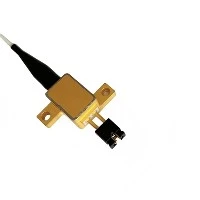
Today, Laser Diodes are ubiquitous. They are the simplest components to convert electrical energy into laser power. Laser diodes are based on various semiconductor compound materials (GaAs, InP or other more complex structures such as GaN). Single-mode laser diodes are low power laser diodes (typically <1W), while multimode laser diodes are higher power devices (typically 10 W to several kW).
Fiber Optics There are generally two types of active fibers used to couple light from laser diodes:
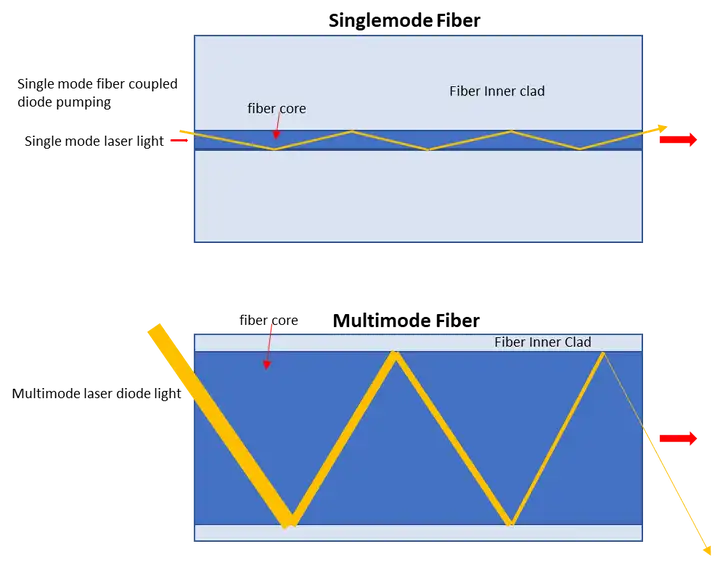
- Single-mode fiber: core typically a few microns (e.g. ~6 µm core at 1 µm wavelength, ~9 µm core at 1.5 µm wavelength)
- Multimode Fiber: Larger diameter to handle higher levels of optical power. Standard versions typically have a core diameter of 62, 100, 200, 400, 800 or even > 1000 µm. The smaller the diameter, the easier it is to focus the light from the fiber onto a small spot using a lens or microscope objective.
Principles of single-mode and multimode fiber. Multimode fiber cores are much larger
Polarization-Maintaining Fiber: Single-mode laser diodes can be standard fiber (SMF) or polarization-maintaining fiber (PM). In the latter, the fiber has a special cladding structure that maintains the polarization of light throughout the length of the fiber. The table below shows the characteristics of various types of single-mode polarization-maintaining fibers offered by Corning. It can be seen that the core diameter becomes very small as the wavelength decreases. An interesting data point to note in the table is the cutoff wavelength. Single-mode fiber works well when considering wavelengths between its cutoff wavelength and about 1.5 times that cutoff wavelength. Below this range, the fiber becomes multimode, and above this range, light can easily leave the fiber when bent.
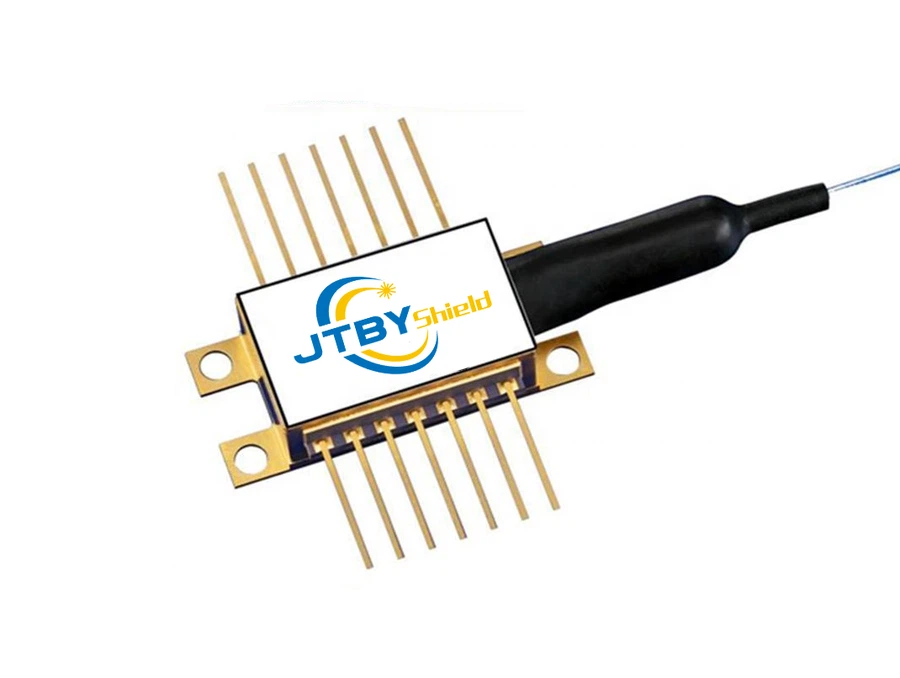
Single-Mode Fiber-Coupled Laser Diodes This type of laser diode is typically assembled in a "butterfly" package that contains a TEC cooler and a thermistor (the trend today is toward smaller form factors). Single-mode fiber-coupled laser diodes are typically capable of output powers from a few hundred milliwatts to 1.5 watts.
Example of a single-mode fiber-coupled butterfly laser diode emitting at 1064 nm (14-pin standard butterfly). These laser diode modules consist of a TE-Cooler, a thermistor, and a monitor (BFM) for measuring optical power levels.
There are several other package styles on the market. For example, the following DIL packages are often encountered in the telecom market, or coaxial packages, where the power is usually less than 10mW.

VCSEL laser diodes are usually not fiber coupled. They are a common type of laser diode used in large diffusion sensing applications, such as computer mouse devices or 3D sensing facial recognition in smartphones.
DFB and Fabry-Perrot edge emitting diodes are usually fiber coupled as described below:
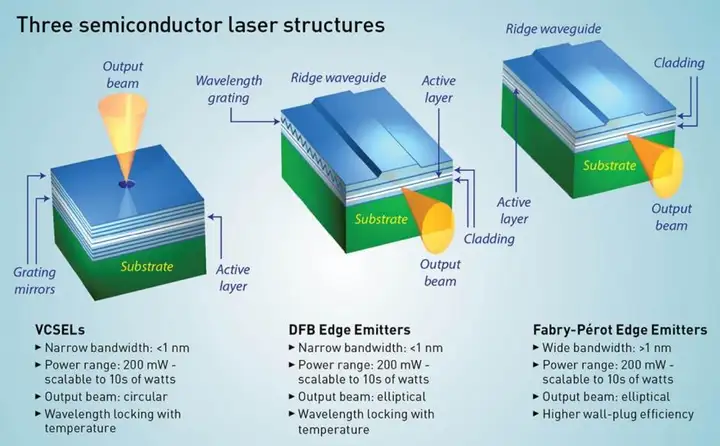
Fabry-Perot laser diodes with Bragg gratings A "standard" fiber-coupled laser diode is a common partially reflective semiconductor cavity in which the back side has a highly reflective coating and the front side has a partially reflective coating. A typical laser diode chip size is about 1*0.5*0.2mm. The main typical features are as follows:
Power range up to 1.5 W for single mode (much more for multimode)
Generally wide bandwidth (>1nm)
The output beam is strongly elliptical.
To reduce the emission bandwidth and improve the overall stability of laser diodes, laser diode manufacturers often add fiber Bragg gratings inside the output fiber.
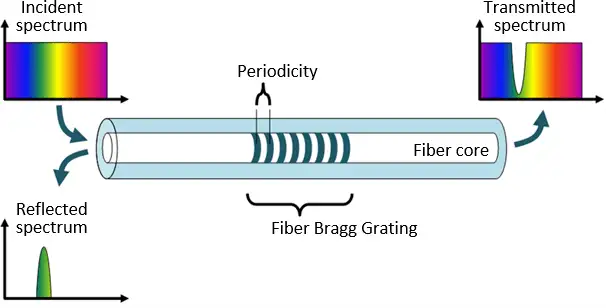
Bragg gratings add a few percent reflectivity to laser diodes at very precise wavelengths. This allows for an overall reduction in the laser diode emission bandwidth. The emission bandwidth is typically 3-5 nm without any Bragg gratings, whereas it is much narrower (~<0.1 nm) when using a Bragg grating. The wavelength spectral temperature tuning coefficient is typically 0.35 nm/°C without any Bragg gratings and much smaller with Bragg gratings. The main suppliers of 915/976/1064 nm single-mode pump laser diodes are companies that developed the fiber amplifier (EDFA: Erbium-Doped Fiber Amplifier) business for the telecom market in the late nineties. Due to their high yield, they offer high reliability and reasonable cost.
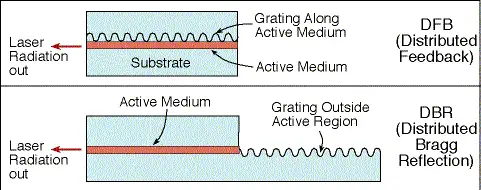
DBR or DFB laser diodes
DFB or DBR laser diode devices integrate a Bragg grating wavelength stabilization section directly onto the laser diode chip. This typically gives a narrower emission wavelength (about 10^(-5) nm) for a 1 MHz DFB rather than about 0.1 nm for a Fabry-Perot with a Bragg grating.
4 Series of Multimode Fiber-Coupled Laser Diodes
Single Emitter: When the laser diode chip is independently assembled on the submount and packaged separately in the laser diode module. We are talking here of typically 15W coupled to a 105 (core)/125µm (cladding) laser diode
Multiple Emitters: When multiple emitters are separated and optically coupled together with other isolated emitters in a multimode fiber (Figure 19-right). As a result, output power levels can be scaled to hundreds of watts, and the size of the fiber can be kept small, such as 100 or 200 µm core.
Monobar: When multiple emitters are held together as a monobar (Figure 17) and assembled in a laser diode module. We are talking here typically around 50 W, typically coupled into a 200 µm (core)/240 µm (cladding) laser diode
Multibar: When multiple bars are assembled in a large water-cooled package and coupled in a large diameter multimode fiber. We are talking here about 100 Watts or even KW coupled into, say, 600 or 800 µm core multimode fiber.
It is worth noting how typical voltage and current levels vary when considering the various series:
A typical single transmitter has a typical voltage level of about 1.5 V and a current of about 15 A.
For multi-emitter laser diodes, the emitters are assembled in series. This means that the current level does not change (typically a maximum of 15 A), but the voltage increases when more and more emitters are considered. (e.g. 4.5V/15A for a 60 W laser diode)
Laser diode bars are assembled in parallel with all emitters. Therefore, the voltage level remains the same, but the current level can easily reach 45 or 50 A.
Also, when multiple bars are assembled together, they are assembled in series, so the current level (say 45 A) does not change, but the voltage increases regularly with the number of bars.
Contact information:
If you have any ideas, feel free to talk to us. No matter where our customers are and what our requirements are, we will follow our goal to provide our customers with high quality, low prices, and the best service.
 Email:info@loshield.com
 Tel:0086-18092277517
 Fax: 86-29-81323155
 Wechat:0086-18092277517


