



With the widespread application of laser technology in industrial processing, medical aesthetics, scientific research and precision detection, laser safety management has become an indispensable key link in standardized operation. Lasers feature high energy concentration and strong radiation penetration. Improper operation or insufficient protection may cause irreversible damage to human eyes, skin and other tissues. This paper systematically elaborates on the basic properties of lasers, radiation hazards, protection standards, standardized operation specifications and common protection misunderstandings, aiming to provide universal and authoritative scientific protection guidelines for laser operators to reduce occupational health risks.
1. Basic Overview of Lasers
1.1 Basic Characteristics of Lasers
Laser is coherent light generated by stimulated radiation, featuring three physical characteristics: high brightness, high collimation and strong monochromaticity. Compared with ordinary light sources, laser energy is highly concentrated and can gather high energy in a tiny light spot. Therefore, it is widely used in industrial processing, medical aesthetics, scientific experiments, precision detection and other fields. Lasers with different wavelengths have distinct physical effects and cause different damage mechanisms to the human body.
1.2 Classification of Common Laser Wavelengths
According to spectral wavelengths, commonly used lasers for civilian and scientific research purposes are divided into four categories with industry-recognized standard parameters without fictitious data:
1)Visible Light Band (400~700nm): Including red and green lasers, mostly used for positioning indication and surveying calibration. The light is visible to the naked eye, and direct exposure may cause glare and temporary retinal damage.
2)Near-Infrared Band (700~1400nm): Covering mainstream lasers such as 755nm, 808nm and 1064nm, commonly applied in hair removal, pigment treatment and metal processing. This band has high light transmittance, easily penetrates the refractive medium of human eyes, and is classified as a high-risk band for eye damage.
3)Mid-Infrared Band (1400~3000nm): It has high water absorption and is mostly used for skin rejuvenation and soft tissue repair, with skin thermal burn as the main hazard.
4)Far-Infrared Band (10600nm): Represented by carbon dioxide fractional laser, its energy is directly absorbed by the epidermis, mainly damaging the cornea and superficial skin.
2. Human Damage Mechanisms Caused by Lasers
2.1 Eye Damage (Highest Risk Part)
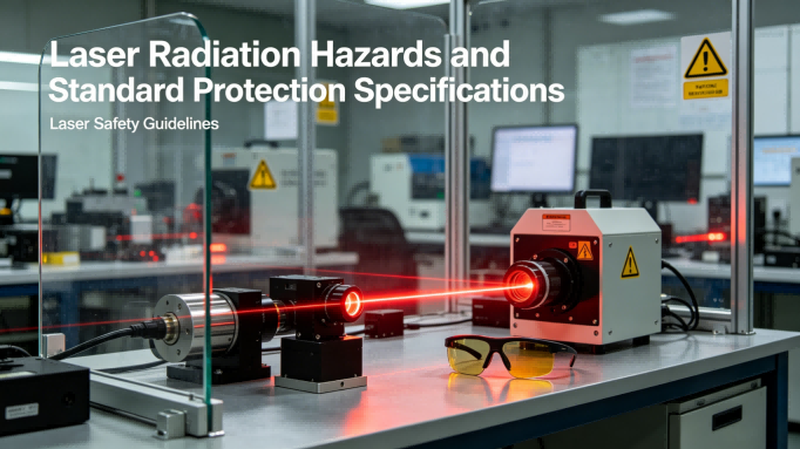
The human eye is the most sensitive organ to lasers. Lasers of different wavelengths damage different eye tissues, and most laser-induced eye damages are irreversible. Visible and near-infrared lasers can penetrate the cornea and lens, directly focusing on the retina, causing retinal burns and macular degeneration, and even permanent visual deterioration in severe cases. Far-infrared lasers cannot penetrate the eyeball and mainly damage the cornea, resulting in corneal edema, stinging and photophobia.
Meanwhile, instantaneous intense laser light triggers the human subconscious blink reflex. Frequent intense light stimulation leads to visual fatigue and optic nerve strain. Long-term unprotected operation may cause blurred vision and decreased color sensitivity.
2.2 Skin Damage
Lasers have a significant thermal effect. Low-power laser exposure for a long time causes skin redness, dryness and abnormal pigmentation; medium and high-power lasers with instantaneous high energy can directly cause epidermal burns, erythema and blisters. Some short-wave lasers exert a slight photochemical effect. Long-term cumulative exposure destroys the skin stratum corneum and weakens the skin barrier function.
2.3 Auxiliary Hazards
During laser operation, the equipment generates electromagnetic radiation and high-frequency noise. In addition, medical aesthetic and industrial ablation lasers produce aerosols and carbonized smoke, which cause chronic adverse effects on the respiratory system and nervous system under long-term exposure.

3. Core Laser Protection Standards and Protection Grades
3.1 Definition of Optical Density (OD)
OD (Optical Density) is a universal international standard for measuring laser protection capability, and the higher the OD value, the stronger the protection performance. The OD value represents the light attenuation multiple with a standardized calculation formula: each increase of 1 in OD value means the light transmittance is reduced by 10 times. For example, OD6 means the light transmittance is reduced by 1 million times, which can block most high-energy laser radiation.
3.2 Standard Protection Grades for Mainstream Wavelengths
Based on universal industrial safety specifications, standardized and undisputed protection configurations are sorted out, suitable for most civilian laser equipment:
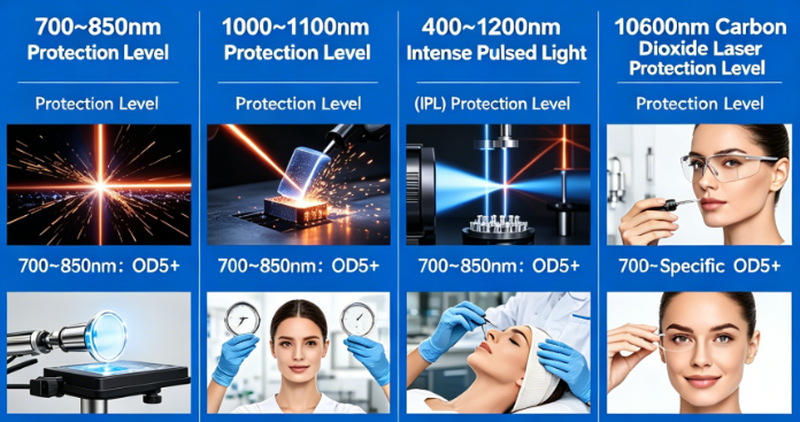
1)700~850nm (Alexandrite & Semiconductor Laser): Recommended protection grade: OD6+, applicable to hair removal and superficial pigment treatment equipment to resist direct and scattered light.
2) 1000~1100nm (Nd:YAG Laser): Recommended protection grade: OD7+. This band features strong penetrability and is mostly used for tattoo removal and deep physical therapy, requiring enhanced eye protection.
3) Broad-Spectrum Intense Pulsed Light (IPL, 400~1200nm): Recommended protection grade: OD5+, designed for miscellaneous spectrum scattered light to prevent glare and chronic light damage.
4) 10600nm (Carbon Dioxide Laser): Recommended protection grade: OD8+. This far-infrared high-temperature laser requires high-density barrier materials to avoid corneal burns.
4. Professional Laser Protection Measures for All Scenarios
4.1 Eye Protection (Top Priority)
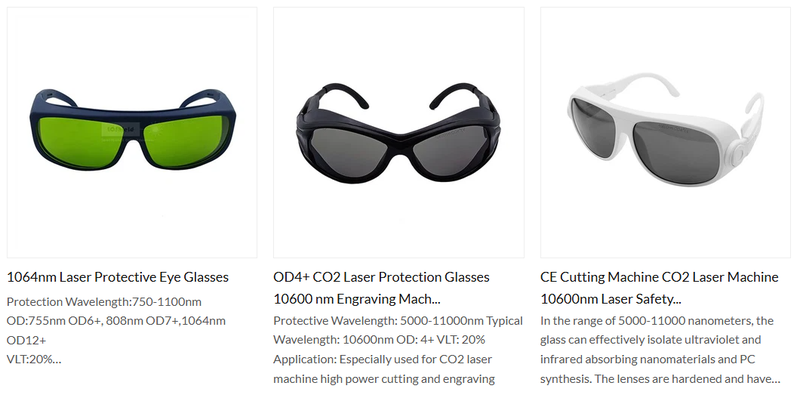
Laser operators must wear professional laser goggles matching the specific wavelength; ordinary sunglasses and industrial goggles are not allowed for replacement. The selection principles are as follows: accurate wavelength matching, qualified OD value, and tight fitting to avoid light leakage. The light transmittance of goggles shall be tested regularly. Goggles with scratches or discoloration must be replaced in time to prevent protection failure.
4.2 Skin Protection
In high-power laser operation scenarios, staff shall wear flame-retardant and laser-proof protective clothing to cover exposed skin. Metal ornaments are prohibited in the operation area to avoid secondary burns caused by laser reflection and focusing. Even in low-power daily operation, long-term laser irradiation on the same skin area should be avoided.
4.3 Environmental Protection Specifications
1)The wall of the operation room is made of matte light-absorbing materials to reduce laser reflection and diffuse scattering;
2)Keep indoor ventilation and equip with smoke purification equipment to treat harmful aerosols generated by laser carbonization;
3)Lock the laser emission switch when the equipment is idle, and never look directly at the laser outlet without protection;
4)Post laser warning signs in the operation area, set up isolated working zones, and prohibit irrelevant personnel from entering.
4.4 Personnel Management Specifications
All laser operators must receive professional safety training and be familiar with the wavelength, hazards and protection methods of the applied laser. Operators shall strictly follow operating procedures and are prohibited from modifying equipment power and optical paths without authorization. Long-term practitioners shall receive special eye examinations every six months to screen for chronic damage to the retina and cornea.
5. Summary of Common Protection Misconceptions
1)No protection is required if the light is not dazzling. Near-infrared laser is invisible to the naked eye, and its scattered light causes no obvious pain, but it continuously damages the retina.
2)Low-power lasers are harmless. Long-term cumulative exposure to low-power lasers causes pigmentation and visual fatigue, leading to chronic damage.
3)Universal goggles are interchangeable. Protective lenses for different laser wavelengths are made of different materials, and mismatched goggles will result in complete protection failure.
6. Conclusion
Laser technology brings great convenience to the medical, industrial and scientific research fields, while lasers have definite photothermal radiation hazards, among which eye damage is irreversible with the highest risk. The core of scientific protection is: wavelength matching, qualified OD value, standardized operation and environmental isolation. Abide by universal industrial safety standards, eliminate fluke mentality, and use protective equipment in a standardized manner to fundamentally avoid laser damage and ensure the physical health of operators.