



Fiber lasers have become the core equipment in modern industrial processing, optical communication, and precision manufacturing due to their high efficiency, high stability, and excellent beam quality. As the key connection component between the laser body, transmission fiber, and processing/transmission equipment, the interface type directly affects the laser's power output, signal transmission quality, and system reliability.
1. Interface Types
Fiber-coupled laser diodes are essential in telecommunications, LiDAR, and industrial material processing. Selecting the correct interface involves two independent domains:
Optical interface – the fiber connector that determines coupling efficiency and back-reflection tolerance.
Electrical interface / package – the mechanical housing and pinout that define thermal management, driving method, and board-level assembly.
This article provides a clear, engineering‑oriented overview of the most common interface types.
2. Optical Interfaces – Fiber Connectors
The connector at the end of the pigtail fiber dictates optical performance.
2.1 FC Series (Ferrule Connector)
FC/PC – flat physical contact. Suitable for low‑speed systems where moderate back‑reflection is acceptable.
FC/APC – angled physical contact (8° polish). Provides extremely high return loss (>60 dB). Mandatory for analog video transmission, precision metrology, and any system sensitive to reflections (e.g., 405 nm, 520 nm diodes).
2.2 SC and LC – Modern Communication Standards
SC – push‑pull latch, robust and low‑cost. Widely used in telecom and data‑com transceivers.
LC – miniature version (half the footprint of SC). Preferred for high‑density faceplates and small‑form‑factor pluggable modules.
2.3 SMA – High‑Power Transmission
Uses a metal threaded sleeve directly gripping the fiber's metal jacket (no ceramic ferrule).
Key advantage: withstands high temperatures and optical power.
Typical applications: medical lasers, high‑power industrial processing.
2.4 Bare Fiber & Custom Interfaces
In R&D or ultra‑high‑power systems, connectors are often omitted entirely. The fiber is either directly fusion‑spliced or terminated with a custom metal capillary.
3. Electrical Interfaces – Packages & Pinouts
The package determines how the laser diode is powered, cooled, and mechanically mounted.
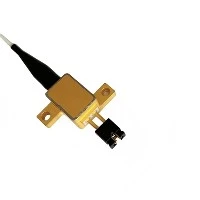
3.1 Butterfly Package – High‑End Standard
14‑pin butterfly (most common) integrates:
TEC (thermoelectric cooler) for temperature stabilisation,
MPD (monitor photodiode) for power control,
Thermistor for temperature readout.
Pinout must be strictly followed (e.g., TEC+/–, LD+/–, thermistor sense lines).
Used in coherent communications, tunable lasers, and external‑cavity designs.
3.2 Coaxial / TO‑CAN Package – Cost‑Effective
TO‑46 / TO‑56 – transistor‑outline style. Simple, low cost, and widely used inside pluggable transceivers or consumer electronics.
Coaxial with RF connector (IEC 62148‑12) – adds a coaxial RF port for high‑frequency modulation.
3.3 DIL (Dual In‑Line)
Simplified predecessor of the butterfly package. Lacks integrated TEC in many variants; used for low‑power, uncooled applications.
4. Practical Mapping – Package + Connector Combinations
| Application | Typical Package | Optical Connector |
|---|---|---|
| Precision metrology, coherent sensing | 14‑pin butterfly | FC/APC (often PM fibre) |
| Inside SFP/SFP+ transceivers | TO‑46 / TO‑56 | LC receptacle (or direct pigtail) |
| High‑power industrial cutting | Custom copper block | SMA or bare fibre |
| Low‑cost data‑com | Coaxial / TO‑can | SC / LC |
Decision guide:
Cooling needed? → Butterfly package.
Reflection sensitive? → APC polish (FC/APC).
High‑density board design? → LC connector + mini butterfly.
5. Relevant Standards – IEC 62148 Series
Standardised interfaces guarantee mechanical interchangeability across vendors.
IEC 62148‑11 – defines mechanical dimensions of the 14‑pin butterfly package (including pigtail strain relief).
IEC 62148‑12 – specifies coaxial RF connector variants for laser transmitters.
Always verify the latest revision when designing a PCB footprint or panel cutout.
6. Summary & Future Trends
No universal interface – the correct choice balances thermal, optical, and board‑level constraints.
Current trends:
Miniaturisation – mini‑butterfly and nano‑packages for co‑packaged optics (CPO).
Passive cooling improvements – pushing the power envelope of TO‑CAN packages.
Higher fibre power handling – new connector materials that tolerate >10 W without glue degradation.
For rapid prototyping, start with a 14‑pin butterfly + FC/APC assembly. For high‑volume cost‑sensitive products, TO‑CAN + LC receptacle is the proven workhorse.
Contact information:
If you have any ideas, feel free to talk to us. No matter where our customers are and what our requirements are, we will follow our goal to provide our customers with high quality, low prices, and the best service.
 Email:info@loshield.com; laser@loshield.com
 Tel:0086-18092277517; 0086-17392801246
 Fax: 86-29-81323155
 Wechat:0086-18092277517; 0086-17392801246


