




Laser line modules have been widely used in many fields such as machine vision, dimensional measurement, 3D scanning, etc. due to their high precision and high efficiency. These applications cover many aspects such as industrial automation, precision machining, quality control, etc., showing the important value of laser line modules in modern industrial production.
In the application of laser line modules, the selection of lens angle is crucial. The appropriate lens angle can not only ensure the accuracy and stability of the laser line, but also improve the accuracy and efficiency of measurement. Different lens angles are suitable for different application scenarios and needs. Therefore, choosing the correct lens angle is crucial for the performance of laser line modules.
In view of this, this article aims to provide guidance on the selection of lens angles for laser line modules, helping users to choose the appropriate lens angle according to specific application scenarios and needs, so as to give full play to the performance advantages of laser line modules. Through reasonable lens angle selection, we can further improve the application effect of laser line modules in machine vision, dimensional measurement, 3D scanning and other fields, and provide strong guarantee for the accuracy and efficiency of industrial production.
Working principle of laser line module
Laser emission:
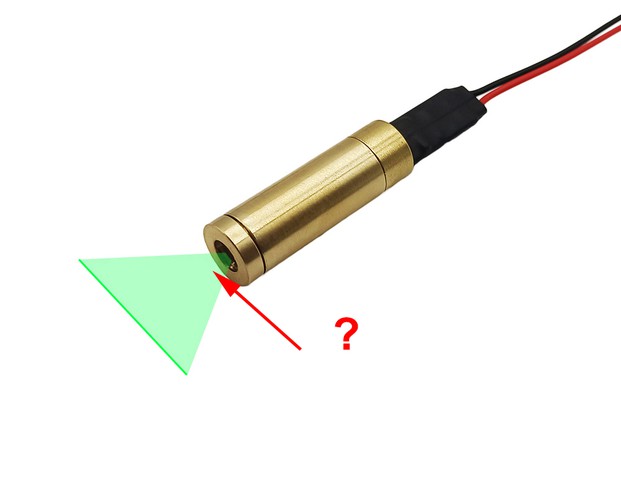
The laser light source (such as semiconductor laser) in the laser line module produces a high-energy, monochromatic and directional laser beam. The laser beam is expanded into a thin sheet of laser line through special optical design, such as using a cylindrical lens or a galvanometer scanning system.
Lens focusing:
The laser line after emission and initial expansion is focused by a set of precisely designed optical lenses. The function of the lens is to focus the laser line on a specific working surface to form a clear and fine laser line for subsequent measurement or processing.
Line laser formation:
The focused laser line forms a narrow and bright laser line on the working surface. This laser line can be used in various applications, such as dimensional measurement, machine vision, 3D scanning, etc., by detecting the intersection of the laser line with the object or the reflected signal to achieve measurement or imaging.
Key factors affecting the quality of laser lines
Line width:
Line width is an important parameter of the laser line module, which determines the fineness and resolution of the laser line. Narrower line width means higher measurement accuracy and resolution, but it may also reduce the energy density and stability of the laser line.
Uniformity:
The uniformity of the laser line refers to whether the light intensity distribution of the laser line is consistent over its length and width. Laser lines with good uniformity can provide more accurate measurement results and clearer images.
Stability:
The stability of the laser line includes its position stability and light intensity stability. Position stability refers to the ability of the laser line to maintain a fixed position for a long time, while light intensity stability refers to the degree of change of the light intensity of the laser line over time. Highly stable laser lines are critical for long-term, continuous measurement and imaging applications

The lens angle is a crucial parameter in the laser line module, which defines the angle between the lens optical axis and the laser emission direction. This angle not only affects the geometric characteristics of the laser line, but also has a significant impact on the energy distribution, depth of field and measurement accuracy of the laser line.
1. Definition of lens angle
The lens angle refers to the angle between the lens optical axis and the laser emission direction. By adjusting this angle, the projection form and characteristics of the laser line on the working surface can be changed.
2. The effect of angle on line width
The lens angle has a direct effect on the line width. When the lens angle increases, the projection width of the laser line on the working surface will also increase accordingly, resulting in a wider line width. On the contrary, when the lens angle decreases, the projection width of the laser line will decrease, thereby narrowing the line width. Therefore, by adjusting the lens angle, the line width of the laser line can be precisely controlled to meet different application requirements.
3. The effect of angle on line uniformity
The size of the lens angle will also affect the uniformity of the energy distribution of the laser line. When the lens angle is too large or too small, the energy distribution of the laser line may become uneven. This is because an angle that is too large or too small will cause the projection shape of the laser line on the work surface to change, making the energy density of some parts higher than other parts. In order to obtain a uniform energy distribution of the laser line, it is necessary to select a suitable lens angle to ensure that the projection shape of the laser line on the work surface is as uniform as possible.
4. The effect of angle on depth of field
The lens angle also affects the depth of field of the laser line. Depth of field refers to the depth range in which the laser line can maintain clear focus. When the lens angle decreases, the depth of field of the laser line increases, which means that the laser line can maintain clear focus in a larger depth range. On the contrary, when the lens angle increases, the depth of field of the laser line decreases, resulting in the laser line only being able to maintain clear focus in a smaller depth range. Therefore, when selecting the lens angle, it is necessary to weigh the depth of field requirements of the specific application.
5. The effect of angle on measurement accuracy
The choice of lens angle has an important influence on measurement accuracy. A suitable lens angle can ensure that the angle between the laser line and the object being measured is close to vertical, thereby reducing the measurement error caused by angle error. In addition, a suitable lens angle can also improve the energy utilization and reception efficiency of the laser line, thereby further enhancing the strength and stability of the measurement signal. These factors work together to improve the accuracy and reliability of measurements.
Lens angle selection basis
1. Different application scenarios have different requirements for laser lines, so it is necessary to select the appropriate lens angle according to the specific scenario.
In dimensional measurement applications, narrower line widths and higher measurement accuracy are usually required. Therefore, a smaller lens angle can be selected to obtain a finer and more accurate laser line.
In machine vision applications, more attention may be paid to the uniformity and stability of the laser line. Depending on specific needs, a moderate or larger lens angle can be selected to ensure that the laser line can evenly cover the target area.
In 3D scanning applications, depth of field and measurement range need to be considered. Depending on the size and shape of the object being measured, a lens angle with a suitable depth of field can be selected.
2. Working distance is one of the important factors to consider when selecting a lens angle.
When the working distance is far, the laser line will diverge during transmission, resulting in an increase in line width. In order to keep the line width of the laser line on the working surface stable and small, a smaller lens angle needs to be selected.
On the contrary, when the working distance is close, a larger lens angle can be selected to obtain a wider laser line coverage.
3. The surface characteristics of the object being measured will also affect the selection of lens angles.
① High reflectivity surface:
For high reflectivity surfaces, such as metal or mirror, a smaller lens angle needs to be selected. This is because a smaller lens angle can reduce the incident angle of the laser line on the surface, thereby reducing the risk of spot saturation.
② Low reflectivity or complex surface:
For objects with low reflectivity or complex surfaces, such as black or rough surfaces, a larger lens angle can be selected. This helps to increase the contact area between the laser line and the surface of the object, and improve the strength and stability of the measurement signal.
Lens angle selection method
Theoretical calculation is a method to derive the best lens angle based on application requirements and laser line module parameters.
1. Analyze application requirements:
Determine the application scenario, such as dimensional measurement, machine vision or 3D scanning.
Clearly define the requirements for laser line characteristics, including line width, uniformity, depth of field and measurement accuracy.
2. Consider laser line module parameters:
Understand the power, wavelength, emission angle and other parameters of the laser line module.
According to the transmission characteristics and physical laws of the laser line, a mathematical model is established to describe the relationship between the laser line and the lens angle.
3. Calculate the best angle:
Use the established mathematical model, combined with application requirements, to calculate the lens angle that can theoretically achieve the best laser line characteristics.
Taking into account the uncertainty and error in practical applications, certain corrections and optimizations can be made.
The selection of the lens angle of the laser line module needs to comprehensively consider key factors such as the application scenario, working distance, surface characteristics of the object to be measured, and parameters of the laser line module. The optimal angle is derived through theoretical calculation, the quality of the laser line at different angles is verified experimentally, and software simulation is used to assist in evaluation to ensure that the selected angle can meet application requirements and optimize laser line performance.
Contact information:
If you have any ideas, feel free to talk to us. No matter where our customers are and what our requirements are, we will follow our goal to provide our customers with high quality, low prices, and the best service.
 Email:info@loshield.com
 Tel:0086-18092277517
 Fax: 86-29-81323155
 Wechat:0086-18092277517


