



Single-mode lasers and Multi-mode lasers occupy an important position in the field of laser technology. Single-mode lasers stand out for their excellent beam quality and high coherence. Their output beam mode is single, and the energy is concentrated in a Gaussian distribution, just like a precision-guided arrow. They are very useful in long-distance communications, precision machining, and high-precision medical treatment, providing key support for high-speed information transmission, fine carving of materials, and precise treatment of diseases. Multi-mode lasers, by virtue of their unique advantages, play an irreplaceable role in many aspects. It can excite multiple modes of light at the same time, with relatively high output power, and relatively less stringent requirements on the light source, and the cost is more affordable. This type of laser is widely used in industrial cutting, lighting, and some occasions with slightly lower precision requirements but higher brightness requirements, such as metal cutting in large manufacturing workshops, gorgeous lighting of urban night scenes, etc., adding brilliance and vitality to industrial production and life, greatly enriching the application scenarios of laser technology, and promoting the vigorous development of related fields.
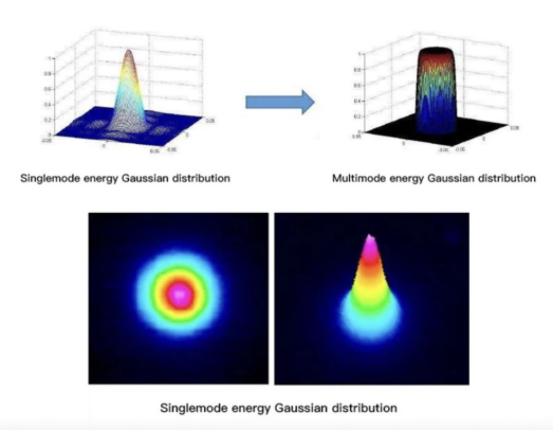
The essential difference between a Single-mode Laser and a Multimode Laser is that a single-mode laser has only one mode in its output beam pattern, while a multimode laser has multiple modes in its output beam pattern. Therefore, we can judge whether the laser is single-mode or multi-mode by M2 (beam quality). According to the different M2, the laser can be divided into 3 types. M2<1.3 is a pure single-mode laser, M2 between 1.3 and 2.0 is a quasi-single-mode laser, and M2>2.0 is a multi-mode laser.
The difference in mode will directly affect the spatial distribution of energy. From the point of view of energy distribution, single-mode lasers present a typical Gaussian distribution, while multi-mode lasers present a typical flat-top distribution, with relatively average energy and superposition of multiple modes, so the beam quality is not as good as single-mode. The energy of single-mode laser is relatively concentrated. After the same laser power is focused by the same optical system, the energy of the single-mode laser at the focus is much higher than that of the multi-mode laser. By comparing their beam quality, focal (or defocus) spot diameter, divergence angle, and focal (or defocus) power density, it can be seen that singlemode lasers outperform multimode lasers in these specifications. More importantly, due to the presence of higher-order modes inside multimode lasers, multimode lasers have greater dispersion and more energy loss than single-mode lasers. So multimode lasers are not a good choice for long-distance transmission.
However, single-mode lasers are not superior to multimode lasers in some respects. Traditional single-mode lasers have very thin cores and small diameters (generally less than 10 μm). The damage threshold of optical fiber is very low, and it is difficult to withstand high-energy light waves. Fiber laser requires signal laser and pump light to be transmitted in the fiber core at the same time, so the output power of fiber laser is very low, the area of fiber end face is small, it is difficult to couple pump light, and the light-to-light conversion efficiency of fiber laser is very low. Since the core of the single-mode laser is thinner, the nonlinear effect of the single-mode laser is relatively large. Multi-mode lasers increase the core diameter on the basis of single-mode lasers, so that there are multiple modes in the fiber and support multi-mode simultaneous transmission. After the coherent superposition of multiple mode fields in a multimode laser, the mode field distribution in the entire fiber core is relatively flat, which can reduce the self-focusing effect during optical transmission. The transmission distance of high-power signal light in the optical fiber can be relatively long, and the stability is high. Multimode lasers not only increase the damage threshold, but also reduce the laser power density by increasing the cross-sectional area of the fiber, thereby effectively suppressing the nonlinear effect in the fiber.
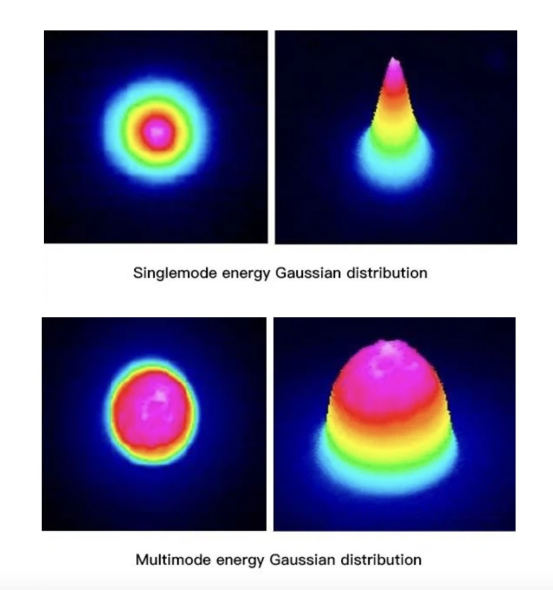
Comparison between single-mode laser and multi-mode laser
Single-mode laser has a small fiber core diameter (3~9um), Gaussian energy distribution, small focal spot, high energy density (at the same power, the energy density is 4-10 times that of multi-mode), and a small heat-affected zone. Especially for high-reflection alloys (aluminum, copper), it can instantly form a molten pool keyhole (the energy density is much greater than the melting threshold of high-reflection alloys), without high reflection, not easy to damage the optical fiber, and can achieve high-speed processing of high-reflection alloys. It also has advantages in micro-connection.
In terms of heat input: single-mode energy is more concentrated, heat-affected zone is small, molten pool is small, thermal deformation is small, and melting depth is large. Single-mode beam is like a sharp knife, and multi-mode is like a bullet head;
Welding process: single-mode keyhole opening is small, and multi-mode keyhole opening is large. Reflected in welding stability, single-mode low-speed welding is unstable, prone to spatter and pores, and needs to be matched with a swing head, a galvanometer, or high-speed welding. Low-speed welding has large spatter, and thin plate lap welding and tailoring are mainly used; reflected in metallography, single-mode has a larger depth-to-width ratio (the ratio of metallographic depth to width); multi-mode can be freely Switching between thermal conduction welding and deep melting welding, suitable for splicing, strong compatibility with gap fluctuations;
Differences in application: single-mode has a small spot, concentrated energy, good penetration, and more precise heat input control, which is more suitable for micro-connection processing (3C, medical, etc.) but the power is not high (2mw~20mw); multi-mode can provide higher power (1W/2W/5W), suitable for large-area welding, and has higher compatibility with processing of different material thicknesses. It can be applied to different thicknesses, different gaps, and heterogeneous materials, and multi-mode also has advantages in cost.

Contact information:
If you have any ideas, feel free to talk to us. No matter where our customers are and what our requirements are, we will follow our goal to provide our customers with high quality, low prices, and the best service.
 Email:info@loshield.com
 Tel:0086-18092277517
 Fax: 86-29-81323155
 Wechat:0086-18092277517


