




How to Choose the Right Laser Diode for Your Application
Choosing the right laser diode means balancing wavelength, optical power, operating mode, package, beam characteristics, driver requirements, and thermal management. This guide explains the key specifications engineers and OEM buyers should review before selecting a laser diode for LiDAR, medical, industrial, sensing, pumping, and other applications.
Choosing a suitable laser diode involves more than specifying wavelength and output power. The device also needs to match the optical system, driver, cooling design, operating mode, and application requirements.
A poor selection can lead to low system efficiency, unstable output, overheating, or reduced service life. For OEM equipment, industrial systems, medical devices, LiDAR, sensing, laser pumping, and scientific instruments, it is worth reviewing the key specifications before selecting a part.
Start With the Wavelength
Wavelength is usually the first parameter to define because different materials, detectors, and optical components respond differently to light.
Common laser diode wavelengths include:
| Wavelength | Typical Applications |
|---|---|
| 405nm | Fluorescence excitation, inspection, curing |
| 450nm | Blue laser modules, material processing, illumination |
| 520nm | Alignment, projection, visible laser systems |
| 635–650nm | Positioning, sensing, barcode scanning |
| 808nm | Solid-state laser pumping, medical equipment |
| 850nm | Machine vision, sensing, infrared illumination |
| 905nm | LiDAR, range finding, time-of-flight systems |
| 915nm | High-power pumping, industrial systems |
| 940nm | 3D sensing, infrared illumination |
| 980nm | Pumping, medical and industrial laser systems |
| 1310nm | Optical communication, sensing |
| 1550nm | Telecom and certain LiDAR systems |
The correct wavelength depends on the absorption characteristics of the target material, detector sensitivity, and the optical components used in the system.
For example, 808nm laser diodes are widely used for solid-state laser pumping, while 905nm pulsed laser diodes are commonly used in range-finding and LiDAR systems.
Note: VCSELs are also widely used in 3D sensing and some LiDAR applications, while edge-emitting laser diodes remain common in high-power pumping and industrial systems.

Determine the Required Optical Power
Once the wavelength is defined, calculate how much optical power actually needs to reach the target.
The rated output of a laser diode is not the same as the usable power after the optical system. Losses may occur through lenses, mirrors, protective windows, filters, beam-shaping optics, and fiber coupling.
Using significantly more power than necessary can increase component cost, heat generation, power-supply requirements, and laser safety requirements.
At the same time, continuously operating a laser diode close to its absolute maximum rating may reduce long-term reliability.
For high-power applications, it is generally better to allow some operating margin rather than designing around the maximum specification.
CW or Pulsed Operation?
Laser diodes are commonly operated in continuous-wave (CW) or pulsed mode.
CW laser diodes provide continuous optical output and are widely used in laser pumping, medical equipment, illumination, industrial systems, and scientific instruments.
Pulsed laser diodes generate short optical pulses and are commonly used in LiDAR, laser range finders, time-of-flight systems, and optical sensing.
For pulsed applications, peak power alone is not enough to evaluate the device. Pulse width, repetition rate, duty cycle, drive current, and thermal limits should also be reviewed.
A laser diode that can produce high peak power during short pulses may not be suitable for continuous operation at the same output level.
Choose a Suitable Package
Package design affects heat dissipation, mechanical mounting, optical alignment, and system integration.
TO-Can
TO-can laser diodes, including TO-18, TO-56, and TO-9 packages, are compact and commonly used in alignment, sensing, measurement, and low- to medium-power optical systems.
C-Mount
C-mount laser diodes are often selected for higher-power applications where efficient heat transfer is required. They can be mounted directly onto an external heat sink.
Fiber-Coupled
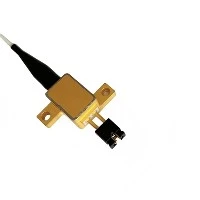
Fiber-coupled laser diodes deliver the optical output through an optical fiber. This is useful when the laser source needs to be located away from the output point or when free-space optical alignment is difficult to implement.
For higher-power systems, package selection should be considered together with the cooling design.
Check Beam Characteristics
Edge-emitting laser diodes do not normally produce a perfectly circular beam.
The fast-axis divergence is typically much larger than the slow-axis divergence, especially in high-power devices.
Key beam parameters include:
- Fast-axis divergence
- Slow-axis divergence
- Beam size
- Beam profile
- Astigmatism
- Fiber core diameter and numerical aperture for fiber-coupled devices
Applications requiring a collimated or tightly focused beam may need additional optics.
This is why two laser diodes with the same wavelength and nominal output power can perform very differently in the same optical system.

Match the Driver and Cooling System
Laser diodes are current-driven semiconductor devices and should normally be operated with a suitable constant-current laser diode driver.
Important electrical specifications include:
- Operating current
- Threshold current
- Maximum current
- Forward voltage
- Slope efficiency
Current spikes and electrostatic discharge can damage the laser junction, sometimes without immediate visible failure. Proper driver protection and ESD-safe handling are therefore important during testing, assembly, and production.
Thermal management is equally important. As junction temperature increases, output power, efficiency, threshold current, wavelength, and lifetime may all change.
Depending on the power level, cooling methods may include passive heat sinks, forced-air cooling, thermoelectric coolers, or water cooling.
For wavelength-sensitive applications such as laser pumping, active temperature control may also be required because the emission wavelength shifts with temperature.
Compare Full Datasheets, Not Just Headline Specifications
Two products advertised as "808nm 5W laser diodes" may not be interchangeable.
Do not rely only on headline specifications. Compare the complete datasheet before placing an order.
| Parameter | Why It Matters |
| Wavelength | Must match the target material or detector |
| Optical power | Determines available output |
| Operating current | Defines driver requirements |
| Forward voltage | Affects electrical design |
| Beam divergence | Influences collimation and focusing |
| Spectral width | Important for wavelength-sensitive systems |
| Package | Determines mounting and cooling |
| Operating temperature | Defines environmental limits |
| Efficiency | Affects power consumption and heat generation |
| Fiber parameters | Critical for fiber-coupled devices |
For OEM applications, also review absolute maximum ratings, storage conditions, mounting recommendations, and any available lifetime or reliability data.
Selecting a device based only on wavelength and nominal optical power can lead to integration problems later.
Match the Diode to the Application
Different applications place different priorities on laser diode specifications.
For LiDAR and range finding, pulse width, peak power, wavelength, switching speed, and detector compatibility are important.
For medical laser equipment, wavelength stability, output consistency, thermal control, and long-term reliability may be more important.
For industrial and laser-pumping systems, engineers often focus on optical power, wall-plug efficiency, cooling, package robustness, and lifetime.
Before contacting a supplier, it is useful to define:
- Required wavelength
- Required optical output power
- CW or pulsed operation
- Preferred package
- Available cooling method
- Beam or fiber requirements
- Operating environment
- Expected service lifetime
Providing these details makes it easier for the supplier to identify suitable laser diode options.

Final Thoughts
There is no single "best" laser diode. The right choice is the one that fits the complete system.
Start with wavelength and usable optical power, then evaluate operating mode, package, beam characteristics, driver requirements, and thermal management.
For OEM or specialized applications, reviewing the full datasheet and sharing actual operating conditions with the supplier can help reduce integration issues and improve long-term reliability.
Our technical team supports OEM laser diode selection and application matching. If you need help choosing a suitable wavelength, power level, package, or operating mode, feel free to contact our engineering team.