


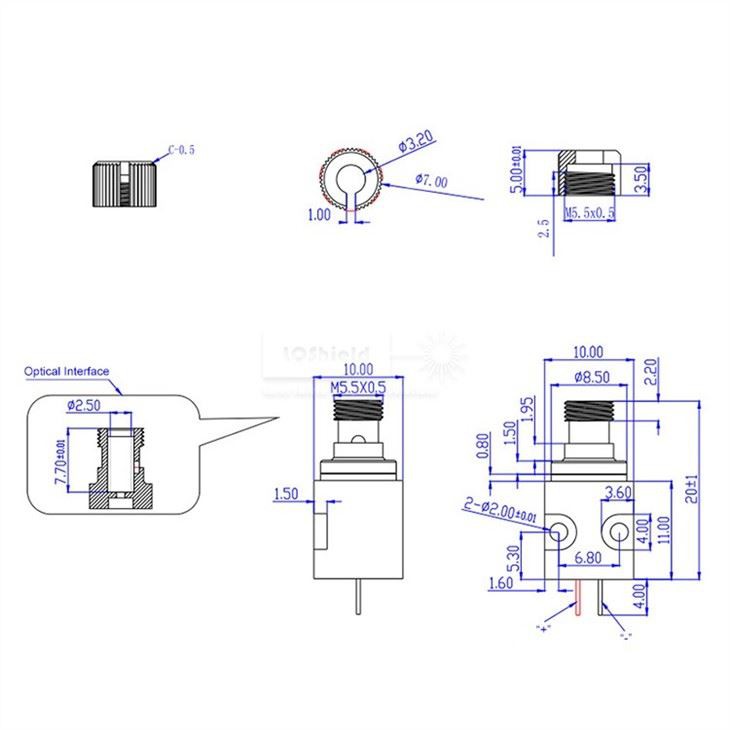


Key Specifications of the 395nm 350mW Fiber-Coupled Laser Diode Module
The 395nm 350mW fiber-coupled laser diode module provides a near-UV laser source for fluorescence excitation, spectroscopy, optical analysis, and OEM optical systems. The laser output is coupled into a 105μm optical fiber, providing flexible beam delivery and easier integration into fiber-based optical setups.
| Key Parameter | Specification | Integration Value |
| Output Wavelength | 395nm | Near-UV wavelength for fluorescence excitation and UV optical applications |
| Optical Output Power | 350mW | Suitable for applications requiring moderate-power 395nm laser excitation |
| Fiber Core Diameter | 105μm | Fiber-delivered output for flexible optical system integration |
| Coupling Efficiency | ≥90% |
|
| Fiber Connector | SMA905 / FC Options | Multiple connector configurations for different optical setups |
| Operating Mode | CW / Custom Modulation | Supports continuous-wave operation and application-specific modulation requirements |
395nm Near-UV Output
With a center wavelength of 395nm, this fiber-coupled laser module operates in the near-UV spectral region. It is designed for systems requiring a compact 395nm laser source, particularly where fiber-delivered excitation simplifies optical alignment and integration.
350mW Fiber-Coupled Output
The module delivers up to 350mW optical output power through the fiber. Compared with a free-space laser source, the 395nm fiber-coupled laser diode allows the laser output to be routed more conveniently to an excitation point, optical instrument, or OEM system.
105μm Fiber with ≥90% Coupling Efficiency
The standard configuration uses a 105μm fiber core with a specified coupling efficiency of ≥90%. Fiber length, numerical aperture (NA), and other fiber parameters can be configured according to the requirements of the customer's optical system.
SMA905 / FC Fiber Connector Options
The 395nm laser module can be configured with SMA905 or FC fiber connectors to support different optical interfaces. If the module needs to connect to an existing spectroscopy, fluorescence, or optical analysis system, the fiber connector and fiber length can be specified during configuration.
CW and Custom Modulation
Standard operation supports CW (continuous-wave) output. Custom modulation options can also be evaluated according to the required control method, modulation frequency, driver configuration, and OEM integration requirements.
Need a 395nm laser configured for your optical system?
Send us your required output power, fiber core/NA, fiber length, connector type, operating mode, and application. Our engineering team can recommend a suitable 395nm fiber-coupled laser configuration for your system.

Why Choose 395nm for Your Application?
The 395nm laser falls within the near-ultraviolet (near-UV) spectral range, making it an ideal light source for optical systems requiring excitation at the UV-visible spectral boundary. For mainstream scenarios including fluorescence excitation, spectral testing, optical inspection and UV optical analysis, wavelength selection between 395nm and adjacent bands such as 405nm needs to be tailored to practical conditions. Key reference factors cover target material absorption characteristics, rated optical power, detector response performance and overall system configuration.
For OEM equipment and laboratory optical systems that demand flexible beam transmission, the395nm fiber-coupled laser diode offers a highly feasible solution. It can stably transmit near-UV laser energy from the laser module to designated excitation and measurement positions, greatly improving system layout flexibility.
395nm Near-UV Laser Output Characteristics
Positioned at the junction of ultraviolet and visible light, the 395nm wavelength is widely adopted as a core near-UV excitation wavelength in industrial and scientific optical applications. Compared with long-wavelength visible lasers, 395nm near-UV laser delivers stronger optical interaction with fluorescent coatings, optical brighteners, dyes and various UV-sensitive materials.
The compatibility of 395nm wavelength with specific applications depends on the absorption and excitation spectral properties of the target material. Featuring 350mW high-power output, the 395nm laser module is perfectly applicable to scenarios where target materials have prominent spectral absorption near 395nm, and systems require higher optical power than that provided by low-power indicator and positioning lasers.
395nm Laser for Fluorescence Excitation
The core application of 395nm laser fluorescence excitation is to activate materials with excitation bands covering the near-UV region. In fluorescence detection systems, material UV sensitivity is not the sole judgment criterion. The core of wavelength selection lies in the effective spectral overlap between the laser excitation band and the absorption/excitation spectrum of fluorophores or target test materials.
A 395nm laser source is the preferred option under the following conditions:
- Fluorescent materials or fluorophores present high excitation efficiency at 395nm;
- The optical system is configured for near-UV excitation rather than visible light excitation;
- High-power excitation is required to enhance fluorescence response or realize fiber-guided excitation;
- The laser source needs to be placed remotely from the excitation and measurement area.
For the above scenarios, the 395nm fiber-coupled laser module can effectively simplify the excitation light transmission path, facilitating seamless integration with spectrometers, fluorescence detection devices, optical inspection equipment and customized OEM optical systems.
Material Absorption Spectrum: The Core of Wavelength Selection
The selection of a 395nm laser diode module must be based on the inherent optical properties of the irradiated material. Materials with similar macroscopic characteristics often have completely different spectral absorption curves - some achieve efficient light absorption at 395nm, while others respond better to 405nm or other adjacent wavelengths.
Before determining the laser wavelength, users need to comprehensively evaluate the following indicators:
- Absorption spectrum of the target material;
- Excitation spectrum of fluorophores;
- Expected excitation efficiency;
- Matching performance of detectors and optical filters;
- Actual optical power demand at the working position;
- Light energy loss caused by optical fibers, lenses, filters and focusing components.
In fluorescence and spectroscopy applications, matching the excitation wavelength with the actual spectral response of the target material is far more reliable than simple color-based wavelength selection.
395nm vs 405nm Laser: Application Scenario Comparison
Both 395nm and 405nm laser diodes are commonly used in near-UV and violet optical systems, yet the two wavelengths are not completely interchangeable and need targeted selection according to application needs.
The 395nm laser has a shorter excitation wavelength, suitable for materials with strong absorption in the near-UV band. In contrast, the 405nm laser is more applicable to materials whose excitation and absorption peaks are located in the violet band, as well as optical systems built with 405nm supporting components.
|
Selection Factor |
395nm Laser |
405nm Laser |
|---|---|---|
|
Spectral Position |
Near-UV / UV-visible boundary |
Violet / near-UV boundary |
|
Best Selection Basis |
Excellent material absorption at 395nm |
Excellent material absorption at 405nm |
|
Fluorescence Excitation |
Ideal for fluorophores with high response near 395nm |
Ideal for materials with stronger excitation band near 405nm |
|
Optical Filters |
Supporting filter sets matched to 395nm excitation |
Supporting filter sets matched to 405nm excitation |
|
Existing System Compatibility |
Adaptable to systems designed for 395nm excitation |
Adaptable to systems designed for 405nm excitation |
|
Final Selection Standard |
Verified by material excitation/absorption spectrum |
Verified by material excitation/absorption spectrum |
It is worth noting that direct replacement of a 405nm laser with a 395nm laser will not yield identical optical performance. Users need to comprehensively test and verify excitation efficiency, filter transmittance, detector response and final fluorescence signal based on the complete optical system.
Advantages of Fiber-Coupled 395nm Laser
Fiber-coupled 395nm laser diodes solve the layout limitation that laser sources cannot be directly arranged at excitation and irradiation positions. Different from traditional free-space laser beams that require overall optical path matching, this product can transmit laser stably to the target position through optical fibers, bringing multiple integration advantages:
- Flexible routing and layout of 395nm laser output;
- Easy docking and integration with spectroscopic and fluorescence instruments;
- Reduced reliance on long-distance free-space optical paths;
- Simpler embedding into compact OEM optical systems;
- Convenient replacement and position adjustment of excitation sources;
- Diversified connector options for matching existing equipment.
The standard 350mW 395nm fiber-coupled laser module supports customized optical fibers and connectors to meet the matching needs of different optical systems.
Applicable Scenarios of 395nm Laser
The 395nm fiber-coupled laser is the optimal choice if your system meets the following requirements:
- Near-UV excitation at 395nm band;
- Stable 350mW high-power optical output;
- Fiber-guided laser energy transmission;
- Fluorescence excitation and spectral analysis testing;
- Integration and upgrading of existing optical instruments;
- Customizable optical fiber, connector, driver and modulation functions.
It should be emphasized that 395nm is not a universal wavelength for all UV and fluorescence applications. The final wavelength solution must be determined by combining the target material's spectral response and the overall optical system design.
Still confused about choosing between 395nm and 405nm lasers for your project? You can provide detailed parameters including target material properties, excitation spectrum, required optical power, fiber specifications and connector types. Our professional engineering team will conduct targeted evaluation to confirm whether the 395nm fiber-coupled laser diode module is suitable for your application scenarios.

Fluorescence Excitation Applications
The 395nm 350mW single mode fiber laser diode provides a compact UV excitation source for optical systems that require stable 395nm illumination and efficient fiber delivery. Its near-UV output can be integrated into fluorescence detection, fluorescence spectroscopy, biomedical instrumentation, and laboratory optical systems where a controlled excitation wavelength is required.
With single-mode fiber output, the 395nm fiber laser diode can deliver the excitation beam directly to a designated optical path, helping simplify system integration where space, beam delivery, and coupling stability are important considerations. The fiber-coupled configuration also allows the laser source to be positioned away from the detection or sample area.
Typical Fluorescence Excitation Uses
Fluorescence detection systems – 395nm UV excitation for optical detection and analytical instruments.
Fluorescence spectroscopy – integrated as an excitation source for laboratory spectroscopy and optical measurement systems.
Biomedical and life-science instruments – suitable for fluorescence-based analysis where a 395nm excitation source matches the optical configuration.
Optical sensing systems – fiber-delivered UV excitation for compact sensing and detection equipment.
Laboratory research equipment – a 395nm laser source for experimental fluorescence excitation and optical testing.
For OEM equipment manufacturers and system integrators, this 395nm single mode fiber laser diode can be configured as part of a complete UV excitation solution, with options for fiber specifications, connector configuration, drive electronics, and mechanical integration according to system requirements.

Package
Standard configuration
Laser diode head
1m single-mode fiber (SMA905 interface, with protective sleeve)
Product parameter table
Optional accessories
Customized fiber length/interface (FC/PC, FC/APC, etc.)
Beam collimator (3mm/5mm/10mm focal length optional)
Constant current drive power supply (5V DC, with PWM interface)
Power monitoring module (real-time feedback of laser power)
Water cooling kit (suitable for high temperature environment)

OEM Customization
For OEM equipment manufacturers and optical system integrators, the 395nm 350mW single mode fiber laser diode can be configured around the requirements of the final application. Rather than using a standard laser component with fixed specifications, customers can discuss the optical, fiber, electrical, and mechanical requirements needed for system integration.
Customization Options
Depending on the project, available configuration options may include:
Fiber configuration – fiber type, fiber length, and fiber output requirements
Connector options – connector configuration matched to the customer's optical setup
Drive electronics – compatible laser driver and power supply requirements
Thermal management – cooling and heat dissipation considerations for continuous operation
Mechanical design – module dimensions, mounting structure, and housing requirements
Optical integration – fiber coupling and output configuration for the customer's optical path
Built for OEM Integration
The 395nm UV laser source can be developed for applications such as fluorescence excitation, optical sensing, spectroscopy, UV inspection, and other specialized equipment. Our engineering team can review the required wavelength, output power, fiber configuration, operating conditions, and mechanical constraints before recommending a suitable 395nm fiber-coupled laser solution.
For volume procurement, customers can also discuss specification consistency, production requirements, labeling, packaging, and other OEM requirements to support repeatable integration across production batches.
Quality Assurance
Strict production testing
- Each device undergoes a 72-hour aging test
- All parameters are calibrated and verified
- Detailed test reports are provided
Perfect after-sales service
- 12-month quality warranty
- Professional technical support team
- Quick response mechanism
Safety Guide
Safety Warning
⚠ Laser safety: 395nm ultraviolet light is harmful to eyes and skin, and protective glasses (OD4+ 395nm only) must be worn when using it.
⚠ Heat dissipation requirements: Long-term high-power operation requires good heat dissipation, and it is recommended to use a TEC or water cooling system.
Safety protection requirements
⚠ OD4+ protective glasses must be used
⚠ Safety warning signs should be set up in the operation area
⚠ Avoid direct skin exposure
Environmental requirements
Working temperature: 15-30℃
Storage temperature: -10-50℃
Relative humidity: <80%
Technical Support & After-Sales Service
Provide 12-month warranty and lifetime technical support.
Support OEM/ODM customization (wavelength, power, fiber configuration, etc.).
Hot Tags: 395nm 350mw Single Mode Fiber Laser Diodes, China, manufacturers, suppliers, factory, customized, wholesale, best, cheap, professional, for sale, near me


