



Three-dimensional laser scanning technology is a technology that began to appear in the mid-1990s, which is another new breakthrough in surveying and mapping technology after GPS spatial positioning system. Through the method of high-speed laser scanning measurement, it can quickly obtain the three-dimensional coordinate data of the surface of the measured object in a large area with high resolution. Due to its fast, non-contact, real-time, dynamic, initiative, high density, high precision, digital, automation, and other characteristics, its application and promotion are likely to cause another revolution in measurement technology like GPS.
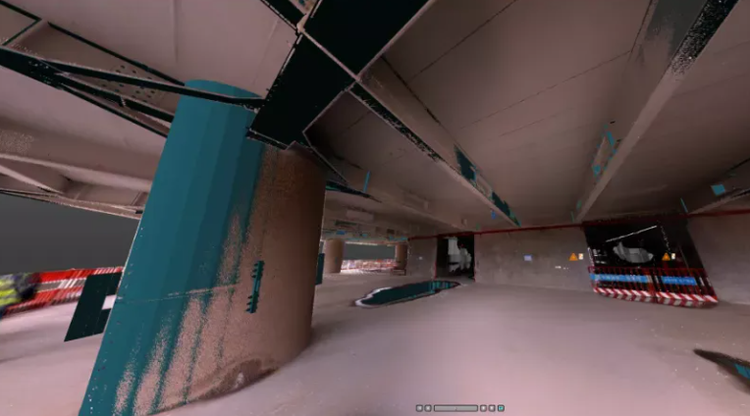
The scanning technology is used to measure the size and shape of the workpiece. Mainly used in reverse engineering, responsible for surface copy, workpiece three-dimensional measurement, for the existing three-dimensional physical objects (samples or models) in the absence of technical documents, can quickly measure the contour collection data of the object, and construct, edit, modify to generate a universal output format of the surface digital model.
Feature
At present, most of the 3D laser scanners on the market have the following functions:
1. Three-dimensional measurement
In the traditional measurement concept, the final output of the measured data is a two-dimensional result (such as a CAD drawing). In the gradual digitalization nowadays, three-dimensional has gradually replaced two-dimensional, because its intuitiveness is not two-dimensional representation, In a three-dimensional laser scanner each time measured data contains not only X, Y, and Z point information, but also R, G, and B color information, as well as the object reflectivity information, such comprehensive information can give people a sense of the object in the computer real representation. It is impossible to do by ordinary measuring means.
2. Quick scan
Fast scanning is the concept of the birth of the scanner, in conventional measurement means, the measurement time of each point is 2-5 seconds, what is more, it takes a few minutes to measure the coordinates of a point, the birth of three-dimensional laser scanner has changed this status quo. The initial measurement speed of 1000 points per second has greatly amazed the measurement community, while the maximum speed of the pulse scanner has reached 50,000 points per second, and the maximum speed of the phase scanner 3D laser scanner has reached 1.2 million points per second, which is the basic guarantee of the detailed description of the object by the 3D laser scanner, ancient style, factory pipes, tunnels, etc. Terrain and other complex areas that cannot be measured are a thing of the past.
Application field
3D laser scanning technology continues to develop and mature, and 3D scanning equipment is gradually commercialized. The great advantage of the 3D laser scanner is that it can quickly scan the object under test, and high-precision scanning point cloud data can be obtained directly without reflecting the prism. This allows for efficient 3D modeling and virtual reproduction of the real world. Therefore, it has become one of the hot spots of current research and has been widely used in the fields of digital protection of cultural relics, civil engineering, industrial surveying, natural disaster investigation, digital urban terrain visualization, and urban and rural planning.

(1) Surveying and mapping engineering field: dam and power station foundation topographic survey, highway surveying and mapping, railway surveying and mapping, bridge, building foundation surveying and mapping, tunnel detection and deformation monitoring, dam deformation monitoring, tunnel underground engineering structure, measurement mine, and volume calculation.
2) Structural measurement: bridge reconstruction and expansion engineering, bridge structure measurement, structural testing, monitoring, geometric size measurement, spatial position conflict measurement, space area, volume measurement, three-dimensional high-fidelity modeling, offshore platforms, measurement of shipyards, power plants, chemical plants and other large industrial enterprises internal equipment measurement; Pipeline, line measurement, all kinds of machinery manufacturing installation.
(3) Architectural and historic site measurement: fidelity measurement of the interior and exterior of buildings, protection and measurement of monuments (ancient buildings, statues, etc.), cultural relic restoration, ancient building measurement, data preservation and other historic site protection, site mapping, fake imaging, on-site virtual model, on-site protective image recording.
(4) Emergency services: anti-terrorism, land reconnaissance and attack mapping, surveillance, mobile reconnaissance, disaster estimation, traffic accident ortho map, crime scene ortho map, forest fire monitoring, landslide debris flow warning, disaster warning and site monitoring, nuclear leakage monitoring.
(5) Entertainment industry: for the design of film products, the design of film actors and scenes, the development of 3D games, virtual museums, virtual travel guidance, artificial imaging, scene virtual, and on-site virtual.
(6) Mining: underground operations in open pit mines and metal mines, as well as areas where personnel in some dangerous areas are not convenient to reach. For example collapse areas, caves, cliff edges,s and so on for 3D scanning.
The 3D laser scanning system is divided into several types: airborne, vehicle, backpack, and handheld. Among them, the use scenario of each type of laser scanner is different, and the accuracy is not the same:
1. Airborne laser scanning system: geodetic mapping, city-level mapping
2. Ground-based laser scanning system: building, decoration, curtain wall
3. Backpack laser scanning system: planning and mapping
4. Handheld laser scanning systems: Industry
Therefore, using different types of 3D laser scanners, we can easily collect high-precision and high-density 3D point cloud data of various small, large, complex, standard, or non-standard scenes, and then quickly reconstruct the true 3D model of the target scene.
Contact information:
If you have any ideas, feel free to talk to us. No matter where our customers are and what our requirements are, we will follow our goal to provide our customers with high quality, low prices, and the best service.
 Email:info@loshield.com
 Tel:0086-18092277517
 Fax: 86-29-81323155
 Wechat:0086-18092277517


