




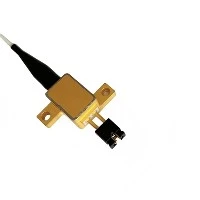
The following problems can be solved by using Photodiode or Phototransistor. For example, the phone camera needs to measure the ambient light to determine if the flash needs to be activated. How to noninvasively assess oxygen levels in the blood? These optoelectronic devices convert light (photons) into electrical signals that a microprocessor (or microcontroller) can "see." In this way, it is possible to control the positioning and arrangement of objects, determine the light intensity and measure the physical properties of the material based on its interaction with the light.
Now let's talk about the second part.

1. Photodiode structure
One of the key requirements for a photodiode is a suitable area for collecting light. Within a standard PN junction, this is relatively small, but the area can be increased by using a PIN diode. Since the intrinsic region is contained in the active junction used for light collection, the region used for light collection is much larger, making the PIN photodiode more efficient.
In the photodiode manufacturing process, thick intrinsic layers are inserted between the P-type and N-type layers. The intermediate eigen layer can be completely eigen or very lightly doped to make it an N-layer. In some cases, it can be grown onto the substrate as an epitaxial layer, or it can be contained within the substrate itself.
The P+ diffusion layer can be developed on a heavily doped N-type epitaxial layer. The contact is made of metal design and can be made into two terminals such as an anode and cathode. The front area of the diode can be divided into two types, such as active surface and passive surface.
The design of the inactive surface can be done with silicon dioxide (SiO2). On an active surface, light can shine on it, while on an inactive surface, light cannot shine. By covering the active surface with an anti-reflective material, the energy of light is not lost, and the maximum can be converted into an electric current.

One of the main requirements of a photodiode is to ensure that the maximum amount of light reaches the intrinsic layer. One of the most efficient ways to achieve this is to place the electrical contacts on the side of the device, as shown in the image. This allows the maximum amount of light to reach the effective region. It is found that since the substrate is heavily doped, there is almost no light loss since this is not an active region.
Since light is mostly absorbed in a certain distance, the thickness of the intrinsic layer usually matches this. Any increase over this thickness will reduce the speed of operation - an important factor in many applications - and will not greatly increase efficiency.
Light can also enter the photodiode from one side of the junction. By operating the photodiode in this way, fewer intrinsic layers can be made to increase the speed of operation, albeit with reduced efficiency.
In some cases, heterojunctions can be used. This form of construction has the added flexibility to receive light from the substrate and has a larger energy gap, making it transparent to light.

As a less standard process, it is more expensive to implement and therefore tends to be used for more specialized products.
2. Photodiode characteristics
(1) volt-ampere characteristics
It refers to the relationship between the photocurrent on the photodiode and the voltage applied to it.
(2) Lighting characteristics
It refers to the relationship between luminous flux and photocurrent when the photodiode voltage between the cathode and anode is constant. The slope of the light characteristic curve is called the photodiode sensitivity.
(3) Spectral characteristics
The relationship between the photocurrent and the wavelength of the incident light is called the spectral property. The photon energy is related to the wavelength of light: the longer the wavelength, the smaller the photon energy; The shorter the wavelength, the more energetic the photon.
3. Function of photodiode
(1) Light control
The photodiode can be used as a photoelectric switch, and its circuit is shown in the following figure. When there is no light, photodiode VD1 is cut off due to reverse voltage. Transistors VT1 and VT2 are also cut off with no base current. The relay is in the release state.
When light is emitted on VD1, it transitions from cutoff to conduction. As a result, VT1 and VT2 turn on successively, relay K draws, and the control circuit is switched on.
(2) optical signal reception
Photodiodes can be used to receive light signals. The following picture shows the optical signal receiving amplification photodiode circuit. The light signal is received by photodiode VD, amplified by VT, and output by coupling capacitor C.
4. Photodiode applications
(1) Photocell
The photocell is essentially a large area of the PN junction. When light is emitted on a PN junction surface, such as the P-region surface, each photon in the P-region produces a free electron-hole pair if the photon energy is greater than the bandgap bandwidth of the semiconductor material.
The electron-hole pair rapidly diffuses inward and forms an electromotive force related to light intensity under the junction electric field. At this time, if we use it as a power supply and connect it to an external circuit, as long as there is light, it will continue to supply power, which is a photocell. In other words, the photocell is a PN-junction photoelectric device with no bias voltage. It can directly convert light energy into electricity.
(2) Solar cells
A solar cell is a semiconductor device. When sunlight hits a semiconductor, some of it is reflected and the rest is absorbed or penetrates the semiconductor. Some of the absorbed light becomes heat, while other photons collide with the valence electrons that make up the semiconductor, creating electron-hole pairs. In this way, light energy is converted into electricity.
Therefore, after the sunlight is irradiated, the two ends of the solar cell will generate DC voltage, thereby converting the sunlight energy directly into DC current. If we solder the metal leads to the P and N layers and connect the load, the current will flow through the external circuit.
In this way, if we connect the series of photocells in parallel, a certain voltage and current can be generated to output power.
(3) photovoltaic lighting system
A photovoltaic power generation system is a power generation system that uses solar cells to convert solar energy into electricity. It uses the photovoltaic effect.
The main components are solar cells, batteries, controllers, and inverters. High reliability, long service life, no pollution, independent power generation, photodiode grid-connected operation.
Because the photodiode photovoltaic mode is greatly affected by external environmental factors such as light and temperature, the operating point changes quickly. There are independent power generation systems and grid-connected power generation systems.
① Independent photovoltaic power generation system
An Independent photovoltaic power generation system is a power generation method that is not connected to the grid. It needs batteries to store energy for the night. Independent solar photovoltaic power generation is mainly used in remote villages and homes
Structure diagram of the volt-generating system
② grid-connected photovoltaic power generation system
Grid-connected photovoltaic power generation system is connected to the national grid to supply power to the grid. It doesn't need batteries. Residential photovoltaic power generation systems are mostly in the home. They are also used in public utilities, night landscape lighting systems, and solar farms.
(4) Other applications of photodiodes are:
•A photodiode is used as a light sensor. Since the current in it is proportional to the intensity of light, it is also used to measure the intensity of light.
•Photodiodes in smoke detectors can be used to sense smoke and fire.
•Photodiodes and LEDs are combined to make optical isolators and optical couplers
•Used as a solar cell in solar panels
•Used for a barcode scanner, character recognition
•For obstacle detection systems,
•Can be used as a page presence and page counter in printers
•For proximity detection, an oximeter
•It is also used for optical encoders and decoders
•Optical information transmission, based on optical fiber communication
•Position sensor
Contact information:
If you have any ideas, feel free to talk to us. No matter where our customers are and what our requirements are, we will follow our goal to provide our customers with high quality, low prices, and the best service.
 Email:info@loshield.com
 Tel:0086-18092277517
 Fax: 86-29-81323155
 Wechat:0086-18092277517


