



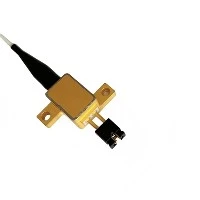
A PIN Photodiode is a semiconductor device consisting of a P-I-N junction that converts an optical signal into an electrical signal that changes as the light changes. It is aimed at the deficiency of general PD, the structure is improved, and the sensitivity is higher than that of the general P-N junction photodiode, and it has the characteristics of single-direction conduction.
1. Principle and structure of PIN diode
The general diode is composed of N-type impurity doped semiconductor material and P-type impurity doped semiconductor material directly to form a PN junction. The PIN diode is to add a thin layer of low-doping Intrinsic semiconductor between the P-type semiconductor material and the N-type semiconductor material.
The structure diagram of the PIN diode is shown in Figure 1 because the intrinsic semiconductor is similar to the medium, this is equivalent to increasing the distance between the two electrodes of the P-N junction capacitor, so that the junction capacitor becomes small. Secondly, the width of the depletion layer in P-type semiconductor and N-type semiconductor is widened with the increase of reverse voltage, and the junction capacitance is also small with the increase of reverse bias. Due to the existence of layer I, and the P region is generally very thin, the incident photon can only be absorbed in layer I, and the reverse bias is mainly concentrated in region I, forming a high electric field region, and the photogenerated carrier in the region I accelerates under the action of the strong electric field, so the carrier transit time constant decreases, thereby improving the frequency response of the photodiode. At the same time, the introduction of layer I enlarges the depletion region and broadens the effective working area of the photoelectric conversion, thus improving the sensitivity.

There are two basic structures of the PIN diode, namely, the structure of the plane and the structure of the mesa, as shown in Figure 2. For Si-pin133 junction diodes, the carrier concentration of layer I is very low (about 10cm order of magnitude), the resistivity is very high (about k-cm order of magnitude), and the thickness W is generally thick (between 10 and 200m); The doping concentration of the P-type and N-type semiconductors on either side of the I layer is usually very high.
The I layers of both planar and mesa structures can be fabricated by epitaxy technology, and the highly doped p+ layers can be obtained by thermal diffusion or ion implantation technology. Planar diodes can be easily fabricated by conventional planar processes. The mesa structure diode also needs to be fabricated (by etching or grooving). The advantages of mesa structure are:
① The bending part of the plane junction is removed, and the surface breakdown voltage is improved;
②The edge capacitance and inductance are reduced, which is conducive to improving the operating frequency.

2. PIN diode working state under different bias
①Positive downward drift
When the PIN diode is applied with a forward voltage, many moles in the P region and N region will be injected into the I region and recombined in the I region. When the injection carrier and the compound carrier are equal, the current I reaches equilibrium. The intrinsic layer has a low resistance due to the accumulation of a large number of carriers, so when the PIN diode is forward-biased, it has a low resistance characteristic. The greater the forward bias, the greater the current injected into the I layer, and the more carriers in the I layer, making its resistance smaller. Figure 3 is the equivalent circuit diagram under positive bias, and it can be seen that it is equivalent to a small resistance with a resistance value between 0.1Ω and 10Ω.
② Zero deviation
When no voltage is applied at both ends of the PIN diode, because the actual I layer contains a small amount of P-type impurities, at the IN interface, the holes in the I region diffuse to the N region, and the electrons in the N region diffuse to the I region, and then form a space charge region. Because the impurity concentration in Zone I is very low compared with that in Zone N, most of the depletion zone is almost in Zone I. At the PI interface, due to the concentration difference (the hole concentration IN the P region is much larger than that in the I region), diffusion motion will also occur, but its effect is much smaller than that at the IN interface and can be ignored. Therefore, at zero bias, the PIN diode presents a high resistance state due to the existence of a depletion region in the I region.
③ Reverse downward bias
The reverse bias is very similar to the zero bias, except that the built-in electric field is strengthened, and the effect is to widen the space charge region of the IN junction, mainly towards the I region. At this time, the PIN diode can be equivalent to the resistance plus capacitance, the resistance is the remaining intrinsic region resistance, and the capacitance is the barrier capacitance of the depletion region. Figure 4 is the equivalent circuit diagram of the PIN diode under reverse bias, and it can be seen that the resistance range is between 1Ω and 100Ω, and the capacitance range is between 0.1pF and 10 PF. When the reverse bias is too large, so that the depletion zone fills the entire I zone, I zone penetration will occur, and the PIN tube will not work normally.
Contact information:
If you have any ideas, feel free to talk to us. No matter where our customers are and what our requirements are, we will follow our goal to provide our customers with high quality, low prices, and the best service.
 Email:info@loshield.com
 Tel:0086-18092277517
 Fax: 86-29-81323155
 Wechat:0086-18092277517


