




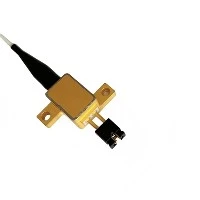
Photodiode is a semiconductor device that converts light into current, and between the p (positive) and n (negative) layers, there is an intrinsic layer. A photodiode receives light energy as an input to produce an electric current. Photodiodes are also known as photodetectors, photoelectric sensors or light detectors.
The photodiode operates under reverse bias conditions, that is, the P-side of the photodiode is connected to the negative electrode of the battery (or power supply), and the N-side is connected to the positive electrode of the battery. Typical photodiode materials are silicon, germanium, indium gallium arsenide phosphide, and indium gallium arsenide.
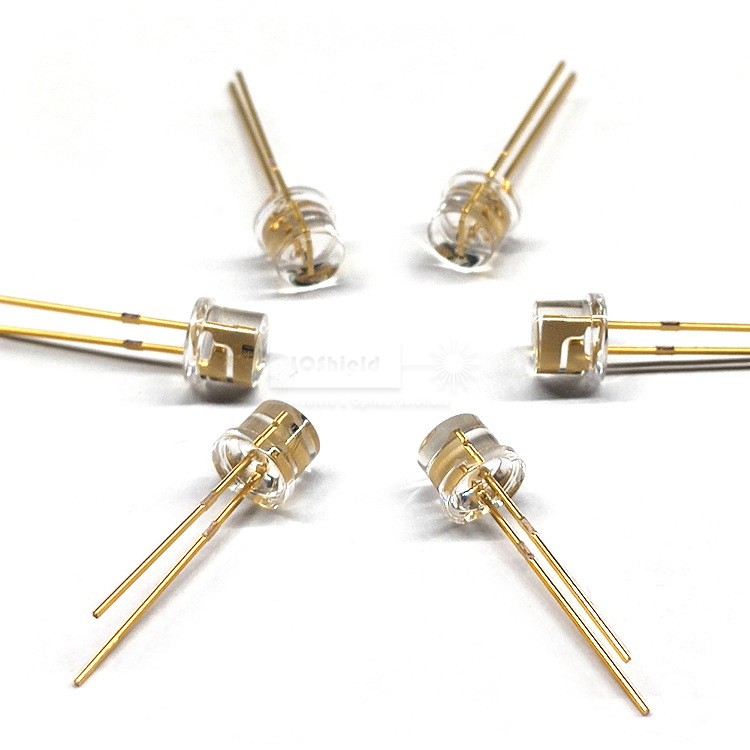
Inside, the photodiode has a light filter, built-in lens, and surface area. When the surface area of the photodiode is increased, the response time is reduced. Very few photodiodes look like light-emitting diodes (LEDs). It has two terminals, as shown below. The smaller terminal serves as the cathode and the longer terminal serves as the anode.

The symbol of the photodiode is similar to the symbol of the LED, but the arrow points inside instead of outside in the LED. The image below shows the symbol of the photodiode.

1. Photodiode principle
Photodiodes work by creating a pair of electron holes when an energetic photon hits the diode. This mechanism is also known as the internal photoelectric effect. If absorption occurs in the depletion region junction, the carriers are removed from the junction by the internal electric field in the depletion region.

Usually, when light illuminates the PN junction, the covalent bond is ionized. This creates holes and electron pairs. The photocurrent is generated due to the generation of electron-hole pairs. When photons with energies greater than 1.1eV hit the diode, electron-hole pairs are formed. When the photon enters the depletion region of the diode, it hits the atom with high energy. This results in the release of electrons from the atomic structure. When electrons are released, free electrons and holes are created.
In general, electrons have a negative charge and holes have a positive charge. Depleted energy will have a built-in electric field. Because of this electric field, the electron-hole pair is far away from the PN junction. Thus, the holes move toward the anode and the electrons move toward the cathode to produce a photocurrent.
Photon absorption intensity and photon energy are proportional to each other. The less energy the photo has, the more it absorbs. This whole process is called the internal photoelectric effect.
Intrinsic excitation and extrinsic excitation are two methods of photon excitation. The intrinsic excitation process occurs when electrons in the valence band are excited by photons to the conduction band.
2. Working circuit of the photodiode
Photodiodes mainly work in three different modes, which are:
(1)Photovoltaic mode
(2)Photoconductive mode
(3)Avalanche diode mode
(1)Photovoltaic mode
This mode is also called zero bias mode. This mode is preferred when photodiodes are operating in low-frequency applications and super-energy level light applications. When the flash hits the photodiode, it creates a voltage. The resulting voltage will have a very small dynamic range and will have nonlinear characteristics. When the photodiode is configured with OP-AMP in this mode, the change in temperature will be very small.
(2)Photoconductive mode
In this mode, the photodiode will operate under reverse bias conditions. The cathode is positive and the anode is negative. As the reverse voltage increases, the width of the depletion layer also increases. As a result, the response time and junction capacitance will be reduced. In contrast, this mode of operation is fast and generates electronic noise.
(3)Avalanche diode mode
Avalanche diodes operate under high reverse bias conditions, which allow avalanche breakdown to multiply to each electron-hole pair produced by photo electricity. The result is the internal gain of the photodiode, which slowly increases the device response.
(4)Photodiode circuit
The circuit diagram of the photodiode is shown below. The circuit can be constructed with a 10k resistor and photodiode. Once the photodiode notices the light, it allows some current to pass through it. The sum of the current supplied through the diode can be proportional to the sum of the light observed through the diode.
3. Connect the photodiode to the external circuit
The photodiode operates in a reverse-biased circuit. The anode is connected to the circuit ground and the cathode is connected to the positive supply voltage of the circuit. When illuminated by light, an electric current flows from the cathode to the anode.
When photodiodes are used with an external circuit, they are connected to a power supply in the circuit. The current generated by the photodiode will be very small. This current value is not sufficient to drive the electronic device. Therefore, when they are connected to an external power supply, it provides more current to the circuit. So the battery is used as a power source. The battery source helps to increase the current value, contributing to the better performance of external devices.
4. Photodiode manufacturing process
Photodiode material
The material of a photodiode determines many of its characteristics. The key characteristic is the wave of light the photodiode responds to, and the other is the noise level, both of which largely depends on the material used in the photodiode.
Different responses to wavelengths occur due to the use of different materials because only photons with enough energy to excite electrons in the band gap of the material produce significant energy to generating the current from the photodiode.
While the wavelength sensitivity of the material is very important, another parameter that can have a significant impact on the performance of the photodiode is the level of noise generated.
Because of their larger band gap, silicon photodiodes produce less noise than germanium photodiodes. However, there is also a need to consider the wavelength of the photodiode required, and germanium photodiodes must be used for wavelengths longer than about 1000 nm.
Go to Part 2 to learn more.
Contact information:
If you have any ideas, feel free to talk to us. No matter where our customers are and what our requirements are, we will follow our goal to provide our customers with high quality, low prices, and the best service.
 Email:info@loshield.com
 Tel:0086-18092277517
 Fax: 86-29-81323155
 Wechat:0086-18092277517


