



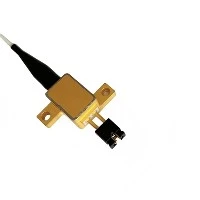
Photo Laser Diode LED is a semiconductor that converts electrical energy into light energy. The color of the light emitted depends on the semiconductor material and composition. LEDs are usually divided into three wavelengths: ultraviolet, visible, and infrared. Commercial LEDs have a single pixel output of at least 5mW and a wavelength range of 360nm to 950nm, each made from a specific semiconductor material.

UV LED: 320-360nm
UV LEDs are rapidly being commercialized, specifically for industrial curing applications and medical/biomedical uses. Until recently, the lower wavelength high-efficiency chip limit shifted from 390nm to 360nm, and developments over the next few years may see 320nm high-efficiency chips commercialized in the region.
Near ultraviolet to green LED: 395nm-530nm
The material for the wavelength range product is indium gallium nitride InGaN, which is technically capable of a wavelength between 395 nm and 530 nm. However, most large suppliers focus on manufacturing blue 450nm-475NMleds, which are used to manufacture white light with phosphors, and green leds in the 520nm-530nm range for traffic signal green lighting.
Rapid advances and increased efficiency are being noted in the blue wavelength range, especially as the race to create brighter and brighter white light sources continues.
Deep red to near-infrared (IRLED): 660nm-900 nm
There are many variations in device structure in this region, but all use aluminum gallium arsenide AlGaAs or GaAs materials. There is still a push to make these devices more efficient, but these improvements are incremental. Applications include infrared IR remote control, night vision lighting, industrial light control, and various medical applications (660nm-680nm).
How LEDs work
LEDs are semiconductor diodes that emit light when an electric current is applied to the forward direction of the device. Enough voltage must be applied so that the electrons pass through the loss zone and combine with the hole on the other side to form an electron-hole pair. When this happens, the electron releases its energy in the form of light, and the result is the emission of photons. The band gap of a semiconductor determines the wavelength of light emitted, and a shorter wavelength equals more energy, so a material with a larger band gap emits a shorter wavelength. A material with a larger band gap also requires a higher conduction voltage. The short-wave UV blue LED has a forward voltage of 3.5 volts, while the near-infrared LED has a forward voltage of 1.5-2.0 volts.
Wavelength availability and efficiency
High-efficiency led can be produced in any wavelength range, only the 535nm to 560nm range cannot produce high-efficiency led lights. The most important factors in the commercialization of a particular wavelength are related to market potential, demand, and industry-standard wavelengths. This is particularly evident in the 420nm-460nm, 480nm-520nm, and 680nm-800nm regions, because these wavelength ranges are not widely used. There are not a large number of manufacturers offering LED products for these wavelength ranges. Nevertheless, it is possible to find small and medium-sized suppliers that can offer these specific wavelengths based on customer demand. Each material technique has a range of wavelengths in which the spot is most effective. This point is very close to the middle of each range. As the semiconductor doping level increases or decreases from the optimal amount, efficiency decreases, which is why blue LEDs have a larger output than green or near-UV light, amber has more output than yellow-green, and near-infrared is superior to 660nm. If there is a choice to be made, it is best to design for the center of the range rather than the edge, it is easier to get the product if you are not operating at the edge of material technology.

Figure 1 - Apply the equation I=(Vcc-Vf)/RL to find the current value. In order to absolutely determine the current flow in the circuit, each LED VF must be measured and the appropriate load resistance specified. In practical commercial applications, the Vcc is designed to be much larger than the VF, so that small changes in the VF do not have a large effect on the overall current. The disadvantage of this circuit is that there is a large power loss through the RL. In applications where the operating temperature range is very narrow (less than 30°C) or where the LED output is not critical, a simple circuit can be used that utilizes a current-limiting resistor, as shown in the figure: A better way to drive an LED is to use a constant current source (see Figure 2). The circuit will provide the same current from device to device and over temperature changes. It also has lower power consumption than using simple current-limiting resistors. Commercial, off-the-shelf LED drivers are available from many different sources. Typically, these operations use the pulse width modulation (PWM) principle of brightness control.
Supply current and voltage to the led
Although LEDs are semiconductors and require a minimum voltage to work, they are still diodes and need to operate in current mode. In DC mode, leds operate in two main ways. The simplest and most common is to use a current-limiting resistor (see Figure 1). The disadvantage of this method is the high heat and power loss in the resistance. In order for the current to remain stable between temperature changes and devices, the supply voltage should be much greater than the forward voltage of the LED.

Figure 2 - Example of a precise stable circuit. This circuit is often referred to as a constant current source. Note that the supply current is determined by the supply voltage (Vcc) minus Vin divided by R1, (Vcc-VIN)/R1.
Contact information:
If you have any ideas, feel free to talk to us. No matter where our customers are and what our requirements are, we will follow our goal to provide our customers with high quality, low prices, and the best service.
 Email:info@loshield.com
 Tel:0086-18092277517
 Fax: 86-29-81323155
 Wechat:0086-18092277517


