



The Laser Diode is the uncrowned hidden champion of modern laser technology. Laser diodes are everywhere, from simple laser Pointers to complex quantum communication satellites. It has superior efficiency, compact construction, numerous types, and most importantly, it is becoming cheaper.
Many people have considered using laser diodes in their products, sometimes as brand-new systems, sometimes as replacements for older lasers. In the face of many kinds of laser secondary tubes, how should engineers choose?
As an example, the following four steps help you determine the laser diode you need.
Step 1: Convert application requirements into laser parameters
In order to find the right laser diode for your application or product, you may first want to determine a set of parameters based on the application. Suppose we want to build a laser interferometer for surface profile analysis or velocity measurement.
To construct the device, we need a laser diode with a coherent length of 1 to 10 m, and the interferogram should vary in temperature (< 0.1 nm/K) and remained stable. We need a collimated Gaussian beam with a power of > 80 mW. The detector we used is based on silicon (Si) and is only suitable for < 1100 nm wavelength. In this case, the central wavelength itself and the polarization are less important. At present, we do not know the type of laser diode package.
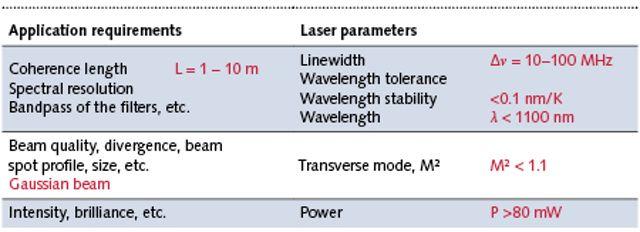
In the picture above, application or product requirements are listed on the left and laser parameters are listed on the right. From the coherent length, Δ can be calculated using the wire-width ν = C /πL= 9.6-95.5 MHZ.
For those new to the field, it is important to understand what these parameters mean.
The coherence length is the distance at which the coherence decays significantly. Please refer to the following formula:
Δν = C /πL
Where Δν is the bandwidth (or line width), C is the speed of light, and L is the coherence length.
The spectral resolution represents the relationship between bandwidth (in nanometers) and wavelength: R = λ / Δλ. In the case of a spectrograph or more general spectrum, a measure of the laser's ability to resolve features of the electromagnetic spectrum.
Bandpass, sensors used to detect laser signals, usually use interference filters to block ambient light. Therefore, the wavelength of the laser source must be kept within the transmission range of the filter. In this case, we can usually ignore the limited center wavelength tolerance.
Beam quality can be defined in several ways. One is the M 2 factor, which indicates how close the beam is to the ideal Gaussian shape. Thus, 1.0 represents a perfect Gaussian beam. The other is the beam parameter product (BPP), for which we must multiply the focused beam waist by the far-field divergence.
Intensity, which represents the power of the laser in the beam area (preferably the focal point). So the units are W/cm 2.
The beam profile refers to the intensity distribution of the laser beam. It may be flat-topped (rectangular distribution) or Gaussian. Single-mode beams are usually (nearly) Gaussian, while multimode beams are usually not. It may have a variety of shapes depending on the number and intensity distribution of the mixing modes.
The brightness of the laser source can be measured by its output power and beam quality. Essentially, it's the laser power divided by BPP. The unit is W/cm 2 times sr.
Step 2: Select a laser type
In the second step, we will describe the laser type more specifically. We face many choices. The right way to approach this problem is to weigh the options. Shades of gray identify the different options commonly used for single-mode laser diodes.
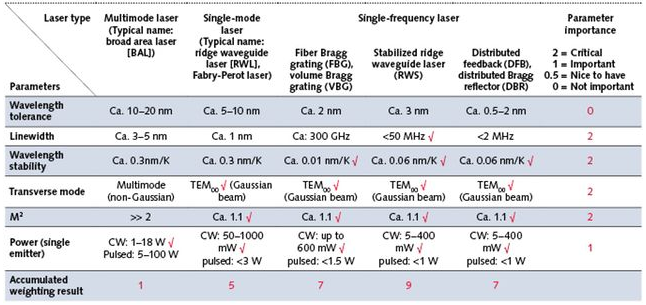
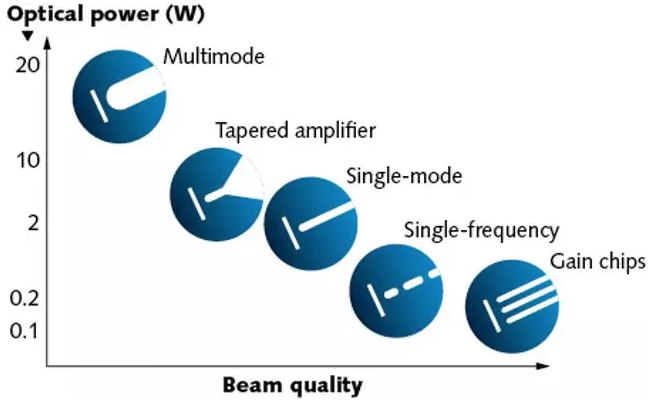
For some types of laser diodes, higher beam quality usually accompanies lower output power.
We label the parameters suitable for the application (take building a laser interferometer as an example). There are no restrictions on wavelength tolerances. So the weight is zero. For the linewidth, the calculation range is between 10 and 100 MHz, so the < in the ridge waveguide column is stabilized; 50 MHz sounds reasonable. Since this is a key parameter, the weight is 2.
Step 3: Select the laser material
Wavelength is usually very important for applications.
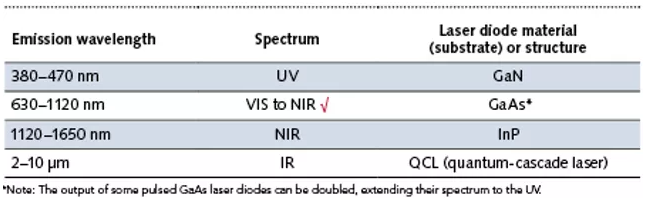
Table 3 Outlines specific materials and their range of wavelengths. In the example, the detector is based on Si, and the laser emission wavelength is limited to < 1100 nm. This means gallium nitride (GaN) or gallium arsenide (GaAs) laser diodes may be suitable for us. Typically, ultraviolet (UV) solutions are more expensive than laser diodes in visible light (VIS) or near-infrared (NIR), so the vis-to-NIR material is marked.
Step 4: Create final diagrams and start looking for suppliers
We now have all the parameters needed for a suitable laser diode. Table 4 shows a set of parameters derived from the previous chart, and we discuss others below:
Mode of operation (CW, pulse, or modulation). This can have a huge impact on heat management as well as packaging styles. For pulsed or pulse-modulated laser diodes with Low duty cycle, there may be less waste heat and therefore smaller package sizes.
Beam collimation (free space, integrated optical element, or fiber pigtail). Much depends on your application. Often, standardized optical connector interfaces, such as ferrule connectors (FC) or standard connectors (SC), are useful.
Encapsulation. Plane package or TO package. Overall size, compatibility of existing solutions, pin configuration. These are all considerations.
With the data in the above table, you can start looking for laser diode suppliers, suppliers can understand your needs based on these data, and provide possible solutions as soon as possible.
Contact information:
If you have any ideas, feel free to talk to us. No matter where our customers are and what our requirements are, we will follow our goal to provide our customers with high quality, low prices, and the best service.
 Email:info@loshield.com
 Tel:0086-18092277517
 Fax: 86-29-81323155
 Wechat:0086-18092277517


