



Lasers, short for Light Amplification by Stimulated Emission of Radiation, have become integral to many aspects of modern technology and medicine. They emit light that is highly directional, coherent, and monochromatic, which makes them useful in various applications but also potentially hazardous. The wavelength range of 190-540 nanometers (nm) is part of the ultraviolet (UV) and visible light spectrum. Understanding the potential risks and protective measures associated with lasers in this range is crucial for safe operation and application in various fields.

Laser Range: 190-540nm
190-280nm (Ultraviolet C - UVC)
Characteristics: UVC lasers emit wavelengths between 190 and 280 nm. This range is known for its strong germicidal properties.
Applications: They are commonly used for sterilization and disinfection, as they can effectively inactivate bacteria, viruses, and other pathogens by damaging their DNA.
280-315nm (Ultraviolet B - UVB)
Characteristics: UVB lasers operate in the range of 280 to 315 nm.
Applications: These are used in dermatological treatments, such as phototherapy for skin conditions like psoriasis and vitiligo.
315-400nm (Ultraviolet A - UVA)
Characteristics: UVA lasers, emitting from 315 to 400 nm, penetrate deeper into the skin compared to UVB and UVC.
Applications: They are used in medical and cosmetic applications, such as in the treatment of certain skin conditions and in tanning lamps.
400-540nm (Visible Light - Violet to Green)
Characteristics: This range includes visible light from violet (around 400 nm) up to green (around 540 nm).
Applications: Visible lasers in this range are used in a variety of fields, from entertainment (laser shows) to medical (ophthalmology) and industrial applications (laser pointers, alignment tools).
Applications of 190-540nm Lasers
Medical and Dermatological Applications
Surgery: Lasers in this range can be used for precise surgical procedures, reducing bleeding and improving recovery times.
Dermatology: Treatments for skin conditions (e.g., psoriasis, acne, pigmentation disorders) often employ UVA and UVB lasers.
Ophthalmology: Visible lasers are used in eye surgeries, such as LASIK, to correct vision problems.
Industrial and Scientific Applications
Instrumentation: UV lasers are essential in spectroscopy, where they help identify materials based on their absorption spectrum.
Manufacturing: UV and visible lasers are used for cutting, engraving, and precision measurement.
Research: Lasers in this range are used in various scientific experiments to study molecular and atomic interactions.
Consumer and Entertainment Applications
Laser Shows: Lasers from violet to green are used for visual effects in entertainment shows.
Pointers and Alignment Tools: Laser pointers and levels often use green and violet lasers for their high visibility.
Sanitization Devices: UVC lasers are increasingly employed in consumer products designed for disinfection.
Laser Hazards
Eye Hazards
Lasers in the 190-540nm range pose significant risks to the human eye. The severity depends on the wavelength, power, and exposure duration.
Retinal Damage: Visible lasers, particularly in the green spectrum, can cause retinal burns and permanent vision loss if viewed directly.
Corneal Injuries: UV lasers can cause photokeratitis, a painful eye condition similar to sunburn, and can also damage the cornea.
Skin Hazards
Burns: High-power lasers, particularly UV ones, can cause skin burns.
Cancer Risk: Prolonged exposure to UV radiation increases the risk of skin cancer, although the risk from laser exposure is typically lower than from prolonged sun exposure.
Respiratory Hazards
Ozone Generation: UVC lasers can generate ozone, which can be harmful when inhaled, causing respiratory problems.
Laser Protection
Engineering Controls
Safety Interlocks: Devices that automatically shut off the laser if a protective cover is removed or a barrier is interrupted.
Beam Enclosures: Enclosing the laser beam to prevent accidental exposure.
 |
 |
Administrative Controls
Training: Ensuring that all personnel operating lasers are properly trained in safe practices and the specific hazards of the lasers they are using.
Signage: Clear labeling of laser-use areas and equipment.
Personal Protective Equipment (PPE)
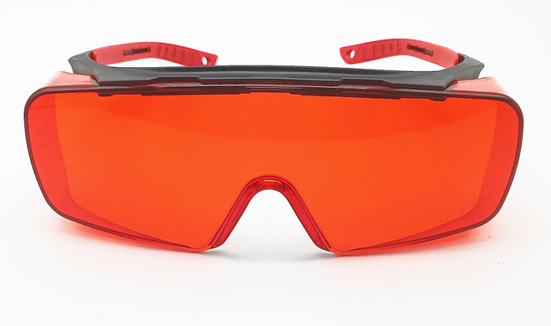
Laser Safety Glasses: Eyewear designed to protect against specific laser wavelengths.
Protective Clothing: Specialized clothing to protect against UV laser exposure and prevent skin burns.
Environmental Controls
Ventilation: Proper ventilation systems to mitigate the accumulation of ozone and other harmful byproducts.
Barriers and Curtains: Use of laser-blocking curtains or barriers to contain the laser beam within a controlled environment.
Conclusion
Lasers in the 190-540 nm range, encompassing ultraviolet and visible light, are powerful tools with diverse applications across medical, industrial, scientific, and consumer sectors. While their utility is vast, the potential hazards they pose require careful consideration and robust safety measures. Understanding the specific risks associated with each wavelength and implementing appropriate protective strategies can significantly mitigate the dangers posed to human health.