



Laser protective glasses CE certification
All products sold in the European Union must bear the CE certification mark, and it is illegal to sell products without the CE mark. For laser safety glasses, this means compliance with the laser protection requirements of the Personal Protective Equipment (PPE) Directive. In theory, manufacturers can use their own standards to show compliance with the directive, and as long as they can demonstrate that their standards are strict enough, they can always test and certify glasses to EN 207 1 (or EN 208 2) in practice.
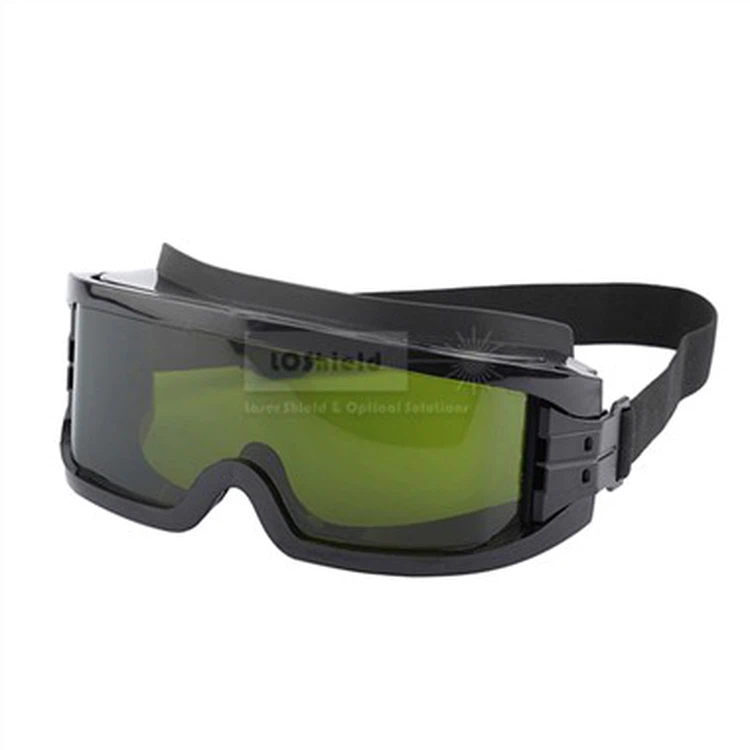
Such tests must be conducted by a government-accredited testing organization - these standards do not allow for self-certification. As a result, all laser protective glasses legally sold in Europe since 1997, when EN 207 became a uniform European standard, have been certified to EN 207 or EN 208.
Although EN 207 is 8 years old, it is still often not well understood. Therefore, we write a short explanation here to help users of laser safety glasses.
Laser protective glasses CE certification testing items:
1. Optical density specifications
Prior to EN 207, laser protective lenses were usually specified by their optical density (OD), which is still a widely used method, especially in the United States (optical density is often the only protective information available for glasses). The OD value of the glasses is the logarithm of the attenuation factor at a given wavelength. Thus, glasses that attenuate Nd: YAG laser radiation by 1,000,000 times have an OD of 6 at 1064 nm.
The method of specifying glasses using optical density involves calculating the maximum accessible emission of the laser and then dividing this by the maximum allowable exposure of the laser radiation (MPE) 3. The logarithm of this number is the minimum required outside diameter of the glasses.
2. Limitations of optical density specifications
If you consider using a high-power CO2 laser emitted at 10600 nm and OD> at the same wavelength; Some polycarbonate glasses of 6 can be graphically illustrated to illustrate the problem of this method. The Level 1 barrier-free emission limit for this wavelength is 10 mW, so this power is safe under all exposure conditions.
Therefore, we might expect glasses to protect us from the 1,000,000 x 10 mW = 10 kW produced by a CO2 laser. However, if the glasses are placed in a CO2 laser beam of several hundred watts, we find that it is quickly destroyed and has little protective effect (even a 20 W beam will immediately burn the glasses).
3. The damage threshold
Thus, we see that the optical density itself does not take into account the damage threshold of the material used to protect us from laser radiation - that is, the power or energy density (W/m2 or J/m2) that the glasses will provide. EN 207 was written to address this problem, taking into account both the optical density and the damage threshold of the glasses.

Laser protective glasses CE certification EN 207 Marking Description:
After EN 207 testing, the laser protective glasses receive various marks, which are printed on the glasses and specify the maximum power and energy density that the glasses can protect at different wavelengths. For example, glasses can be marked with:
DI 750-1200 L5
R 750-1200 L6
M 750-1200 L4
This means that in the wavelength range of 750-1200 nm, the glasses have the following grades:
D L5 I L5 R L6 M L4
D, I, R, and M represent CW or different pulse lengths, as follows:
d -- Continuous Wave (CW)
I -- Pulse length > 100 ns pulse, "long pulse"
[R -- Pulse length > 1 ns and <100 ns pulses, "Q switch"
Medium - pulse length < 1 ns pulse, "femtosecond" 4
The "L number" (L5, L6, L4, etc.) refers to the maximum power or energy density specified by the glasses. The actual value must be looked up from Table B1 in EN 207.
For the glasses markers given above, the values are:
Continuous wave - 1 MW/m2 DL5
Long pulse - 500 joules/m2 I L5
Q switch -- 5 kJ/m2 R L6
Femtosecond -- 1.5 joules/m2 M 4
Increasing the L-number by 1 will increase the power and energy density values by an order of magnitude. Note, however, that EN 207 subdivides the L numbering table into three wavelength ranges, namely 180-315 nm, 315-1400 nm, and 1400-1,000,000 nm. The relationship between L number and power/energy density shown above applies only to the 315-1400 nm wavelength region. For other wavelengths, see EN 207.
L value and optical density
In addition to being able to withstand the power of the laser beam without being destroyed, the filter must also be able to attenuate the laser beam for protection. During EN 207 testing, in order for the filter to obtain an L rating, the optical density of the filter at the specified wavelength must exceed the L value. Thus, in the example shown above, we can infer the OD> of the glasses in the wavelength range of 750-1200 nm; 6 (because of the RL6 class in this wavelength range). However, we don't have to worry about calculating MPE and accessible emission, as the maximum power/energy density has been specified for each L number.
To specify the appropriate L number for your laser, do the following:
1. Determine the minimum laser beam diameter to which a person may be exposed under reasonably foreseeable circumstances
2. Calculate the beam cross-sectional area
3. Calculate the average power density by dividing the average power of the laser by the beam area.
4. Look for the required L number from Table B1 of EN 207 and add D before this number.
For pulsed lasers, in addition:
1. Calculate the energy density by dividing the energy of each pulse by the beam area 5.
2. Look for the required L number from Table B1 of EN 207. Previously, I was used for long pulses, R for Q switches, and M for femtosecond lasers.
3. Therefore, a 532 nm laser emitting a pulse of 1 MJ, 7 ns at a frequency of 10 kHz and having a minimum accessible beam diameter of 2 mm would require glasses with the following minimum specifications:
D 532 L6 (equivalent to 10 MW/m2)
R 532 L5 (corresponding to 500 J/m2)
Note: This article is intended to help laser users, laser safety officers, and laser protection consultants better understand EN207 and is not intended to be an exhaustive study of the topic.
EN 207 Personal eye Protection. Filters and goggles to protect against laser radiation (laser goggles)
EN 208 Personal Eye Protection. Glasses for adjusting work on lasers and laser systems (laser adjusting glasses)
In fact, it includes picosecond pulses.
For "femtosecond" lasers outside the 315-1400 nm range, you will need to calculate the peak power density.
Contact information:
If you have any ideas, feel free to talk to us. No matter where our customers are and what our requirements are, we will follow our goal to provide our customers with high quality, low prices, and the best service.
 Email:info@loshield.com
 Tel:0086-18092277517
 Fax: 86-29-81323155
 Wechat:0086-18092277517


