



The Laser Rangefinder (LRF) is a marvel of modern technology, finding applications from the battlefield and the golf course to construction sites and autonomous vehicles. But have you ever wondered what makes this powerful tool tick? The performance of an LRF-its maximum range, accuracy, and reliability in tough conditions-is directly determined by the intricate dance of its internal components.
The Basic Working Principle of an LRF
Most LRFs operate on a simple yet incredibly precise principle called "Time-of-Flight" (ToF).
The instrument emits a short, invisible pulse of laser light towards a target.
This pulse travels to the target, reflects off it, and returns to the device.
An ultra-precise timer measures the exact time, t, it took for the round trip.
Using the constant speed of light, c, the distance is calculated with the formula: Distance = (c × t) / 2.
A simple analogy is shouting at a canyon and timing how long it takes to hear the echo. An LRF does this with light, millions of times per second, and with phenomenal accuracy.
The Five Core Components of an LRF Explained
Core Component 1: The Laser Transmitter Unit – The "Mouth"
This unit is responsible for creating and projecting the laser pulse.
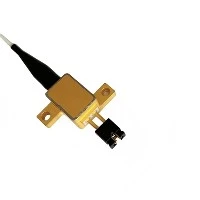
Laser Diode: The heart of the transmitter, this semiconductor generates the coherent laser light. Most LRFs use near-infrared wavelengths (e.g., 905nm or the eye-safer 1550nm) for better atmospheric transmission and invisibility.
Drive Circuit: This provides a powerful, precise, and instantaneous electrical pulse to the laser diode, ensuring a consistent and sharp laser burst.
Transmitter Optics (Collimating Lens): This lens system takes the naturally divergent light from the diode and shapes it into a tight, parallel beam. This concentrates the energy, allowing it to travel long distances with minimal spread.
Performance Impact: The laser's peak power and beam quality directly determine the maximum range and the ability to range small, distant objects.
Core Component 2: The Optical Receiver Unit – The "Eyes"
While the transmitter sends the signal, the receiver's job is to catch the faint returning echo.
Objective Lens (Receiver Lens): A large-aperture lens that acts like a "light bucket," gathering as much of the reflected laser light as possible.
Narrowband Optical Filter: A crucial component placed in front of the detector. It is tuned to allow only the specific wavelength of the laser (e.g., 905nm) to pass through, effectively blocking out sunlight, streetlights, and other ambient noise.
Photodetector (Avalanche Photodiode - APD): This is where the magic of conversion happens. An APD converts the faint incoming light pulse into a weak electrical signal. Its key advantage is "avalanche" gain-it internally amplifies the signal, making it exceptionally sensitive to very low light levels.
Performance Impact: The size of the objective lens and the sensitivity of the APD are critical for achieving long range. The filter's quality dictates performance in bright, sunny conditions.

Core Component 3: The High-Precision Timing Unit – The "Stopwatch"
This is the brain behind the accuracy. Measuring the time-of-flight requires incredible precision.
Time-to-Digital Converter (TDC): This specialized integrated circuit is the high-tech stopwatch. It measures the interval between the launch of the laser pulse and the detection of the return signal with resolutions in picoseconds or nanoseconds.
Performance Impact: The TDC's precision is the direct determinant of ranging accuracy. A timing error of just one nanosecond translates to a distance error of about 15 centimeters.
Core Component 4: The Control & Signal Processing Unit – The "Brain"
This unit orchestrates the entire operation and makes sense of the raw data.
Microcontroller / Digital Signal Processor (DSP): The central processing unit of the LRF.
Signal Processing Circuitry: This amplifies, filters, and shapes the weak and noisy electrical signal from the APD.
Key Tasks:
Sending the trigger command to the laser driver and simultaneously starting the TDC.
Analyzing the processed signal to definitively identify the true laser return echo amidst noise.
Filtering out false triggers (e.g., from rain, dust, or birds).
Commanding the TDC to stop upon valid signal detection and performing the final distance calculation.
Core Component 5: The Display & User Interface Unit – The "Face"
This is how the user interacts with the device and receives the information.
Display: An OLED or LCD screen that shows the measured distance, mode, battery status, and other data.
Eyepiece / Viewing System: In monocular-style LRFs, this is a magnifying optical system used to aim at the target.
Control Buttons: For power, mode selection, and initiating measurements.
Performance Impact: This unit defines the user experience through display clarity, refresh rate, and ease of use. Modern LRFs often integrate ballistics solvers, Bluetooth, and other features here.
How the Core Components Work Together
The seamless operation of an LRF is a symphony of coordinated actions:
Initiate: The user presses the button. The Control Unit sends a command.
Emit & Start Clock: The Drive Circuit fires the Laser Diode, sending a pulse through the Transmitter Optics. Simultaneously, the Control Unit triggers the TDC to start timing.
Receive: The reflected pulse is collected by the Objective Lens, filtered by the Optical Filter, and converted into an electrical signal by the APD.
Process & Detect: The Signal Processing circuitry cleans and amplifies the signal. Once a valid return is identified, it alerts the Control Unit.
Stop Clock & Calculate: The Control Unit commands the TDC to stop. It reads the time t, and the microcontroller calculates the distance.
Display: The result is sent to the Display Unit for the user to see.
Conclusion and Future Outlook
In summary, the five core components form a complete system: the Laser Transmitter is the spear, the Optical Receiver is the shield, the Timing Unit is the ruler, the Control Unit is the brain, and the Display is the window. Together, they transform a fundamental physical principle into a powerful, portable tool.
LRF Technology Trends
Chip-Scale Integration: Efforts are underway to integrate the laser, detector, and even TDC onto a single microchip, leading to smaller, cheaper, and lower-power devices.
Sensor Fusion: LRFs are increasingly being combined with GPS, inertial measurement units (IMUs), cameras, and thermal imagers to create rich, multi-dimensional data systems.
Enhanced Intelligence: The integration of AI will enable features like automatic target recognition, tracking, and classification, making LRFs smarter and more autonomous than ever before.
Contact information:
If you have any ideas, feel free to talk to us. No matter where our customers are and what our requirements are, we will follow our goal to provide our customers with high quality, low prices, and the best service.
 Email:info@loshield.com; laser@loshield.com
 Tel:0086-18092277517; 0086-17392801246
 Fax: 86-29-81323155
 Wechat:0086-18092277517; 0086-17392801246


