


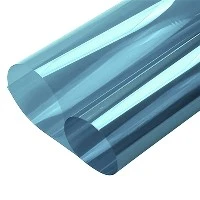

1064nm wavelength laser is widely used in industrial cutting, medical surgery, scientific research and other fields due to its high energy density and precise focusing ability. With the continuous increase of laser power (some industrial equipment has reached more than 50kW), traditional protective materials can no longer meet safety requirements. OD10+ blue laser safety window film (optical density ≥ 10) is a new generation of protection solution that can achieve 10¹⁰ times energy attenuation for 1064nm laser (that is, the energy allowed to pass is only one billionth of the original energy), becoming the core safety barrier in high-risk scenarios.
1. Core Characteristics: Optical and Protective Properties
1.1 Wavelength-Specific Protection
1064nm Laser Attenuation: OD10+ rating (10¹⁰ attenuation), capable of blocking continuous lasers up to 100kW or single-pulse energy of 1J.
Stray Light Filtering: Visible light transmittance (400-700nm) ≥65%, with >99% filtering efficiency for infrared stray light (e.g., 1200-1600nm).
1.2 Key Physical Parameters
| Property | Specification |
|---|---|
| Thickness | 0.1-0.5mm |
| Visible Light Transmittance | 60%-75% |
| Temperature Resistance | Short-term tolerance ≤120℃ |
| Tensile Strength | ≥55MPa |
1.3 Environmental Adaptability
Weather Resistance: Passes 72-hour salt spray test (5% NaCl) and 48-hour damp heat test (85℃/85% RH).
UV Stability: Transmittance degradation <3% after 1000 hours of UV exposure.
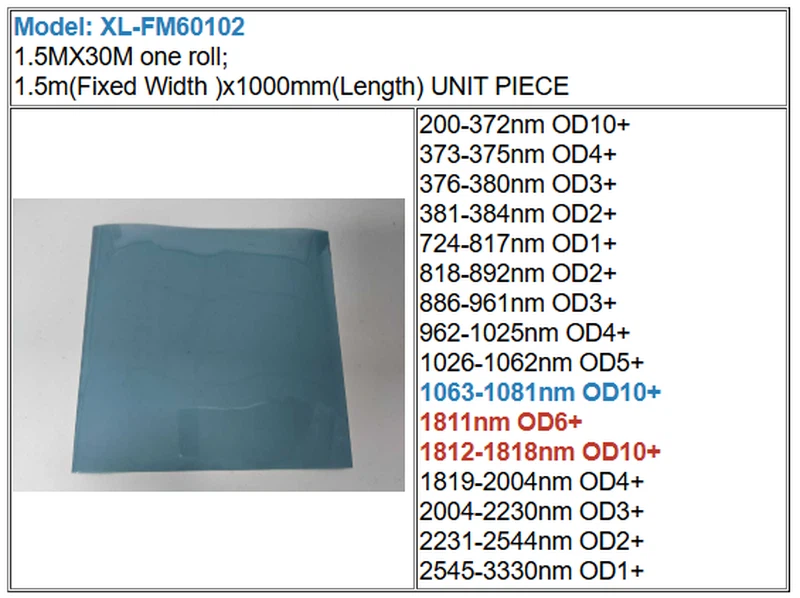
2. Protection Mechanism: Material-Centric Design
2.1 Enhanced Intrinsic Absorption
Molecular Chain Modification: Aligns PET molecular chains via directional stretching, increasing intrinsic absorption at 1064nm to 70%-80%.
Defect Utilization: Leverages controlled micro-defects (e.g., grain boundaries, vacancies) to dissipate laser energy through phonon scattering.
2.2 Surface Functionalization
Anti-Reflective Coating: Reduces visible light reflection (<1%) while enhancing 1064nm absorption.
Thermal Diffusion Layer: A high-thermal-conductivity non-metallic coating (thermal conductivity >5W/m·K) prevents localized heat buildup.
2.3 Dynamic Response Features
Nonlinear Absorption: Automatically increases absorption rate under high power density (>10kW/cm²) for adaptive protection.
Thermally Induced Phase Transition: Generates micron-level scattering particles at >120℃ to block laser penetration.
3. Application Scenarios and Compatibility
3.1 Industrial Manufacturing
High-Power Laser Processing: Compatible with 50-100kW fiber laser cutting/welding systems, shielding against scattered light and metal vapor.
Automated Production Lines: Directly adheres to equipment observation windows, supporting real-time monitoring for robotic vision systems.
3.2 Medical and Scientific Research
Laser Surgical Devices: Used in ophthalmic YAG lasers and dermatology equipment, balancing safety with medical-grade visual clarity.
Laboratory Safety: Cost-effective temporary shielding for femtosecond laser experiment cabins.
3.3 Special Environments
High-Temperature Workshops: Tolerates ambient temperatures up to 80℃ (with forced-air cooling).
Flexible Applications: Bendable with a radius ≤10mm, suitable for curved surfaces or temporary barriers.

4. Safety Standards and Operational Guidelines
4.1 Installation and Testing
Sealing Requirements: Edges sealed with high-temperature silicone (pressure differential ≤5Pa per ISO 6780).
Performance Verification:
Laser Power Meter Testing: Confirms radiation intensity <0.1μW/cm² at 30cm from the window under maximum power.
Transmittance Calibration: Uses D65 standard light source with ≤±3% error.
4.2 Maintenance Protocols
Cleaning Procedures: Monthly cleaning with ultrapure water or lint-free cloths; organic solvents prohibited.
Lifespan Monitoring: Quarterly OD value checks; replacement mandatory if annual attenuation exceeds 2%.
5. Advantages and Limitations
5.1 Key Advantages
Eco-Friendly Compliance: Lead-free, halogen-free, and >90% recyclable (meets RoHS/REACH directives).
Cost Efficiency: Mass production costs 50%-70% lower than ceramic-based alternatives.
Ergonomic Design: Blue coating reduces infrared glare, improving visual comfort by 40%.
5.2 Current Limitations
Power Density Threshold: Continuous laser power density ≤50kW/cm² (short-term tolerance ≤100kW/cm²).
Transmittance Trade-off: Requires auxiliary lighting due to lower visible light transmittance vs. standard glass.
Conclusion
The 1064nm OD10+ blue laser safety window film leverages material science advancements to deliver robust protection without complex structural designs. By optimizing PET's intrinsic properties and surface functionality, this solution balances safety, cost, and environmental sustainability. As laser technology evolves, such innovations will play a pivotal role in enabling safer high-power applications across industries.