



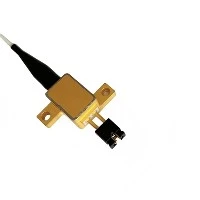
Near-infrared laser refers to a laser with a wavelength in the range of 700 nanometers to 1400 nanometers. This band is between visible light and mid-infrared, and has unique physical properties and wide application value. This type of laser has good tissue penetration and can reach a penetration depth of several millimeters or even centimeters in biological tissues; it is relatively far from the absorption peak of water, which can reduce nonspecific thermal damage; the transmission loss in the atmosphere is small, which is suitable for long-distance applications.
1. Classification of YAG lasers
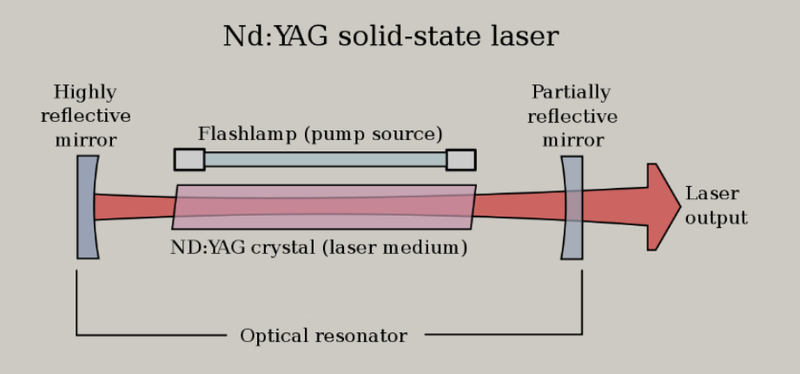
Nd:YAG lasers are the most important type of solid lasers in the field of near-infrared lasers, and usually output near-infrared lasers with a wavelength of 1064nm. According to the working mode and performance characteristics, they can be divided into the following main types:
- Continuous wave (CW) Nd:YAG lasers can provide stable continuous laser output, with output power ranging from a few watts to several kilowatts, and are mainly used in material processing, medical surgery and scientific research. Its advantages are stable output and high beam quality.
- Q-switched Nd:YAG lasers can generate short pulses at the nanosecond level through Q-switching technology, with peak power reaching megawatts or even higher. Widely used in laser radar, laser ranging, laser marking and medical beauty.
- Mode-locked Nd:YAG lasers can generate ultrashort pulses of picoseconds or even femtoseconds, and have important applications in ultrafast spectroscopy, micro-nano processing and biomedical imaging.
- Frequency-doubled Nd:YAG lasers convert 1064nm near-infrared light into output of shorter wavelengths through nonlinear crystals, expanding the application range of YAG lasers.
2. Application scenarios
Near-infrared lasers have shown wide application value in many fields.
- In the medical field, Nd:YAG lasers are widely used in various surgical treatments and cosmetic applications, such as retinal photocoagulation, prostate hyperplasia treatment and skin beauty.
- In the field of industrial manufacturing, near-infrared lasers are mainly used for material processing and treatment. High-power continuous Nd:YAG lasers are used for metal welding and cutting, while Q-switched Nd:YAG lasers are widely used in precision marking, micro-hole processing and surface treatment.
- The scientific research field is an important driving force for near-infrared laser technology. Mode-locked Nd:YAG laser systems provide a powerful tool for studying ultrafast phenomena and are widely used in nonlinear optics, quantum optics, and ultrafast spectroscopy.
- Military and security fields are also important application scenarios for near-infrared lasers. Laser rangefinders and laser target indicators are key components of modern weapons and equipment; laser radar systems play an important role in battlefield reconnaissance and environmental monitoring.

3. Possible hazards caused by near-infrared lasers
Near-infrared lasers may cause a variety of hazards to the human body and equipment during use.
- Eye damage is the most serious and common laser injury, because near-infrared lasers can penetrate the cornea and lens and act directly on the retina. Even with medium-power lasers, short-term exposure may cause retinal burns, hemorrhage, and even permanent vision loss.
- Skin damage is another common laser hazard. High-power near-infrared lasers can cause skin burns, manifested as erythema, blisters, and even carbonization. Long-term and repeated exposure to low-power near-infrared lasers may cause chronic skin lesions.
- The risk of fire and explosion caused by lasers cannot be ignored. High-power near-infrared laser beams can ignite many common materials. In oxygen-rich environments or places with flammable and explosive gases, lasers may become ignition sources and cause serious accidents.
- Electrical hazards are another type of risk associated with laser systems. High-power lasers usually require a high-voltage power supply of several thousand volts, and improper operation may cause electric shock accidents. The capacitors of the laser system may still store dangerous amounts of electricity even after the power is turned off.

4. Selection of laser protective equipment
In view of the potential hazards of near-infrared lasers, it is crucial to choose the right protective equipment.
- Laser protective glasses are the most basic and most important personal protective equipment, and their selection needs to consider multiple technical parameters. For 1064nm Nd:YAG lasers, the optical density value of protective glasses should be determined based on the maximum possible exposure to laser power.
- Laser protective masks and protective clothing provide additional protection for the face and body. Protective masks are usually made of special materials that can resist the damage of scattered lasers and reflected lasers. Laser protective clothing is mainly used for high-risk operations in the medical and scientific research fields. It is usually made of specially treated materials that can effectively absorb and disperse laser energy.
- Engineering control measures are an important part of laser protection. The laser safety interlock system can immediately cut off the laser output when the protective cover is accidentally opened. The laser beam containment system can minimize the propagation path of the laser in the air and reduce the risk of accidental exposure.
- Environmental monitoring and personal dose monitoring equipment are becoming increasingly important in modern laser safety systems. Laser power meters and energy meters can monitor the laser radiation level in the working area in real time; laser safety sensors can detect the intensity of reflected and scattered lasers and issue alarms in time.

5. Summary
Near-infrared laser technology has penetrated into many key fields such as industry, medicine, scientific research and military, showing great application value and development potential. However, with the widespread application comes the safety challenges that cannot be ignored. The potential harm of near-infrared lasers to the eyes and skin, fire and electrical risks, etc., all require us to attach great importance to laser safety protection.