



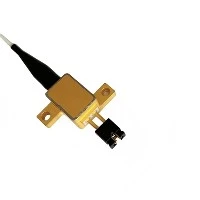
Laser Diode (LD) is an electro-optical conversion device based on semiconductor PN junction, which generates highly directional and highly coherent laser through the principle of stimulated radiation. Its basic working principle is that under forward bias, electrons and holes recombine in the activation region to release photons, which are amplified by the optical resonant cavity to form laser output. Laser diodes are widely used in optical communications, laser printing, medical equipment (such as laser surgery), barcode scanning and industrial processing. It is very important to study its pin distribution, which can not only ensure the correct connection with the drive circuit and ensure stable operation, but also avoid device damage or performance degradation (such as abnormal optical power, shortened life, etc.) caused by misconnection of pins.
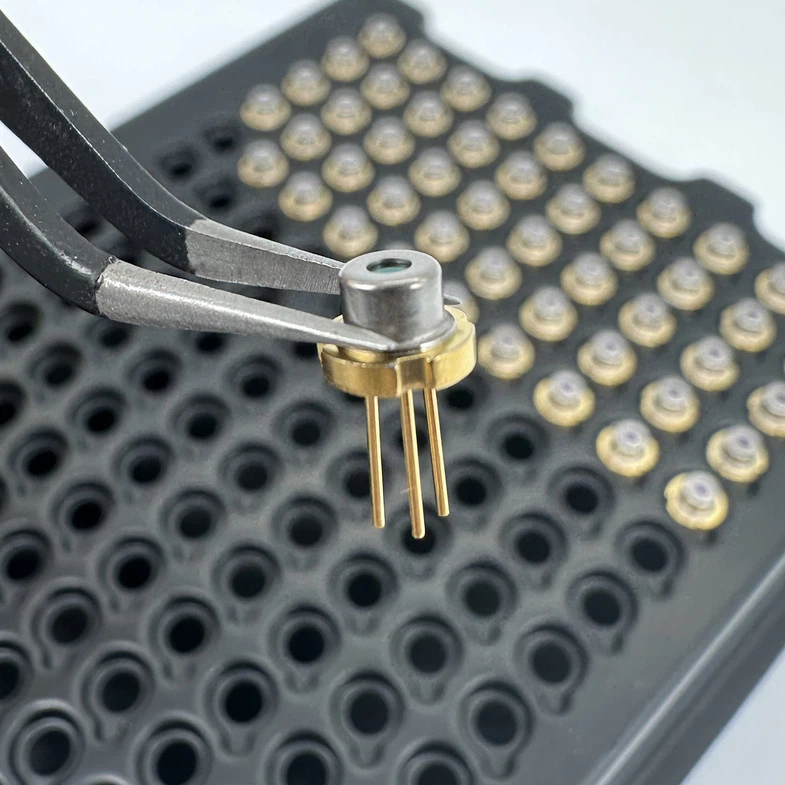
Basic structure of laser diode (LD)
1. Core components
①Semiconductor PN junction:
The core of laser diode is PN junction composed of doped semiconductor materials (such as GaAs, InP, etc.). Under forward bias voltage, electrons and holes recombine in the junction area, releasing photons to form stimulated radiation.
②Optical resonant cavity:
Constituted by cleavage surface or coated reflector, so that photons are reflected back and forth in the cavity and amplified, and finally form coherent laser output.
2. Package type
Common TO-Can package (transistor outline package):
Metal shell with glass window, commonly used in low-power laser diodes (such as laser pen, CD/DVD laser head). Typical number of pins: 3 pins (anode, cathode, monitoring PD) or 5 pins (with TEC control).
3. Relationship between the number of pins and package
①3 pins (most common):
Anode (LD+), cathode (LD-), monitoring photodiode (PD).
②5 pins or more:
Add thermoelectric cooler (TEC) control pins (TEC+, TEC-) for temperature stabilization of high-power lasers.
Some multimode lasers may include additional modulation or enable pins.
Typical pin layout and functions of TO-Can packaged laser diodes
1. Pin distribution diagram

2. Detailed explanation of each pin function
① Anode (Anode, LD+)
Function: The positive pole of the laser diode, connected to the current input terminal of the drive circuit.
Electrical characteristics: Constant current drive is required, and the typical operating current is tens of mA to several A (depending on the power).
Note: Reverse connection may immediately damage the device.
② Cathode (Cathode, LD-)
Function: The negative pole of the laser diode, connected to the ground terminal or current loop of the drive circuit.
Electrical characteristics: Usually connected to the shell (TO-Can package shell needs to be grounded for heat dissipation).
③ Monitor photodiode (Monitor PD)
Function: Real-time detection of laser output power, feedback to the drive circuit to achieve closed-loop control (such as APC mode).
Pin configuration:
PD cathode (pin 1): connected to the current-voltage conversion circuit (such as a transimpedance amplifier).
PD anode (usually shares pin 2 or shell with LD cathode).
Note: Failure to connect the monitor PD may cause unstable output power or overload.
Correctly understand and apply its pin functions
1. Ensure that the circuit is connected correctly
Avoid misconnection and damage to the device:
Laser diodes are sensitive components. Reverse pin connection (such as reverse connection of anode and cathode) may cause instantaneous overcurrent and burnout.
Drive circuit matching:
The pin definitions of different packages (such as TO-Can, SMD) may be different. It is necessary to clarify the pin functions (such as LD anode, monitoring PD cathode) to design a matching constant current drive circuit.
2. Achieve stable light output
The role of monitoring photodiode (PD):
The monitoring PD is used to feedback optical power. If it is not connected correctly (such as the PD cathode is not connected to the feedback loop), the laser may cause output power fluctuations or overload due to open-loop control.
Thermoelectric cooler (TEC) pin:
High-power lasers require TEC temperature control. If the TEC pin is not connected to the temperature control circuit, it may cause wavelength drift or efficiency reduction due to overheating.
3. Avoid common problems in debugging
Typical failure cases:
Monitoring PD is not connected → laser power is out of control → accelerated aging.
TEC pins are floating → temperature rises → wavelength shifts (especially in DWDM systems).
Quick troubleshooting:
Being familiar with the pin distribution can quickly locate the problem (such as using a multimeter to measure whether the voltage drop on the LD/PD pin is normal).

Studying the pin distribution of the laser diode is not only a guarantee of correct connection, but also the key to optimizing performance, extending life and improving system stability. Ignoring this link may lead to hardware damage, optical performance degradation or increased debugging costs.
Recommended operation process:
1. Check the datasheet → 2. Verify the pin identification → 3. Design the matching circuit → 4. Monitor key parameters (current, temperature, optical power) during testing.
JTBYShield We can provide laser products with a wavelength range of 375nm~1920nm. Product types include: single-mode laser diodes, multi-mode laser diodes, fiber-coupled laser modules, fiber-coupled laser systems, collimated laser modules, RGB white light lasers, etc.
We can be customized according to customer requirements (wavelength/power/package/fiber type/fiber core diameter, etc.). If you have any needs, please contact us!

Contact information:
If you have any ideas, feel free to talk to us. No matter where our customers are and what our requirements are, we will follow our goal to provide our customers with high quality, low prices, and the best service.
 Email:info@loshield.com
 Tel:0086-18092277517
 Fax: 86-29-81323155
 Wechat:0086-18092277517


