



Laser diodes are critical components in applications ranging from fiber-optic communications to medical devices and industrial cutting systems. The choice of packaging technology-whether TO-Can (Transistor Outline) or 9-Pin (e.g., Butterfly/DIL)-directly impacts performance, thermal management, and cost. This article provides a technical comparison to guide selection based on power, integration needs, and target applications.

2. TO-Can Package: Structure and Characteristics
2.1 Design Overview
Physical Structure: Cylindrical metal housing (typically TO-18 or TO-56), hermetic sealing, and a glass window for beam emission.
Pin Configuration: Commonly 3-pin or 5-pin (anode/cathode for the laser diode, optional monitor photodiode).
2.2 Key Advantages
Cost-Effectiveness: Mature manufacturing process with low unit cost (e.g., $5–$20 per unit).
Compact Size: Suitable for space-constrained designs (e.g., laser pointers, barcode scanners).
Moderate Thermal Performance: Metal casing dissipates heat adequately for low-to-medium power (<500 mW).
2.3 Limitations
Limited Functionality: Fewer pins restrict integration of auxiliary features (e.g., no built-in TEC).
Power Constraints: Unsuitable for high-power applications due to thermal bottlenecks.
3. 9-Pin Package: Structure and Characteristics
3.1 Design Overview
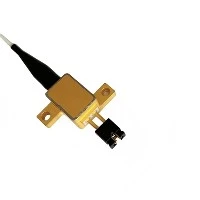
Physical Structure: Rectangular housing (Butterfly or DIP-style) with 9+ pins for multifunctionality.
Integrated Components:
Thermoelectric Cooler (TEC): Actively stabilizes temperature for wavelength consistency.
Monitor Photodiode (PD): Provides real-time optical feedback.
Thermal Sensor: Enables closed-loop temperature control.
3.2 Key Advantages
High-Power Support: Robust thermal management (TEC + heatsinking) for powers >1 W.
High-Speed Modulation: Low-inductance pins suit telecom applications (e.g., 10G/100G transceivers).
All-in-One Integration: Eliminates external driver complexity for TEC/PD.
3.3 Limitations
Higher Cost: Complex assembly raises prices (e.g., $50–$200 per unit).
Larger Footprint: Not ideal for miniaturized devices.
4. Critical Parameter Comparison
| Parameter | TO-Can | 9-Pin |
|---|---|---|
| Pin Count | 3–5 pins | 9+ pins |
| Thermal Management | Passive (metal casing) | Active (TEC integrated) |
| Power Handling | <500 mW | >1 W |
| Additional Features | Basic (LD + PD) | LD + PD + TEC + sensor |
| Cost | Low ($5–$20) | High ($50–$200) |
| Typical Applications | Consumer electronics, sensors | Telecom, medical lasers |
5. Application Scenarios
5.1 TO-Can Dominates When:
Budget is tight: Mass-produced devices (e.g., DVD players).
Size matters: Wearable sensors or handheld tools.
Environment is stable: No extreme temperature fluctuations.
5.2 9-Pin Excels When:
Precision is critical: Fiber-optic pumps requiring wavelength stability.
High power is needed: Industrial cutting/engraving systems.
High-speed signals: Data center transceivers with GHz modulation.
6. Selection Guidelines
6.1 Decision Factors
Power Requirements: TO-Can for <500 mW; 9-Pin for >1 W.
Integration Needs: 9-Pin simplifies designs needing TEC/feedback.
Cost Sensitivity: TO-Can wins for high-volume, low-margin products.
6.2 Emerging Trends
TO-Can Upgrades: Hybrid designs with improved heat dissipation.
9-Pin Miniaturization: Compact variants for portable medical devices.
TO-Can packages offer a cost-effective, compact solution for low-power applications, while 9-Pin variants deliver superior performance for high-power, high-speed systems. The choice hinges on power demands, integration complexity, and budget constraints. As packaging technologies evolve, the gap between these two formats may narrow, but their core trade-offs will remain relevant for years to come.
Contact information:
If you have any ideas, feel free to talk to us. No matter where our customers are and what our requirements are, we will follow our goal to provide our customers with high quality, low prices, and the best service.
 Email:info@loshield.com
 Tel:0086-18092277517
 Fax: 86-29-81323155
 Wechat:0086-18092277517


