




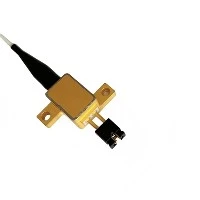
Converting laser diodes into tunable semiconductor lasers significantly improves the accuracy and stability of measurement systems through precise wavelength selection and control. This is particularly important for high-precision applications such as spectroscopic analysis, precision measurements and scientific research.
Laser Diodes
Laser diodes are well-established subcomponents in various consumer products, such as laser pointers, barcode scanners or CD/DVD/Blu-ray drives. Their success stems from their compactness, ease of operation, high conversion efficiency and high cost-performance. However, the emission spectrum of bare laser diodes is broad and the lasing wavelength is not well defined.
Typically, the two end faces of a semiconductor laser tube form a resonant cavity and determine the (longitudinal) lasing mode. The broad gain curve of the semiconductor supports multiple modes simultaneously, each with a different frequency. Even diodes with a single longitudinal mode can exhibit mode hopping and spectrally unstable output beams at small changes in chip temperature or driver current.
Tunable single-frequency semiconductor lasers consist of a laser diode and a frequency-selective module, such as a grating, for laser frequency selection and tuning. We can provide wavelengths from 190 nm to 4000 nm, with narrow linewidth and tunability - up to 120 nm mode-hop-free tunability in some systems. These lasers can be amplified with standalone amplifiers or integrated in complete master oscillator power amplifiers (MOPAs) up to 4 W. Most laser amplifier systems use tapered amplifiers. Wider spectral coverage can be achieved with frequency-doubled lasers - from 190 nm to 680 nm, with powers up to 1 W. The most important features of all these laser systems are low noise (low RIN noise and narrow linewidth) and low drift. These excellent characteristics depend on extremely good laser driver circuits. To achieve higher laser stability, the linewidth can be narrowed to 1 Hz by using different types of laser frequency-locking modules, which can be controlled by convenient digital circuits.
Mode Selection
By introducing frequency selective feedback into the laser cavity, excellent semiconductor laser properties such as narrow emission linewidth, large coherence length, precise wavelength selection and tuning or stabilization of the emission frequency can be achieved. JTBYShield offers two tunable single frequency semiconductor lasers. Both utilize grating structures to select and control the emission frequency. One is a grating stabilized external cavity semiconductor laser (ECDL).
It contains an optical grating mounted in front of the laser diode as the first resonant cavity face, while the second resonant cavity face is the back of the diode, the laser tube and the feedback element form the "external resonant cavity".

Schematic diagram of external cavity semiconductor laser
Another approach is laser diodes with gratings built into the semiconductor itself: distributed feedback (DFB) and distributed Bragg reflector (DBR) semiconductor laser tubes.
The grating filter, the semiconductor gain curve, the internal semiconductor laser tube mode, and (if applicable) the external cavity mode determine the lasing mode. Precise temperature and current control and proper matching of the components are necessary for stable single-mode operation.

Mode selection in external cavity diode lasers

Schematic diagram of external cavity semiconductor laser

DBR Laser Diode Schematic
Wavelength Tuning
DFB and DBR diodes can be wavelength tuned by adjusting the semiconductor laser tube current and/or temperature. They can be tuned by about 1-2 nm without any mode hopping.
To change the wavelength of the ECDL, the spectral response of the mode-selective device needs to be changed, for example by changing the angle of incidence on the grating. Operating in the mode where the total gain is maximum, this causes the laser to jump to another longitudinal mode and emit at a new wavelength.
Fine tuning of the lasing wavelength is achieved by changing the length of the external cavity, which changes the current longitudinal mode supported by the single-mode operation of the laser.
Mode-hop-free tuning

DL Pro Laser
The large mode-hop-free tuning range is determined by the coordinated tuning of multiple factors. Our DL pro lasers achieve wide frequency hopping free tuning by simultaneously changing the grating angle, external cavity length and semiconductor laser tube current to achieve optimal synchronization. The mode-hop-free tuning of DL pro is typically 20-50 GHz, with a rugged and quasi-monomeric structure to obtain stable working conditions.
Application fields
1. Application in the field of communication
Tunable semiconductor lasers play a key role in optical communication systems, especially in wavelength division multiplexing (WDM) and dense wavelength division multiplexing (DWDM) systems. Its wavelength tuning capability enables it to flexibly adapt to the needs of different channels, improving the transmission capacity and efficiency of the network.
2. Application in the medical field
In the medical field, tunable semiconductor lasers are widely used in high-precision surgery, laser therapy, and biomedical imaging. Its precise wavelength control and high stability make it an ideal choice for applications such as ophthalmic surgery, dermatology treatment, and cancer treatment.
3. Application in scientific research
Tunable semiconductor lasers have important applications in scientific research, such as spectral analysis, precision measurement, and quantum optics research. Its narrow linewidth and high side mode suppression ratio make it excel in high-resolution spectral measurement and low-noise laser source requirements.
4. High-precision measurement
The application of tunable semiconductor lasers in high-precision measurement includes distance measurement, speed measurement, and strain measurement. Its high coherence and narrow linewidth characteristics enable interferometric measurement systems to achieve extremely high measurement accuracy and stability.
5. Spectral analysis
When tunable semiconductor lasers are used for spectral analysis, they can provide high-resolution and high-sensitivity spectral data. Their applications in environmental monitoring, chemical analysis, and biosensing help detect trace components and analyze complex samples.
6. Optical frequency scanning interferometry
The application of tunable semiconductor lasers in optical frequency scanning interferometry achieves absolute distance measurement of the target by changing the laser frequency. Its high precision and long coherence length make it widely used in terrain mapping and space exploration.
Converting laser diodes into tunable semiconductor lasers introduces frequency selective feedback mechanisms to achieve mode selection, uses grating structures (such as external cavity gratings and built-in grating DFB/DBR) to control wavelength tuning, and optimizes the stability of laser output and the mode-hop-free tuning range through synchronous tuning methods. These innovations not only improve the accuracy and stability of laser systems, but also expand their application potential in high-precision measurement, spectral analysis, and optical frequency scanning interferometry ranging.
JTBYShield provides high-performance single-frequency tunable semiconductor lasers that can be used in applications such as laser spectroscopy, biophotonics, fundamental quantum physics, and semiconductor detection/metrology. If you are interested, please feel free to contact us for more product details.
Contact information:
If you have any ideas, feel free to talk to us. No matter where our customers are and what our requirements are, we will follow our goal to provide our customers with high quality, low prices, and the best service.
 Email:info@loshield.com
 Tel:0086-18092277517
 Fax: 86-29-81323155
 Wechat:0086-18092277517


