



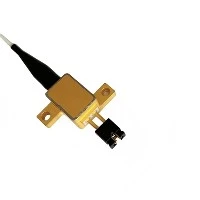
Solid-State Lasers is a laser whose light-emitting medium is a solid material, usually a crystal or glass, doped with rare earth or transition metal ions, rather than a liquid or gas.
Solid-state lasers emit laser light over a wide range of wavelengths, from ultraviolet (UV) to infrared (IR), depending on the choice of dopant and the composition of the crystal or glass. The output power can range from milliwatts (mW) to several watts (W), or even higher, depending on the specific laser design, gain medium, and pumping mechanism.

Solid-state lasers are mainly composed of two parts: a solid host material and active ions doped in the host material. Active ions need to have specific properties, such as sharp fluorescence lines, broad absorption bands, and high quantum efficiency at the desired wavelength. On the other hand, the host material should have properties such as strength, fracture resistance, high thermal conductivity, and optical quality.
After doping with rare earth ions, both glass and crystalline materials exhibit these desired properties. Suitable host materials include silicate glass, phosphate glass, and various crystalline materials such as garnet, aluminate, metal oxide, fluoride, molybdate, tungstate, etc. Commonly used active ions include rare earth ions such as neodymium, erbium, and holmium, as well as transition metals such as chromium, titanium, and nickel.
Some famous solid-state lasers include ruby lasers, Nd:YAG lasers, Nd:glass lasers, Nd:Cr:GSGG lasers, Er:glass lasers, alexandrite lasers, and titanium:sapphire lasers.
Solid-state lasers can work in either continuous wave (CW) mode, which produces continuous laser output, or pulsed mode, which produces short pulses of high-power laser light.
Construction of solid-state lasers

To make a solid-state laser, a laser rod needs to be installed near an arc lamp or flash lamp. The lamp tube is connected to a power source. The laser rod and the lamp tube are arranged in parallel, surrounded by a reflector. At both ends of the laser cavity, a high reflective mirror and an output coupler are placed. To remove excess heat, the laser is cooled using a circulation system, usually using cooling water or a glycol mixture.
Solid-state laser energy diagram
The active medium used by solid-state lasers is a solid material. Generally, all solid-state materials are optically pumped, that is, a light source is used as an energy source and applied to the gain medium. After absorbing the pump energy, the electrons in the gain medium are excited to a higher energy level. In the excited state, some electrons will jump from a higher energy level to a specific transferable energy level.

Compared with other excited states, the lifetime of the transient state is longer, so it can store and accumulate energy. When the electron in the transient state changes back to the ground state, a photon with a specific energy and wavelength is released. This process is called stimulated emission and produces coherent light.
The generated photons are reflected multiple times between mirrors or other reflective elements in the laser cavity. This feedback mechanism amplifies the stimulated emission and produces an intense laser beam. The amplified partial beam escapes through one of the partial reflectors to form the laser output.
The output beam usually has a narrow linewidth, which is characterized by a specific wavelength related to the energy difference between the transient state and the ground state.
Advantages of solid-state lasers:
1. Solid-state lasers generally do not experience material loss compared to gas lasers because the laser medium is in a solid state. The active medium in a solid-state laser, such as a crystal or glass, maintains its composition and does not consume or deplete during operation.
3. Solid-state lasers can produce both continuous and pulsed output.
4. Their construction is relatively simple.
Disadvantages of solid-state lasers:
1. Solid-state lasers are less efficient in converting input energy into laser output.
2. The divergence of the laser beam is not constant and can vary between 1 milliradian and 20 milliradian.
3. Power loss may occur when the laser rod is overheated.
Applications of solid-state lasers:
Solid-state lasers have a wide range of applications in various fields. In addition to spectroscopy and telecommunications, applications of solid-state lasers include
Material processing: Solid-state lasers are widely used for cutting, drilling, welding, and engraving various materials such as metals, plastics, ceramics, and composites. They are highly accurate and can handle both macro and micro processing tasks.
Medical and Biomedical: These lasers are used in medical procedures such as laser surgery, dermatology (e.g. tattoo removal), ophthalmology (e.g. vision correction), dentistry, and cosmetics. They can precisely target and ablate tissue with minimal damage to surrounding areas.
Scientific Research: Important tools for scientific research, including spectroscopy, fluorescence imaging, particle acceleration, and the study of ultrafast phenomena. They are able to provide precisely controllable light sources for studying materials and fundamental physical and chemical processes.
Defense and Security: These lasers are used in defense and security applications, including laser target designators, range finding, directed energy weapons, and laser countermeasures. They provide precise and powerful light sources for military, aerospace, and security uses.
Telecommunications: Solid-state lasers play a vital role in fiber-optic communication systems, acting as optical amplifiers and light sources to transmit signals over long distances at high data rates.
Contact information:
If you have any ideas, feel free to talk to us. No matter where our customers are and what our requirements are, we will follow our goal to provide our customers with high quality, low prices, and the best service.
 Email:info@loshield.com
 Tel:0086-18092277517
 Fax: 86-29-81323155
 Wechat:0086-18092277517


