



There are many types of optical fibers, and the functions and performance required vary according to different uses. But for cable and communications fiber optics, the design and manufacturing principles are basically the same, such as:
① small loss;
② It has a certain bandwidth and small dispersion;
③ Easy wiring;
(4) easy to form a series;
(5) High reliability;
⑥ Manufacturing is simple;
⑦ Cheap and so on.

The classification of optical fiber is mainly summarized from the working wavelength, refractive index distribution, transmission mode, raw materials and manufacturing methods. Here are some examples of various classifications。
(1) Working wavelength: ultraviolet fiber, observant fiber, near-infrared fiber, infrared fiber (0.85μm, 1.3μm, 1.55μm).
(2) refractive index distribution: step (SI) fiber, near step fiber, gradient (GI) fiber, other (such as triangle, W, concave, etc.).
(3) Transmission mode: single-mode fiber (including polarized holding fiber, non-polarized holding fiber), multi-mode fiber.
(4) Raw materials: quartz fiber, multi-component glass fiber, plastic fiber, composite fiber (such as plastic cladding, liquid fiber core, etc.), infrared materials, etc. The coating material can also be divided into inorganic materials (carbon, etc.), metal materials (copper, nickel, etc.), and plastic.
(5) Manufacturing method: the pre-molding includes vapor-phase axial deposition (VAD), chemical vapor phase deposition (CVD), etc., and the drawing method includes Rod in a tube and double crucible method.
Quartz Fiber
Silica Fiber takes silica (SiO2) as the main raw material and controls the refractive index distribution of the core and cladding according to different doping amounts. Quartz (glass) series optical fiber, with low consumption, and broadband characteristics, has been widely used in cable television and communication systems.
The advantage of quartz glass fiber is low loss, when the optical wavelength is 1.0-1.7μm (about 1.4μm), the loss is only 1dB/km, and at 1.55μm low, only 0.2dB/km.
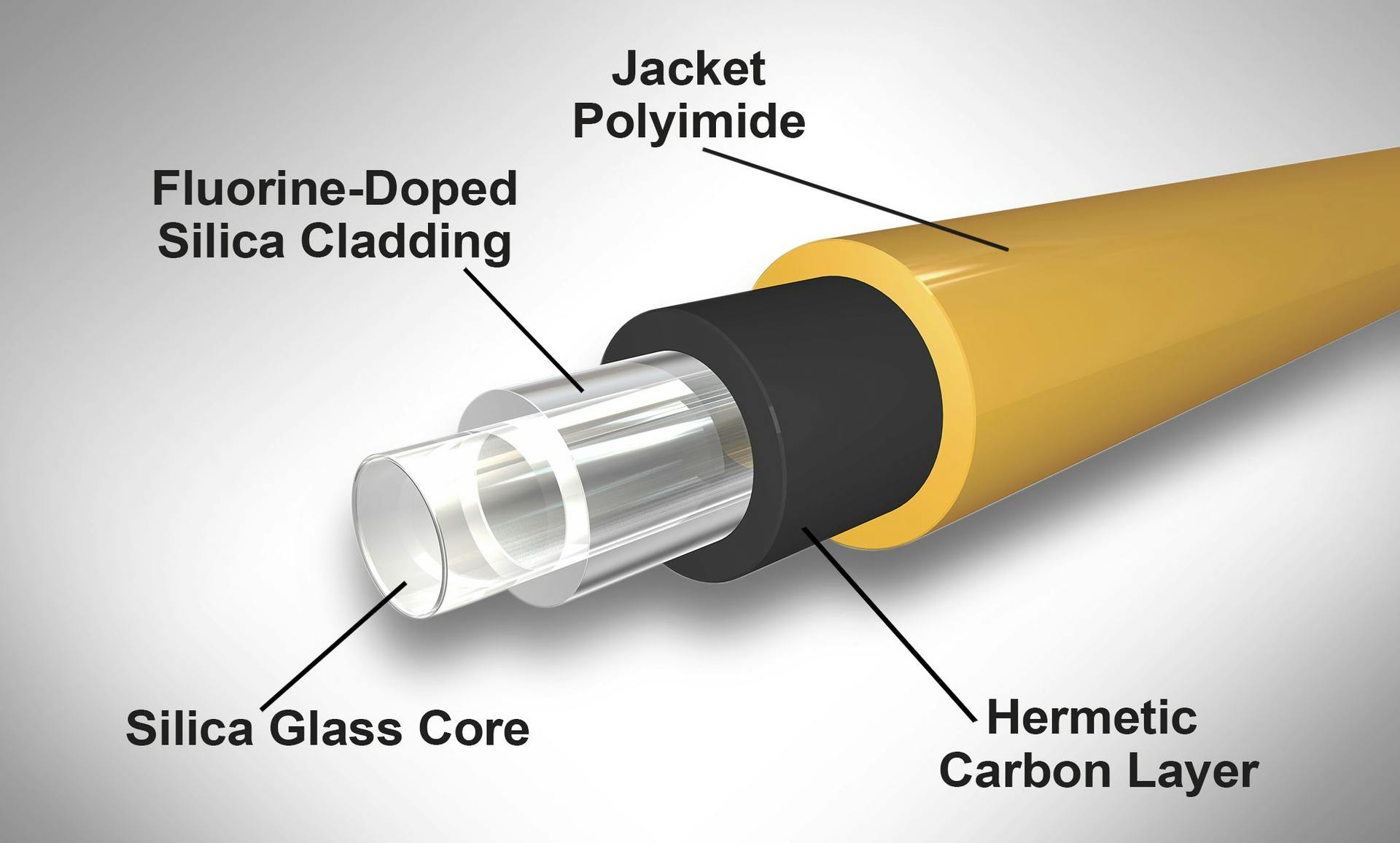
Fluorine-doped Fiber
A Doped Fluorine Fiber is one of the typical products of quartz optical fiber. In general, germanium dioxide (GeO2) is the dopant in the control core of the communication fiber in the 1.3μm wave domain, and the cladding is made of SiO2. But the core of fluorine fiber, most of the use of SiO2, and in the cladding is mixed with fluorine. Because Rayleigh scattering loss is the scattering phenomenon caused by the change of refractive index. Therefore, it is hoped to form the refractive index of the doping factor, less is better. The action of fluoride is mainly to reduce the refractive index of SIO2. Therefore, it is often used for doping cladding.
Compared with other fiber materials, quartz fiber has a wide spectrum of light transmittance from ultraviolet light to near-infrared light and can be used for light conduction and image transmission in addition to communication purposes.
Infrared Fiber
The working wavelength of the quartz series fiber, which is developed for optical communication, is only 2μm, although it is used for short transmission distances. For this reason, can work in the field of longer infrared wavelength, the developed fiber is called infrared fiber. Infrared Optical Fiber is mainly used for transmitting light energy. For example temperature metering, thermal image transmission, laser scalpel medical treatment, thermal energy processing, and so on, the popularity rate is still low.
Composite Optical Fiber
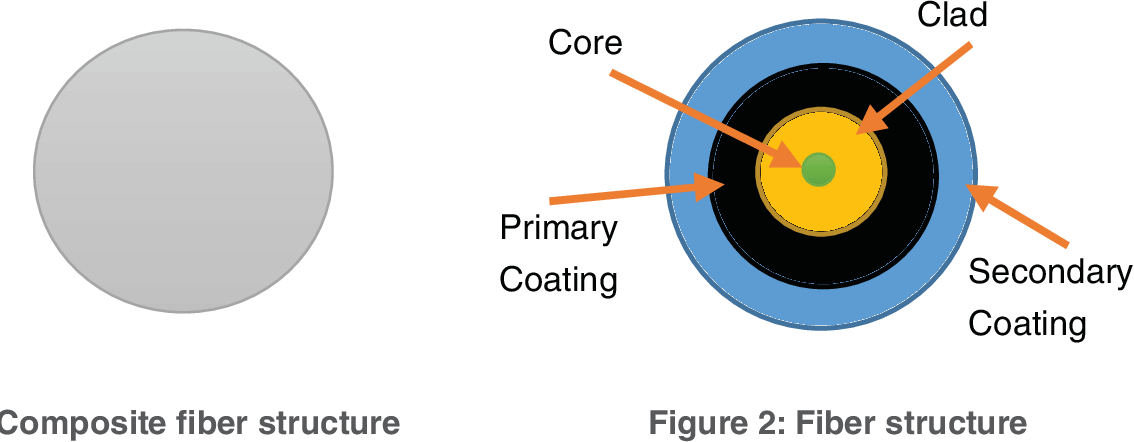
Compound Fiber is a kind of multi-component glass fiber made by mixing oxides such as sodium oxide (Na2O), boron oxide (B2O3), and potassium oxide (K2O) in SiO2 raw materials. The multi-component glass has a lower softening point than quartz glass and a large difference in refractive index between the core and cladding. A fiber optic endoscope is used primarily in medical operations.
Fluoride Fiber
Fluoride Fiber is made of fluoride glass. The representative of fluoride fiber is ZBLAN fiber, whose raw material is zirconium fluoride (ZrF2), barium fluoride (BaF2), lanthanum fluoride (LaF3), aluminum fluoride (AlF3), sodium fluoride (NaF), and another fluoride in accordance with a certain proportion of the combination. Optical transmission is mainly achieved at 2 ~ 10μm wavelength. Due to the possibility of ultra-low loss fiber, ZBLAN fiber is being developed for the feasibility of long-distance communication fiber. For example, its theoretical low loss can reach 10^-2 ~ 10^-3 dB/km at 3μm wavelength, while quartz fiber can reach 0.15~0.16dB/Km at 1.55μm wavelength. ZBLAN fiber is difficult to reduce the scattering loss, can only be used in 2.4 ~ 2.7μm temperature sensitizer and thermal image transmission, and has not been widely used. Recently, a 1.3μm Praseodymium doped fiber amplifier (PDFA) is being developed to use ZBLAN for long-distance transmission.
Plastic-coated Optical Fiber
Plastic Clad Fiber (Plastic Clad Fiber) is made of high-purity quartz glass as the fiber core, and plastic with a slightly lower refractive index than quartz, such as silica gel, as the cladding step type fiber. Compared with quartz fiber, it has the characteristics of a thick core and high numerical aperture (NA). Therefore, it is easy to combine with an LED light source, and the loss is smaller. Therefore, it is very suitable for local area network (LAN) and near field communication.

Single Mode Fiber
Single-mode fiber This refers to the fiber that can transmit only one mode in the working wavelength. It is often referred to as single-mode fiber (SMF: Single-ModeFiber). Optical fiber is widely used in cable TV and optical communication. Because the fiber core is very thin (about 10μm) and the refractive index is a step distribution, the normalized frequency V parameter < 2.4, in theory, only single-mode transmission can be formed. In addition, SMFS do not have multi-mode dispersion, which not only widens the optical fiber with more transmission bands but also results in the additional cancellation of the material dispersion and structural dispersion of SMFS, whose synthetic properties exactly form the characteristics of zero dispersion, thus broadening the transmission band. There are many types of SMFS due to different dopants and different manufacturing methods. In used Clad Fiber, the cladding is two-fold, and the cladding that is adjacent to the core is of lower refractive index than the outer folded cladding
Multimode Fiber
Multi-mode fiber An optical fiber whose propagation modes are multiple according to its working wavelength is called multi-mode fiber (MMF: MUlti ModeFiber). The core diameter is 50μm, and the transmission bandwidth is dominated by mode dispersion compared with SMFS because of the hundreds of transmission modes. Historically used for short-distance transmission in cable television and communication systems. Since the appearance of SMF fiber, it seems to have formed a historical product. In practice, MMFS have an advantage over Lans because of their larger core diameter than SMFS and their ease of combining with LEDs and other light sources. As a result, MMFS is gaining renewed attention in the field of short-distance communication. When MMFS are classified according to the refractive index distribution, there are two types: gradient (GI) type and step (SI) type. The refractive index of GI type is highest at the core center and decreases slowly along the cladding. Due to the SI-type light wave in the process of reflection and advance in the fiber, the time difference of each light path will be generated, resulting in the distortion of the outgoing light wave and the larger color excitation. As a result, the transmission bandwidth is narrowed and the application of SI MMF is less.

Contact information:
If you have any ideas, feel free to talk to us. No matter where our customers are and what our requirements are, we will follow our goal to provide our customers with high quality, low prices, and the best service.
 Email:info@loshield.com
 Tel:0086-18092277517
 Fax: 86-29-81323155
 Wechat:0086-18092277517


