



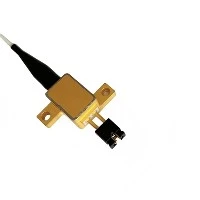
Green Lasers (wavelengths of approximately 495-570nm) lie in the middle of the visible spectrum. Because their wavelength closely matches the sensitivity of the human eye, they are widely used in display, medical, and laser technology. This article compares the characteristics of four common green laser wavelengths to provide a selection guide for different application requirements.
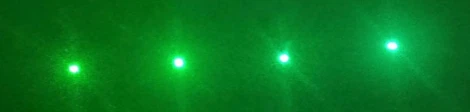
Four common green laser wavelengths:
1. 532nm (High-Power Pulsed Green Light)
① Physical Mechanism:
Second harmonic generation (SHG) of 1064nm infrared light from an Nd:YAG laser is performed using a KTP/KDP crystal, strictly satisfying the phase matching condition Δk = 0.
② Technical Features:
High monochromaticity with a linewidth <0.1nm
Peak power reaching the MW level (Q-switched mode)
Typical beam quality M² <1.3
③ Application Limitations:
Requires precise temperature control to maintain the frequency-doubled efficiency, resulting in a relatively large system size.
2. 520nm (Semiconductor Direct Light Emitting)
① Device Structure:
Based on an InGaN/GaN multiple quantum well structure, the emission wavelength is precisely controlled to 520±5nm through bandgap engineering.
② Photoelectric Characteristics:
Electro-optical conversion efficiency >30% (latest laboratory data)
Modulation bandwidth reaches GHz levels
Typical lifetime >50,000 hours (@25°C)
③ Market Status:
It has become the standard green light solution for Micro-LED displays, with global shipments exceeding 2 billion units in 2023.
3. 510nm (Narrowband Bioluminescence Excitation)
① Generation Method:
LED Solution: Nitride Phosphor Excitation
Laser Solution: Coumarin-Based Dye Laser
② Spectral Characteristics:
Full Width at Half Maximum (FWHM): LED approximately 25nm, laser <5nm
Perfectly matches the excitation spectrum of fluorescent dyes such as FITC
③ Special Applications:
For blue-green laser underwater communications, 510nm is 40% less susceptible to Rayleigh scattering than 532nm.
4. 515nm (Wide Color Gamut Display Light Source)
① Technological Breakthrough:
Using GaN-based in-plane polarization control technology to address the "efficiency drop" issue of direct-emitting green laser diodes.
② Colorimetric Advantages:
Covering 92% of the Rec. 2020 color gamut
Color purity ΔUV < 0.005 (better than 0.01 at 520nm)
③ Emerging Applications:
Stokes shift detection in confocal microscopy
Vegetation identification bands in lidar
Comparison of Key Parameters
| Wavelength (Color) | Light Source Type | Key Properties | Typical Applications |
|---|---|---|---|
| 532nm | Frequency-doubled Nd:YAG laser (second harmonic of 1064nm) | High brightness, high energy, good beam quality, but lower efficiency | Laser pointers, medical lasers, scientific measurements |
| 520nm | Semiconductor laser diode/LED | Close to human eye sensitivity peak (555nm), energy-efficient, low cost | Display backlighting, general lighting, indicators |
| 510nm (Cyan-green) | Special LED/dye laser | Transition between blue and green, good underwater penetration | Biofluorescence labeling, underwater optical communication |
| 515nm (Emerald green) | Direct-emission green laser diode | Extremely high color saturation, wide color gamut | Laser projection, professional displays, fluorescence microscopy |
1. Efficiency Comparison:
532nm relies on nonlinear frequency conversion, resulting in significant energy loss; 520nm/515nm semiconductor light sources are more energy-efficient.
510nm LED efficiency is limited by the material and is generally lower than 520nm.
2. Human Eye Perception:
520nm is closest to the peak of photopic vision (555nm), appearing brighter in low-light environments.
515nm, due to its high saturation, is more suitable for scenes requiring high color reproduction.
3. Special Applications:
532nm has strong coherence and is often used in holography or laser interferometry.
510nm, located within the window of minimum attenuation in water, is ideal for underwater applications.
4. Technology Trends:
Direct-emission green laser diodes (such as 515nm) are gradually replacing frequency-doubled light sources and becoming the mainstream in high-end displays.
Application Scenario
1. 532nm (High-Power Pulsed Green Light)
①Main Applications:
Precision Machining: Laser marking, micro-cutting, and drilling of brittle materials, leveraging its high monochromaticity and high peak power to achieve submicron machining accuracy.
Medical Surgery: Used in vascular treatment, stone fragmentation, and dermatological treatments due to its high absorption rate in hemoglobin and melanin.
Research and Measurement: Laser interferometers and Raman spectroscopy excitation sources, relying on its narrow linewidth and high coherence.
②Technical Limitations:
The system is complex, requiring frequency-doubling crystals and precise temperature control, resulting in a bulky design.
The operating cost is high, and the electro-optical conversion efficiency is typically less than 20%.
2. 520nm (Direct Light Emitting Semiconductor)
①Main Applications:
Consumer Electronics Displays: Green pixels in smartphones and VR/AR displays, relying on its high energy efficiency and miniaturization.
General Lighting: LED projectors and automotive daytime running lights, ideal for balancing brightness and power consumption.
Optical communications: Visible light communication (VLC) modulation, leveraging its high modulation bandwidth.
② Technical Limitations:
Limited output power makes it difficult to meet industrial-grade high-power requirements.
The wavelength is susceptible to temperature changes, requiring additional temperature control compensation.
3. 510nm (Narrowband Bioluminescence Excitation)
① Main Applications:
Biomedical imaging: Flow cytometry and confocal microscopy, precisely matching the excitation spectrum of fluorescent dyes such as FITC.
Ocean exploration: Underwater LiDAR and communications, due to the low scattering loss of seawater at 510nm.
Environmental monitoring: Chlorophyll fluorescence detection for algal biomass assessment.
② Technical Limitations:
Highly specialized application scenarios, limited market demand.
High cost of light source components limits adoption.
4. 515nm (Wide Color Gamut Display Light Source)
① Main Applications:
High-end display technology: Laser cinema, HDR projectors, covering the Rec. 2020 wide color gamut standard.
Precision optical inspection: Surface defect detection and color calibration rely on high color purity.
Fluorescence microscopy: Efficient matching with specific fluorescent proteins (such as mNeonGreen).
② Technical Limitations:
Semiconductor lasers are difficult to manufacture, and low yields lead to high costs.
A complex optical system is required to achieve optimal color accuracy.
Different green light wavelengths (532nm, 520nm, 510nm, and 515nm) offer advantages in terms of monochromaticity, power consumption, efficiency, and cost. The choice depends on specific needs: 532nm is suitable for high-precision processing and medical applications, but the system complexity is high; 520nm dominates consumer electronics due to its high efficiency and energy saving; 510nm is specialized for biological detection and underwater communications, with a narrower application range; and 515nm, with its ultra-wide color gamut, is the preferred choice for high-end displays, but at a higher cost. Future developments in semiconductor laser technology may further expand the performance of 520nm and 515nm wavelengths, further expanding their application boundaries.
Contact information:
If you have any ideas, feel free to talk to us. No matter where our customers are and what our requirements are, we will follow our goal to provide our customers with high quality, low prices, and the best service.
 Email:info@loshield.com
 Tel:0086-18092277517
 Fax: 86-29-81323155
 Wechat:0086-18092277517


