




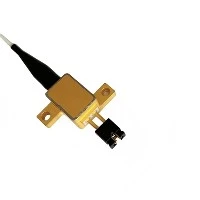
Technical Foundation: How Laser Modules Enable Precise "Touchless Touch"
To understand the role of the laser module, one must first grasp the basic anatomy of an interactive projection system.
Basic Components of an Interactive Projection System:
Display Unit: The projector.
Sensing Unit: The laser module paired with a camera (or infrared sensor).
Processing Unit: The computer running specialized core algorithms.
Interface: The projected image itself.
Core Working Principle of the Laser Module:
The magic of touchless interaction is achieved through a precise optical process:
Creating a "Light Curtain": The laser module emits one or more planes of invisible infrared laser lines, creating a flat, parallel optical sensing layer just above the projection surface.
"Interruption" as a "Trigger": When a finger or stylus enters this light curtain, it blocks or scatters the laser light.
Precise "Capture": A high-speed camera, calibrated to see the specific wavelength of the infrared laser, captures the exact point(s) of interruption in real-time.
Algorithmic "Interpretation": Sophisticated software algorithms analyze the camera's feed, calculating the precise X and Y coordinates of each interruption. These coordinates are instantly mapped to cursor actions on the screen, creating the seamless illusion of touch.
Key Technologies for Enabling "Multi-Touch":
Enabling multiple, simultaneous touch points requires advanced techniques:
High-Density Scanning: The density of the laser lines or grid determines the resolution and accuracy of touch point recognition.
Multiplexing and Time-Division Techniques: By rapidly cycling through different laser patterns or sectors, the system can track multiple independent touch points concurrently.
Intelligent Gesture Recognition: Advanced algorithms differentiate between fingers, palms, and other objects, and accurately interpret a wide range of gestures including tap, drag, pinch-to-zoom, and rotate.


Core Advantages: Why Choose Laser Modules?
Laser modules offer a distinct set of advantages that make them superior for professional and demanding interactive applications:
Exceptional Precision and Resolution: The highly collimated nature of laser light allows for sub-millimeter accuracy, which is essential for detailed tasks like digital drawing, drafting, and design.
Minimal Latency: The speed of light, combined with efficient processing algorithms, results in near-instantaneous touch response, providing a fluid and natural user experience.
Strong Immunity to Ambient Light: By operating in the infrared spectrum and using optical filters, laser-based systems can effectively reject interference from visible light, ensuring stable performance even in brightly lit environments.
Support for Large-Scale Interactive Areas: The optical plane created by lasers can be easily scaled to cover large areas-from a tabletop to an entire wall-without a linear increase in cost or complexity, unlike some capacitive solutions.
High Reliability and Long Lifespan: Semiconductor laser diodes are solid-state devices with no moving parts, offering operational lifetimes of tens of thousands of hours and minimal maintenance requirements.
Application Scenarios: Innovative Practices Driven by Laser Modules
The unique capabilities of laser modules are unlocking new possibilities across diverse sectors:
Education and Training:
Interactive Classrooms: Transforming desks and walls into massive, collaborative sandboxes where multiple students can interact with learning content simultaneously.
Virtual Laboratories: Allowing students to conduct chemical experiments or physics simulations in a safe, cost-effective, and engaging virtual environment.
Commercial Display and Retail:
Interactive Windows & Digital Signage: Captivating passersby and inviting them to interact with product information directly from outside the store, boosting engagement and footfall.
Product Customization Experiences: Enabling customers to configure a car's features or change the color of furniture using intuitive gestures on a life-sized projected interface.
Enterprise Collaboration and Command & Control:
Smart Conference Systems: Replacing traditional whiteboards with interactive walls that enable real-time, multi-user brainstorming, chart editing, and project review.
Emergency Command Centers: Visualizing complex scenarios on a large projected map, allowing commanders to deploy resources and strategize with intuitive touch gestures.
Cultural Tourism and Creative Entertainment:
Interactive Art Installations: Creating immersive experiences where the movements and touches of the audience directly influence the projected visuals and sound.
Immersive Gaming & Theme Parks: Using touches on walls and props to trigger narrative elements in escape rooms or themed attractions, deepening visitor involvement.
Children's Interactive Play Zones: Projecting games onto floors and walls that children activate by running, jumping, and touching, promoting active and safe play.


Challenges and Future Trends
Despite their advanced capabilities, the technology continues to evolve.
Current Challenges:
Complex Gesture Recognition: Accuracy in recognizing non-standardized, complex, or fine-grained hand gestures still has room for improvement.
Cost Considerations: High-end laser modules and the sophisticated processing algorithms required can still be a significant investment, limiting mass adoption.
Environmental Adaptability: Performance can be challenged in direct, intense sunlight or other extreme environmental conditions.
Future Trends:
AI Empowerment: The integration of AI and deep learning will lead to smarter, more natural, and adaptive recognition of gestures and even physical objects placed within the interactive area.
Miniaturization and Integration: Laser modules will become smaller, more power-efficient, and more seamlessly integrated into a wider array of consumer and professional devices.
Convergence with AR/VR: Laser sensing technology will merge with Augmented and Virtual Reality to create robust Mixed Reality (MR) experiences, blending the physical and digital worlds seamlessly.
Cost Reduction and Proliferation: As the technology matures and achieves economies of scale, costs will decrease, paving the way for ubiquitous adoption in public spaces, offices, and homes.
Conclusion
Laser modules, with their unparalleled precision, lightning-fast response, and remarkable stability, have firmly established themselves as the cornerstone of modern multi-touch interactive projection technology. They are the silent enablers of the immersive and collaborative experiences we see today. As innovation continues, laser modules will undoubtedly push the boundaries of interaction even further, creating exciting new possibilities for how we connect with the digital world, truly realizing a future where every surface has the potential to be interactive.
Contact information:
If you have any ideas, feel free to talk to us. No matter where our customers are and what our requirements are, we will follow our goal to provide our customers with high quality, low prices, and the best service.
 Email:info@loshield.com; laser@loshield.com
 Tel:0086-18092277517; 0086-17392801246
 Fax: 86-29-81323155
 Wechat:0086-18092277517; 0086-17392801246


