



Since its introduction in 1964, CO2 lasers have become an important tool in industrial processing, medical cosmetology, and scientific research. Traditional CO2 lasers use direct current (DC) excitation, but in recent years, radio frequency (RF) excitation technology has gradually become the mainstream due to its advantages such as high efficiency, stability, and long life. RF excitation stimulates gas discharge through high-frequency electromagnetic fields, avoiding the problem of electrode loss in traditional DC excitation, and significantly improving the performance and reliability of the laser.
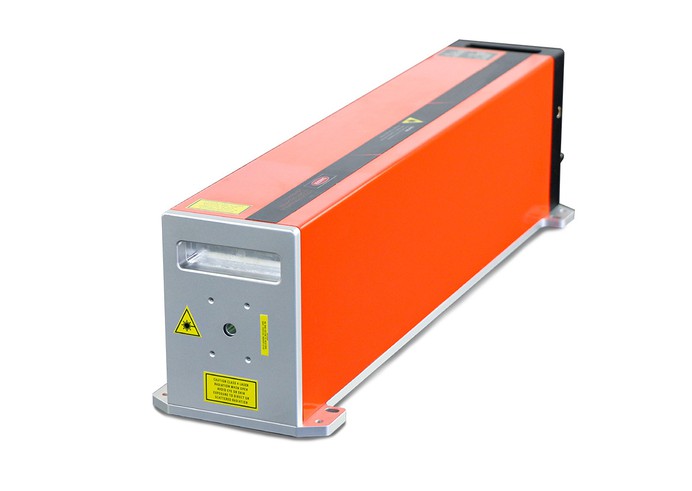
80W CO2 RF Lasers
Core advantages of CO₂ RF lasers
1. Efficient and stable laser output
RF excitation uses a high-frequency AC electric field (usually 13.56 MHz or 27.12 MHz) to excite CO₂ gas molecules. Compared with DC excitation, its energy conversion efficiency is higher (up to 15%~20%) and the power output is more stable. Since RF excitation does not require electrodes to directly contact the gas, it avoids electrode ablation and gas contamination problems, and the service life of the laser can be extended to 20,000~40,000 hours, far exceeding the 8,000~15,000 hours of DC excitation lasers.
2. Precise control capability
RF excitation has a faster modulation response speed and supports high-frequency pulse mode (kHz level), which is suitable for fine processing scenarios such as micro-hole drilling and precision cutting. In addition, RF-excited CO₂ lasers have better mode stability and beam quality (M² value close to 1.1), which can reduce the heat-affected zone (HAZ) during processing and improve processing accuracy.
3. Compact structure and low maintenance requirements
The RF module adopts an electrode-free design, which avoids the performance degradation caused by electrode oxidation and sputtering in traditional DC excitation. At the same time, the modular design makes it easier to integrate into the automated production line, with lower maintenance costs, and only requires regular replacement of laser gas (CO₂/N₂/He mixed gas).
4. Energy saving and environmental protection
RF-excited CO₂ lasers have higher electro-optical conversion efficiency (30%~50% higher than DC excitation), reducing energy consumption. In addition, due to less gas consumption, operating costs are further reduced, which is in line with the development trend of green manufacturing.
Typical application areas of CO₂ RF lasers
1. Industrial processing
Precision cutting and engraving:
Suitable for high-precision cutting of non-metallic materials (such as acrylic, wood, leather, and ceramics), with smooth incisions and no burrs.
In the electronics industry, it is used for fine processing of flexible circuit boards (FPCs) and PCBs.
Welding and drilling:
In the aerospace field, it is used for precision welding of thin metals (such as titanium alloys and aluminum alloys).
In automobile manufacturing, it is used for high-precision drilling (such as micro-hole processing of fuel injectors).
2. Medical cosmetology
Dermatology surgery:
Using the vaporization effect of CO₂ laser, it is used for scar removal, mole removal, skin remodeling and other treatments, with the advantages of less bleeding and faster recovery.
Dental and surgical operations:
Used for soft tissue cutting and hemostasis, such as gum trimming, tumor resection, etc., to reduce the risk of postoperative infection.
3. Scientific research and communications
Laser spectroscopy:
Used for atmospheric composition detection (such as CO₂ concentration monitoring) and molecular absorption spectroscopy research.
Infrared laser radar (LIDAR):
In the fields of autonomous driving and environmental monitoring, the 10.6μm wavelength of CO₂ laser is suitable for long-distance detection.
4. Emerging fields
3D printing (selective sintering):
Used for laser sintering of polymer materials (such as nylon and TPU).
New energy industry:
In lithium battery manufacturing, it is used for pole piece cutting and diaphragm processing.
Comparison with traditional technologies
1. RF excitation vs. DC excitation
| Comparison items | RF excitation | DC excitation |
| Lifespan | 20,000~40,000 hours | 8,000~15,000 hours |
| Energy consumption | High electro-optical efficiency (15%~20%) | Low efficiency (10%~15%) |
| Maintenance requirements | No electrode loss, simple maintenance | Electrodes need to be replaced regularly |
| Beam quality | More stable (M²≈1.1) | Susceptible to electrode ablation |
2. CO₂ laser vs. fiber laser
Applicable materials:
CO₂ laser (10.6μm) is good at processing non-metals (plastics, ceramics, glass), while fiber laser (1μm) is more suitable for metal cutting.
Processing accuracy:
CO₂ laser has more advantages in fine engraving and medical surgery, while fiber laser performs better in high-speed metal cutting.
Future development trends
1.Technology improvement direction
Higher power and smaller size: RF modules are developing towards kilowatt-level power while maintaining a compact design.
Intelligent control: Combined with AI algorithms to optimize laser parameters and achieve adaptive processing.
2.Market prospects
The growth in demand for medical beauty and microelectronics processing will drive the expansion of the RF CO₂ laser market.
Green manufacturing policies will promote the popularization of low-energy, long-life lasers.
CO2 laser RF modules have shown strong competitiveness in the fields of industry, medical treatment, scientific research, etc. with their advantages of high efficiency, stability, and long life. With the advancement of technology, RF-excited CO2 lasers will play a more important role in high-precision processing and emerging markets, becoming one of the key directions for the development of laser technology in the future.
Contact information:
If you have any ideas, feel free to talk to us. No matter where our customers are and what our requirements are, we will follow our goal to provide our customers with high quality, low prices, and the best service.
 Email:info@loshield.com
 Tel:0086-18092277517
 Fax: 86-29-81323155
 Wechat:0086-18092277517


