



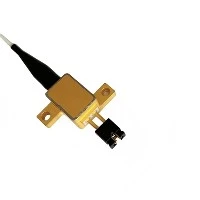
Infrared cameras play a core role in night vision, thermal imaging, security monitoring and other fields, but they have limitations such as insufficient distance estimation accuracy. Laser Rangefinder Modules have complementary values such as accurate distance measurement, target positioning, and three-dimensional modeling. Combining laser ranging modules with infrared cameras can enhance their functional dimensions in security, autonomous driving, industrial inspection, etc., expand application scenarios and enhance performance.

Technical basis of laser ranging module
1. Distance measurement principle
- Time of flight method (ToF): The distance is calculated by measuring the time from the emission to the return of the laser pulse. Specifically, a pulse laser with a very short duration is emitted by the laser emission system. After passing the distance to be measured, it is reflected by the target object. The emitted pulse laser signal is received by the photodetector in the laser receiving system. The time interval circuit calculates the time t between the laser emission and the arrival of the echo signal, and then calculates the distance between the target object and the emission according to the speed of light c and the formula D=ct/2.
- Phase ranging method: The laser beam is amplitude modulated with the frequency of the radio band, and the phase delay generated by the modulated light going back and forth on the measurement line is measured, and then the distance represented by this phase delay is converted according to the wavelength of the modulated light. That is, the time required for the light to go back and forth on the measurement line is measured by an indirect method, and then the distance is calculated.
- Triangulation ranging method: It is suitable for short-distance high-precision scenarios, such as the field of industrial robots. The semiconductor laser is focused by a lens onto the object to be measured, and the reflected light is collected by another lens and projected onto the CCD array. The signal processor calculates the position of the light spot on the array through trigonometric functions, thereby obtaining the distance between the sensor and the object to be measured.
2. Key components
- Laser transmitter: Commonly used are vertical cavity surface emitting lasers (VCSEL) and edge emitting lasers, which are used to generate high-frequency laser pulses or continuous lasers and are the signal source for laser ranging5.
- Receiving sensor: Such as avalanche photodiodes (APDs) or single photon avalanche diodes (SPADs), which can detect extremely weak light signals and convert the received laser signals into electrical signals for subsequent processing.
- Signal processing unit: Responsible for processing and analyzing the electrical signals transmitted by the receiving sensor and calculating relevant information such as distance. It includes time interval measurement circuits, phase measurement circuits, algorithm processing modules, etc., to achieve accurate processing of signals under different ranging principles and accurate calculation of distances.
Collaborative design of laser ranging and infrared camera
1. Hardware integration solution
① Common optical path design
- Principle: Use optical elements such as spectroscopes to make laser and infrared light share part of the optical path. This design can reduce the complexity and volume of the system while improving the accuracy and efficiency of the measurement.
- Advantages: The common optical path design can simplify the system structure and reduce manufacturing costs, and because the laser and infrared light share the optical path, it is easier to achieve synchronous measurement and data fusion of the two technologies.
- Application scenarios: Suitable for scenarios where distance measurement and temperature detection are required at the same time, such as fire rescue, industrial detection, etc.
② Independent module parallel connection
- Principle: Install the laser ranging module and the infrared camera as two independent modules, and combine the measurement results of the two through data fusion technology.
- Advantages: The design of independent module parallel connection can maintain the independence and flexibility of laser ranging and infrared camera, which is convenient for adjustment and optimization according to specific application scenarios. At the same time, through data fusion technology, more comprehensive and accurate measurement results can be achieved.
- Application scenarios: Suitable for scenarios that require high-precision measurement and multi-dimensional data analysis, such as autonomous driving, security monitoring, etc.
2. Software algorithm fusion
① Point cloud and thermal imaging superposition
- Principle: Superimpose the point cloud data obtained by laser ranging with the thermal imaging data of the infrared camera to achieve distance-temperature joint analysis.
- Advantages: This fusion method can provide richer information dimensions, allowing users to understand the distance and temperature distribution of the target object at the same time. In scenarios such as fire rescue, this helps to more accurately judge the fire and personnel location and improve rescue efficiency.
- Application scenarios: fire rescue, industrial detection, environmental monitoring and other fields.
② Dynamic target tracking
- Principle: Use laser ranging technology to assist in speed measurement and trajectory prediction of moving objects in infrared videos. The target distance information obtained by laser ranging, combined with the motion trajectory in the infrared video, can achieve accurate tracking and prediction of dynamic targets.
- Advantages: Dynamic target tracking technology can improve the system's monitoring ability and accuracy of moving objects, and is suitable for scenarios that require real-time monitoring and tracking of dynamic targets.
- Application scenarios: autonomous driving, security monitoring, sports competition and other fields.
Application scenarios and cases
1. Security monitoring
① Perimeter protection
Application method: In perimeter protection, the laser ranging module can monitor the protection area in real time. When an intrusion target enters the monitoring range, the laser ranging can quickly trigger the infrared camera. With its night vision function, the infrared camera can clearly image in low light or even no light environment, and accurately locate and identify the intrusion target.
Case: In the perimeter protection of important places such as airports and military bases, this collaborative system can effectively detect and locate people or vehicles trying to break in illegally, and issue an alarm in time to ensure safety.
② Human/vehicle distance warning in low-light environment
Application method: In low-light environment such as at night or in dark corners, infrared cameras can capture thermal infrared images of people or vehicles, but it is difficult to accurately measure the distance. At this time, the laser ranging module plays a role, accurately measuring the distance between the target and the camera. When the distance is less than the preset threshold, the system issues a warning.
Case: In parking lots, community entrances and exits, etc., this technology can realize accurate distance warning for people and vehicles entering and leaving, assist security personnel in management, and prevent vehicle collisions or illegal intrusions.
2. Autonomous driving and drones
Infrared night vision + laser ranging fusion to improve the ability to detect obstacles at night
Application: On autonomous driving vehicles and drones, infrared cameras can provide thermal imaging of roads and obstacles at night or in low light conditions, while laser ranging modules can accurately measure the distance between the vehicle and the obstacles in front. After the data of the two are fused, more comprehensive and accurate environmental information is provided to the autonomous driving system, enabling it to better plan driving paths and avoid obstacles.
Case: When autonomous driving cars are driving at night, they can use this technology to detect pedestrians, animals or other vehicles on the road in advance, accurately judge the distance, and take braking or avoidance measures in time; drones can also more effectively perceive the surrounding environment and avoid collisions with obstacles when performing patrol, search and rescue tasks at night.
3. Industrial inspection
Non-contact distance-temperature simultaneous monitoring of high-temperature equipment (such as metallurgical furnaces)
Application: For high-temperature equipment such as metallurgical furnaces, infrared cameras can monitor the temperature distribution of the equipment non-contactly, while laser ranging modules can accurately measure the distance between the equipment and the object being measured. Through the collaboration of the two, the distance-temperature simultaneous monitoring of high-temperature equipment can be achieved, and equipment abnormalities or problems in the production process can be discovered in time.
Case: During the steel smelting process, this technology can monitor the temperature changes and material distances in the metallurgical furnace in real time, helping staff to adjust process parameters to ensure production safety and product quality.
4. Military and rescue
Target identification and ranging in battlefield environments or smoke
Application: In battlefield environments or smoke-filled scenes, infrared cameras can penetrate smoke and identify targets based on the principle of thermal imaging, but the ranging accuracy is limited. The laser ranging module can accurately measure the target distance in a complex environment, providing key data for weapon aiming, combat decision-making, etc. The combination of the two can achieve accurate identification and precise ranging of targets.
Case: In military operations, this technology can help soldiers detect enemies and accurately measure distances in severe weather or complex terrain conditions, thereby improving combat effectiveness; in rescue operations, such as earthquakes and fire scenes, it can quickly locate the position and distance of trapped people, providing strong support for rescue work.
The integration of laser ranging modules with infrared cameras unlocks new capabilities in automation, security, and robotics. While challenges like spectral interference and power management persist, advancements in filtering, AI, and chip-scale optics are driving adoption.
Contact information:
If you have any ideas, feel free to talk to us. No matter where our customers are and what our requirements are, we will follow our goal to provide our customers with high quality, low prices, and the best service.
 Email:info@loshield.com
 Tel:0086-18092277517
 Fax: 86-29-81323155
 Wechat:0086-18092277517


