


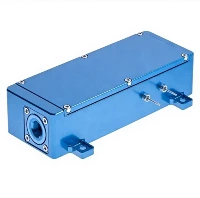
Semiconductor Lasers are also called laser diodes or LD for short. Semiconductor lasers are laser emitting devices that emit monochromatic high-power radiation light through the principle of stimulated radiation. The emission angle of the output light is narrow, and what we see is almost collimated. The laser beam can be directly modulated, that is, the output intensity of the light can change as the signal changes.

Working Principle
The working principle of semiconductor laser light emission is stimulated radiation. The principle of stimulated radiation is outlined: electrons that absorb external energy (electric energy, light energy) at a high energy level will emit a photon that is exactly the same as the external photon after sensing the surrounding external photon ( Energy, direction of motion, quality... are exactly the same), so there are more photons in the same direction, and this process is called stimulated radiation of light.
The above is just a principle, but in practice, to make a semiconductor laser work and emit light, we need working materials, external energy, substrates, and mirrors to form a semiconductor laser structure. We can simulate the laser through the following simple steps:
1. Fix the working substance on the substrate, and stimulate the working substance to emit light spontaneously through external energy. The current light is ordinary weak natural light, with irregular directions and low light intensity. Not all substances can act as this luminous substance, if you are interested, you can check all of them.
2. On the left and right sides of the working substance, there are more than two radiation mirrors (one with 100% reflectivity and one with 95% reflectivity), so that the irregular light emitted by the working substance spontaneously radiates, and the light in the two directions of left and right is It will be reflected back by the radiation mirror to continuously stimulate the working substance to produce stimulated radiation. When the photons increase to a certain threshold, we can see that the obvious light overflows from the mirror with a reflectivity of 95%. Of course, the outside is encapsulated with metal (copper), and the photons that are not in the direction of the mirror If it comes into contact with the metal layer of the outer package, it will be lost in the form of heat energy.
3. If you think about it, the photons on the diagonal line of the radiation mirror will also be radiated and increased, so the light that comes out has a certain divergence angle. In the future, we can use optical components such as collimating mirrors to process the light in the next step.

What are the wavelengths of Semiconductor Lasers:
1. The wavelength is 193nm~337nm, which is the wavelength range of ultraviolet laser, which is invisible to the naked eye.
2. The wavelength of the violet laser is: 365-405nm, which is the wavelength range of the violet laser, visible to the naked eye.
3. The wavelength of blue light laser is: 445nm~488nm, which is the wavelength range of blue light laser, visible to the naked eye.
4. The wavelength of the green laser is: 514nm~543nm, which is the wavelength range of the green laser, visible to the naked eye.
5. The wavelength of red laser is: 633nm~658nm, which is the wavelength range of infrared laser, visible to the naked eye.
6. The wavelength is 780nm~1060nm, which is the wavelength range of infrared laser, which is invisible to the naked eye.

Applications of Semiconductor Lasers:
1. Communication applications: Semiconductor lasers can be used in high-speed communication fields, such as optical fiber communication, wireless communication and data center networks. Among them, VCSEL (Vertical Cavity Surface Emitting Laser) is one of the most commonly used semiconductor lasers for short-distance communication, which is characterized by narrow spectral width, low power, and relatively low cost.
2. Medical applications: semiconductor lasers can be used in medical devices, such as laser scalpels, skin beauty, etc. The laser scalpel uses a high-energy-density laser beam for cutting, which has the advantages of bloodless and minimally invasive, and can be used in ophthalmology, stomatology, dermatology, and laparoscopic surgery.
3. Manufacturing applications: semiconductor lasers can be used in manufacturing industries, such as laser cutting, laser marking, laser welding, etc. Laser cutting technology can be used for cutting metal materials and non-metal materials, and has the advantages of high precision, fast speed and high output.
4. Obstacle avoidance application: Semiconductor lasers can be used in sweeping robots and LIDAR systems in autonomous driving technology. The LIDAR system can realize three-dimensional imaging of the surrounding environment and is an important sensor for autonomous vehicles.
5. Biological detection application: Semiconductor lasers can be used in the field of biological detection, such as fluorescence analysis, protein detection, etc. Its high intensity and monochromaticity make it widely used in biological analysis.
6. Machine vision applications: commonly used narrow line width semiconductor lasers, thinner line lasers, small pixel errors captured by sensors, and high-precision scanning and measurement can be widely seen in automated production workshops.

There are many other applications, there are more than 100 by rough calculation, so I won’t list them one by one here. You can also go to your side to find out where semiconductor lasers are used.
Contact information:
If you have any ideas, feel free to talk to us. No matter where our customers are and what our requirements are, we will follow our goal to provide our customers with high quality, low prices, and the best service.
 Email:info@loshield.com
 Tel:0086-18092277517
 Fax: 86-29-81323155
 Wechat:0086-18092277517


