

Laser collimation mainly describes the parallelism and divergence angle of the laser beam. An ideal laser beam should have perfect parallelism, that is, the light at each point on the cross section of the beam remains parallel during propagation.
However, in practice, due to factors such as the characteristics of the laser light source, the imperfection of the optical components, and the influence of the transmission medium, the laser beam will have a certain degree of divergence, and the divergence angle is a physical quantity used to quantify the degree of divergence. The smaller the divergence angle, the better the parallelism of the laser beam and the higher the collimation; conversely, the larger the divergence angle, the lower the collimation.
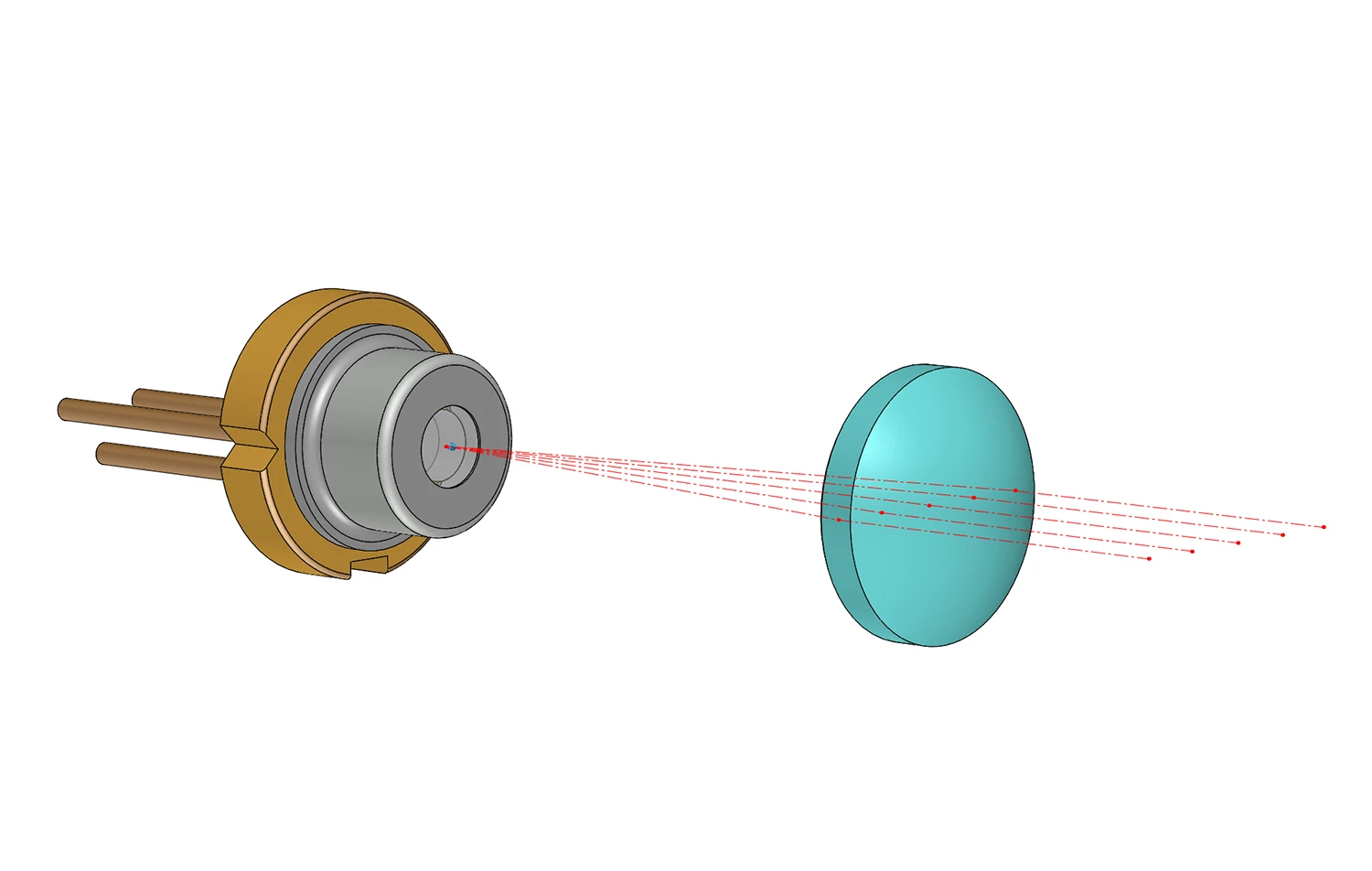
Key laser module parameters affecting laser collimation
I. Laser diode (LD) parameters
①Emitter size
Principle: The emitter is the starting position of the laser diode's light emission, and its size has a significant effect on the divergence characteristics of the laser beam. A smaller emitter means that the energy of the laser beam is more concentrated in the initial stage, and it is easier to maintain good parallelism during the subsequent propagation process, which is conducive to achieving high collimation.
Example: In some high-precision laser processing applications, such as semiconductor lithography, laser diodes with extremely small emitters are required to produce highly collimated laser beams, thereby achieving precise processing of tiny structures.
②Fast axis and slow axis divergence angles
Principle: The laser beam emitted by the laser diode has different divergence angles in the direction perpendicular to the junction plane (fast axis) and in the direction parallel to the junction plane (slow axis). This inherent difference in divergence angles will bring challenges to the collimation design, because in order to achieve high collimation, separate adjustments and compensations need to be made for the divergence characteristics of different axes.
Example: When designing a laser diode module, special optical designs are required, such as using cylindrical lenses with different focal lengths to collimate the beams in the fast and slow axis directions respectively, in order to overcome the impact of this divergence angle difference.
2. Optical component parameters
① Focal length and numerical aperture (NA) of collimating lens
Principle: The focal length of the collimating lens determines the degree of focusing of the beam after passing through the lens. A short focal length lens can focus the beam at a shorter distance, so that the beam reaches the collimated state faster; while a long focal length lens can keep the beam divergent relatively uniformly at a longer distance, which is suitable for some application scenarios with looser requirements on beam divergence. The numerical aperture reflects the ability of the lens to collect the beam. The larger the numerical aperture, the higher the efficiency of the lens in collecting the beam, but it may also introduce more aberrations and affect the collimation.
Example: In optical fiber communication, in order to efficiently couple the laser beam into the optical fiber, a lens with a short focal length and a large numerical aperture is usually used to collimate the laser beam to improve the coupling efficiency. However, in some laser processing applications with extremely high requirements for alignment, lenses with long focal length and small numerical aperture may be selected to ensure the collimation of the beam.
② Lens aberration (spherical aberration, coma, etc.)
Principle: Lens aberration is a beam distortion phenomenon caused by imperfect optical design and manufacturing of the lens. Spherical aberration causes the beam to focus at different positions after passing through the lens, forming spherical aberration; coma causes the beam to shift in the propagation direction, forming a comet-shaped distortion. These aberrations reduce the collimation of the laser beam and affect the performance of the laser system.
Example: In a high-quality laser imaging system, a specially designed aspheric lens is required to correct the aberration to improve the clarity of the image and the collimation of the laser beam.

3. Laser wavelength
① Relationship between wavelength and diffraction limit
Principle: According to diffraction theory, the laser beam will diffract during propagation, and the diffraction limit is closely related to the wavelength of the laser. The shorter the wavelength, the less obvious the diffraction phenomenon, and the easier it is for the laser beam to achieve a small divergence angle, thereby improving the collimation. Therefore, due to its shorter wavelength, UV laser is easier to achieve a small divergence angle and has a higher collimation than visible light and infrared laser.
Example: In high-precision lithography processes, UV lasers are often used as light sources to achieve smaller line widths and higher resolutions. This is because the short wavelength of UV lasers enables them to produce beams with higher collimation, thereby achieving finer pattern etching on silicon wafers.
|
|
|
| 405nm Laser | 633nm Laser |

4. Module structure design
① Mechanical assembly accuracy
Principle: The coaxiality deviation between the laser diode and the lens will cause the laser beam to shift and tilt during propagation, thereby reducing the collimation. Therefore, during the assembly process of the laser module, the coaxiality accuracy of the laser diode and the lens must be ensured to ensure that the laser beam can pass through the lens normally and be collimated.
Example: In high-end laser equipment, the use of precise mechanical assembly processes and adjustment mechanisms can control the coaxiality deviation between the laser diode and the lens within a very small range, thereby improving the collimation of the laser beam and the performance of the equipment.
② Thermal stability
Principle: Temperature changes will cause the thermal expansion and contraction of the lens material, thereby changing the shape of the lens; at the same time, temperature changes will also cause the wavelength of the laser diode to drift. These factors will affect the collimation performance of the laser beam. Therefore, in order to ensure that the laser module can maintain good collimation under different temperature environments, corresponding thermal compensation measures need to be taken.
Example: In some laser equipment that needs to work under harsh environmental conditions, such as outdoor laser rangefinders, materials with good thermal stability are used to make lenses and laser diode brackets, and temperature sensors and thermal compensation circuits are equipped to monitor and compensate for the impact of temperature changes on laser collimation in real time.
5. Beam shaping technology
① Use aspheric lenses, cylindrical mirrors or fiber coupling to improve collimation
Principle: Aspheric lenses can correct aberrations such as spherical aberration through special curved surface design to improve the collimation of the beam; cylindrical mirrors can collimate beams in a specific direction, and are often used to correct the difference in divergence angles in the fast and slow axis directions of laser diodes; fiber coupling can use the waveguide characteristics of optical fibers to achieve collimated transmission of laser beams.
Example: In some solid-state lasers, aspheric lenses are used to collimate the laser beam to improve the output power and beam quality of the laser. In laser display technology, cylindrical lenses are often used to adjust the divergence angle of the laser beam in the horizontal and vertical directions to achieve better image display effects.
Common methods for optimizing laser collimation
1. Select low divergence angle laser diodes
① Principle
The divergence angle of the laser diode is one of the key factors affecting the laser collimation. When a laser diode with a small divergence angle emits a laser, the energy of the beam is more concentrated, and it can maintain good directionality in the initial stage, thus providing a basis for obtaining a laser beam with high collimation.
Different types of laser diodes have different divergence angle characteristics due to differences in their structures and manufacturing processes. For example, quantum well laser diodes can achieve a smaller divergence angle through special material growth and band structure design.
② Implementation method and effect
In the design of laser equipment, selecting a suitable low divergence angle laser diode according to specific application requirements is an important step in optimizing the collimation. For example, in long-distance communication, selecting a laser diode with a very small divergence angle can ensure the collimation of the laser beam during transmission and reduce energy diffusion and loss.
The use of a low divergence angle laser diode can keep the laser beam at a smaller spot size at a longer distance, improve the brightness and intensity of the beam, and enhance the penetration ability and resolution of the laser system. In optical storage technology, the use of low divergence angle laser diodes can achieve higher density data storage.
2. Use high-precision optical components
① Principle
Optical components play the role of focusing, collimation and shaping in laser systems. High-precision optical components have better optical performance, such as lower aberration, higher transmittance and more precise optical parameter control, which can effectively correct the distortion of laser beams and improve the collimation of lasers.
Achromatic lens is a common high-precision optical component. Through special material combination and optical design, it can eliminate or reduce the chromatic aberration between light of different wavelengths, so that the laser beam can get good collimation effect at all wavelengths.
② Implementation method and effect
When designing a laser system, it is crucial to select high-quality optical components and perform precise installation and debugging. For example, the use of achromatic objective lenses in microscopes can improve the clarity of images and the accuracy of laser scanning, so that the laser beam can be more accurately focused on the sample and achieve high-resolution imaging.
The use of high-precision optical components can also improve the stability and reliability of laser systems. In some complex environmental conditions, such as high temperature, high humidity or strong magnetic field environment, high-quality optical components can maintain the stability of their optical performance and ensure the consistency of laser collimation.

3. Active calibration technology
① Principle
Active calibration technology is to monitor the state of the laser beam in real time and automatically adjust the laser system according to preset parameters or feedback signals to ensure that the laser beam always maintains good collimation. The autofocus system is a common active calibration technology that can sense the focal position of the laser beam and accurately focus the beam on the target position by adjusting the position of the lens or reflector.
② Implementation method and effect
In laser processing equipment, the autofocus system can monitor the position change of the workpiece surface in real time and adjust the focus point of the laser beam to ensure the accuracy and quality of laser processing. In laser communication, active calibration technology can ensure that the laser beam is accurately aligned with the receiving end, improving the efficiency and stability of communication.
Active calibration technology can also be combined with other optimization methods to form a closed-loop control system to further improve the stability and reliability of laser collimation. For example, combining the autofocus system with a temperature sensor and a thermal compensation circuit can automatically adjust the focus and collimation state of the laser beam when the temperature changes.
4. Temperature control design
① Principle
Temperature changes will affect the performance of laser diodes, including wavelength drift, threshold current changes, etc. These changes will cause changes in the optical properties of the laser beam, which in turn affects its collimation. Therefore, by stabilizing the operating temperature of the laser diode through temperature control design, the influence of temperature on the laser beam can be reduced and the collimation of the laser can be improved.
TEC (thermoelectric cooler) cooling is a commonly used temperature control technology that can accurately control the temperature of the laser diode. TEC cooling is based on the Seebeck effect and realizes cooling or heating functions by controlling the direction of the current.
② Implementation method and effect
Integrating the TEC cooling module in the laser device and setting appropriate temperature control parameters according to the characteristics of the laser diode and the working environment can effectively stabilize the operating temperature of the laser diode. For example, in high-performance lasers, the use of TEC cooling can control the temperature of the laser diode within a very small fluctuation range, ensuring the stability of the laser wavelength and the collimation of the beam.
Temperature control design can also improve the reliability and life of the laser equipment. Stable operating temperature can prevent the laser diode from being damaged due to overheating and extend its service life. At the same time, reducing the impact of temperature changes on the laser beam also helps to improve the overall performance and stability of the laser system.
Laser collimation mainly measures the parallelism and divergence of the laser beam. Its performance is closely related to several key parameters of the laser module, including the light-emitting point size and inherent divergence angle of the laser diode, the focal length and aberration of the collimating lens, the laser wavelength, the mechanical assembly accuracy and thermal stability of the module, etc. Optimizing these parameters (such as selecting low divergence angle diodes, high-precision optical components and temperature control design) can significantly improve the collimation, thereby meeting the high requirements for beam quality in industrial processing, communications, medical and other fields. In the future, intelligent calibration technology and new optical materials will further promote the improvement of laser collimation performance.
Contact information:
If you have any ideas, feel free to talk to us. No matter where our customers are and what our requirements are, we will follow our goal to provide our customers with high quality, low prices, and the best service.
 Email:info@loshield.com
 Tel:0086-18092277517
 Fax: 86-29-81323155
 Wechat:0086-18092277517


