


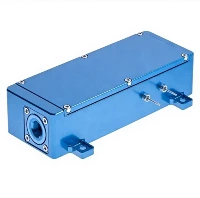
A DPSS laser (diode-pumped solid-state laser) is a solid-state laser that uses one or more laser diodes as the pump source for a solid-state gain medium such as Nd or Nd₄.
Compared with traditional lamp-pumped solid-state lasers, DPSS lasers offer high efficiency, lower thermal load, compact size, good beam quality and stable laser output.
DPSS technology is widely used in industrial processing, scientific research, spectroscopy, medical equipment, measurement and other precision laser applications.

What Is a DPSS Laser?
DPSS stands for Diode-Pumped Solid-State.
A DPSS laser normally consists of:
Laser diode → gain crystal → optical cavity → laser output
The laser diode provides pump light, while the solid-state crystal acts as the gain medium.
This is different from a direct diode laser. In a diode laser, the semiconductor itself generates the final laser beam. In a DPSS laser, the laser diode is mainly used to pump a solid-state laser crystal.
Common gain media include Nd and Nd₄.
How Does a DPSS Laser Work?
The operation of a DPSS laser can be divided into three main steps.
1. Diode Pumping
A laser diode emits pump light into the solid-state gain crystal.
The pump wavelength is selected to match an absorption band of the laser crystal, allowing pump energy to be absorbed efficiently.
2. Laser Amplification
The absorbed pump energy excites ions inside the gain medium.
Through stimulated emission, light is amplified inside the optical resonator.
3. Laser Output
Once the optical gain is sufficient, the resonator produces a stable laser beam.
A common example is a 1064 nm DPSS laser based on Nd or Nd₄.
The 1064 nm infrared light can also be frequency-doubled to produce 532 nm green laser light, or frequency-tripled to produce approximately 355 nm UV light.
What Are the Advantages of DPSS Lasers?
High Efficiency
Laser diodes have a narrow emission spectrum that can be matched closely to the absorption wavelength of the gain medium.
This reduces wasted pump energy and improves overall laser efficiency compared with traditional lamp pumping.
Good Beam Quality
DPSS lasers can provide excellent beam quality and low beam divergence.
This makes them suitable for applications that require precise focusing, accurate positioning or high optical intensity.
Lower Thermal Load
Because diode pumping delivers energy more efficiently to the gain medium, less unwanted heat is generated.
Lower thermal load can improve laser stability and reduce cooling requirements.
Compact Size
Laser diodes and their power supplies are much smaller than traditional flashlamp pumping systems.
As a result, DPSS laser modules can be compact and easy to integrate into optical equipment.
Stable Laser Output
With proper temperature control and optical design, DPSS lasers can provide stable output power, wavelength and beam characteristics.
This is important for scientific, medical and precision industrial applications.
Common DPSS Laser Wavelengths
Several wavelengths are widely used in diode-pumped solid-state laser systems.
| Wavelength | Typical Applications |
|---|---|
| 1064 nm | Laser marking, measurement, research |
| 532 nm | Alignment, spectroscopy, imaging, fluorescence |
| 355 nm | Micromachining, precision processing, UV applications |
| 266 nm | UV spectroscopy and precision material processing |
The required wavelength depends on the gain medium, nonlinear conversion process and final application.

DPSS Laser Applications
DPSS lasers are widely used where good beam quality, stable output and compact design are important.
Common DPSS laser applications include:
- Laser marking and engraving
- Precision micromachining
- Spectroscopy
- Scientific research
- Medical and biomedical equipment
- Fluorescence excitation
- Laser measurement
- Optical sensing
- Alignment and positioning
- Semiconductor and electronics processing
Different wavelengths are suitable for different materials and applications.
For example, infrared DPSS lasers are widely used in laser processing and measurement, while green and UV DPSS lasers are commonly used where shorter wavelengths or smaller focused spots are required.
DPSS Laser vs. Diode Laser
A DPSS laser and a diode laser are not the same.
A diode laser generates laser light directly from a semiconductor gain medium.
A DPSS laser uses a diode laser as the pump source for a solid-state gain medium.
In simple terms:
Diode Laser → Pump Energy → Solid-State Crystal → DPSS Laser Output
Diode lasers are generally simpler and highly efficient, while DPSS lasers can provide excellent beam quality and access to wavelengths produced through solid-state gain media and nonlinear frequency conversion.
How to Choose a DPSS Laser
When selecting a DPSS laser module, consider the following parameters:
Wavelength
Choose the wavelength according to the target material, detector or application.
Output Power
Determine the required laser power for the application.
CW or Pulsed Operation
Choose continuous-wave or pulsed output according to the process requirements.
Beam Quality
Precision focusing and measurement applications often require good beam quality and low divergence.
Power Stability
Scientific and measurement applications may require highly stable laser output.
Cooling Method
Higher-power DPSS lasers require appropriate thermal management.
JTBYShield DPSS Laser Modules
JTBYShield provides DPSS laser modules for industrial, scientific, medical and optical applications.
When selecting a DPSS laser, please provide:
Wavelength + output power + CW or pulsed operation + beam requirements + application
Our technical team can help select a suitable laser configuration according to your system requirements.
For available models, visit our DPSS Laser Module product category.
Frequently Asked Questions
What does DPSS mean?
DPSS stands for Diode-Pumped Solid-State. A DPSS laser uses a semiconductor laser diode to pump a solid-state laser gain medium.
What is the difference between DPSS and diode lasers?
A diode laser generates the final laser output directly from a semiconductor. A DPSS laser uses a diode laser to pump a solid-state crystal that generates the final laser output.
What are the main advantages of DPSS lasers?
The main advantages include high efficiency, good beam quality, compact size, reduced thermal load and stable laser output.
What are common DPSS laser wavelengths?
Common DPSS laser outputs include 1064 nm, 532 nm, 355 nm and 266 nm, depending on the gain medium and frequency conversion design.
What are DPSS lasers used for?
DPSS lasers are widely used in laser marking, precision processing, spectroscopy, medical equipment, scientific research, measurement and optical sensing.
Conclusion
A DPSS laser combines semiconductor diode pumping with a solid-state gain medium to provide an efficient, compact and stable laser source.
Its good beam quality, wavelength flexibility and reliable performance make DPSS technology suitable for a wide range of industrial, scientific and medical applications.
If you need a DPSS laser module, contact JTBYShield with your required wavelength, output power, operating mode and application.