




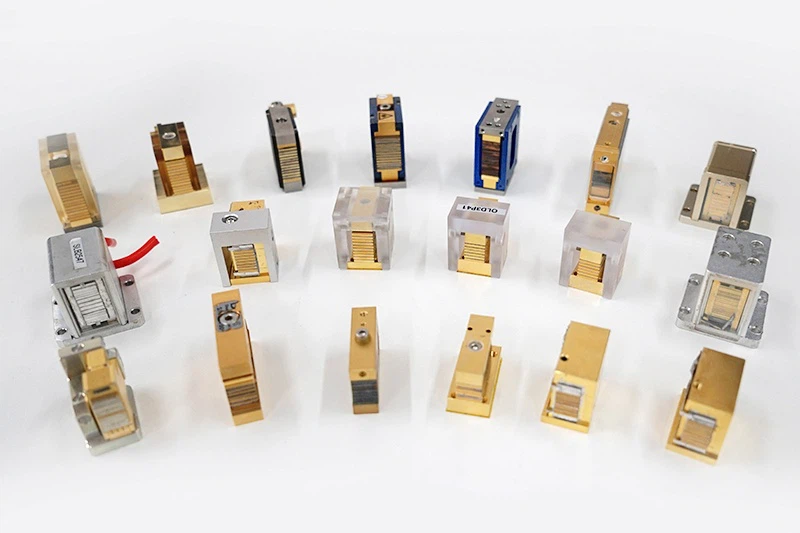
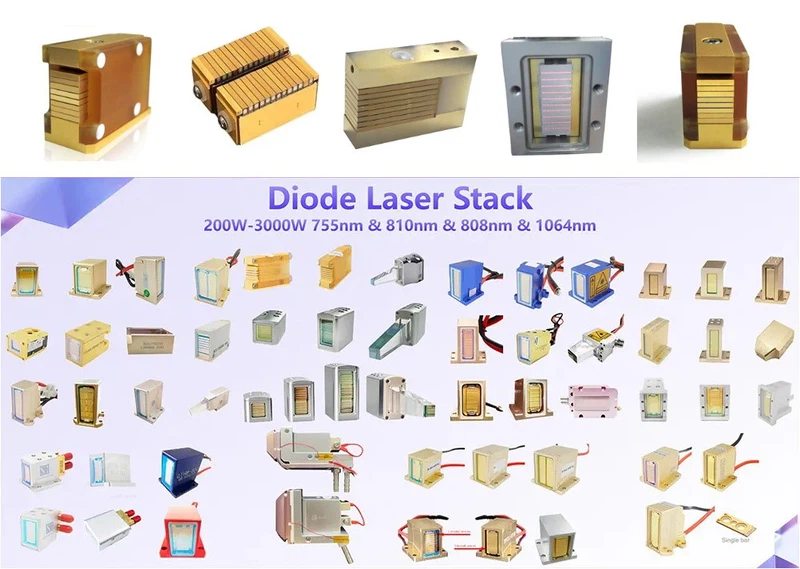
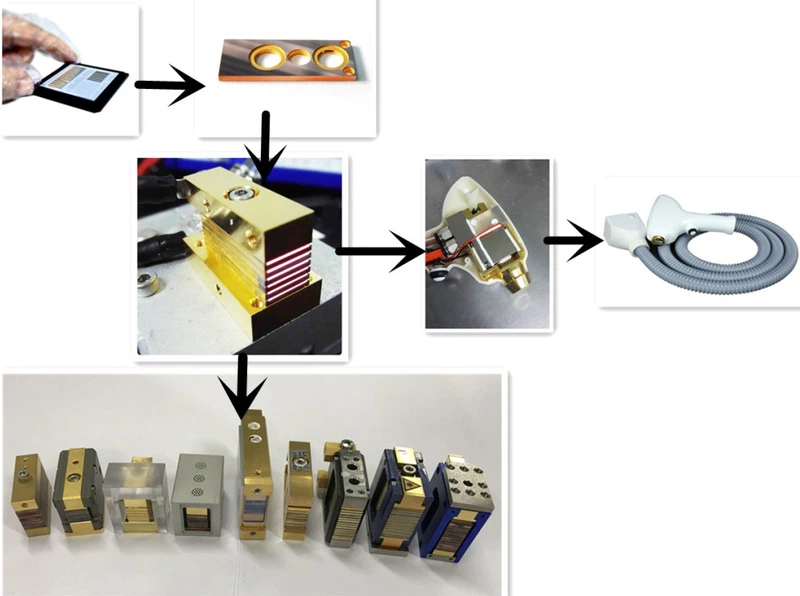
Diode Laser Stacks, a key component of modern semiconductor light source technology, achieve high-power output through the integration of multiple laser diode units. They are widely used in industrial processing, medical treatment, and scientific research. Their core parameters (such as wavelength, threshold current, operating current, and divergence angle) directly determine the device's optical performance, energy efficiency, and applicable scenarios, and are key considerations in design and application. These parameters not only influence the laser beam's directionality, stability, and monochromaticity, but also impact the system's thermal management, coupling efficiency, and long-term reliability. Therefore, precise control and optimization of these parameters are crucial for improving overall performance.
Core Parameters of Diode Laser Stacks
1. Optical Parameters
① Wavelength
Common specifications include 755nm, 808nm, 940nm, 980nm, and 1064nm. Different wavelengths correspond to the absorption peaks of specific materials (e.g., 980nm for metal welding, and near-infrared absorption outside the CO₂ band for plastic cutting). Wavelength accuracy must be controlled within ±5nm to ensure process stability.
② Output Power
Typical output power for a single bar is 50W. By connecting multiple bars in series, the total stack power can reach 1kW. The difference in peak power between continuous wave (CW) and pulsed modes significantly affects processing speed.
③ Beam Quality
Quantified by the beam parameter product (BPP), lower values indicate better focusing performance. The fast-axis divergence angle is typically greater than the slow-axis (e.g., 60° fast axis vs. 10° slow axis). Cylindrical lens correction is required to improve coupling efficiency.
2. Electrical Parameters
① Operating Voltage
The operating range of each bar unit is 1.5V–2.5V. In a series configuration, the total voltage is linearly superimposed and must match the constant current/constant voltage mode of the driver.
② Threshold Current
The minimum injection current required to initiate laser oscillation. A high threshold current indicates a high quantum well defect density, resulting in reduced energy efficiency.
③ Slope Efficiency
The power increase per unit current increment (W/A) reflects the efficiency of carrier conversion to photons and is significantly affected by temperature drift.
3. Thermal Management Parameters
① Thermal Resistance
A measure of heat dissipation capability (°C/W). Low thermal resistance designs can reduce junction temperature rise (recommended <0.1°C/W). Microchannel liquid cooling solutions can keep thermal resistance to less than one-third of traditional packages.
② Cooling Method
For high-power applications, deionized water cooling or phase change material conduction cooling is preferred. For lightweight devices, a combined heat pipe and air cooling solution is an option.
4. Structure and Package Parameters
① Number of Bars and Arrangement
Select a 10-bar or 20-bar modular configuration based on power requirements. The array layout should optimize optical uniformity and thermal distribution.
② Fill Factor
The ratio of the light-emitting area to the chip area. High-density filling improves brightness but increases the risk of crosstalk.
③ Package Type
C-mount is suitable for standard optical systems, macro-channel packaging facilitates dense stacking, and customized housings can integrate monitoring sensors.
5. Reliability Parameters
① Lifetime
Industrial-grade products are generally marked with a 10,000-hour MTBF (mean time between failures). Actual lifespan is limited by operating current density and temperature control levels.
② Failure Mechanisms
These include output degradation caused by thermal degradation of the active area, sudden COD damage, and electrical shorting caused by solder fatigue. These failures must be mitigated through redundant design and a soft-start strategy.
Key Considerations for Parameter Selection
1. Application Scenario Requirements Drive Parameter Priority
① High-Power Industrial Cutting (e.g., metal/composite processing)
Key Requirements: Maximum output power (≥1kW), wide wavelength adaptability (980nm preferred), and stability in harsh environments.
Key Parameters: Total power density, thermal resistance control (to ensure continuous operation without frequency throttling), and beam uniformity (to reduce cutting edge burrs). A multi-bar stack with microchannel water cooling is required, along with redundant power modules to cope with transient load fluctuations.
Typical Configuration Example: 20-bar array, 50W per bar, BPP <4mm·mrad, liquid cooling with a closed-loop temperature control system.
② Precision Medical Applications (e.g., minimally invasive surgery, dermatology)
Key Requirements: Strict wavelength accuracy (within ±2nm), low divergence angle (slow axis <5°), and ultra-low noise output.
Key Parameters: Wavelength stability (to avoid tissue carbonization), small spot size (achieved through high fill factor), and electromagnetic compatibility (EMI shielding design). Single-bar, low-power modules are often used, combined with fiber coupling and air cooling.
Typical configuration example: single-bar 20W, 808nm narrow linewidth, CS-mount package with integrated temperature sensor.
2. Hard Constraints of System Integration
① Heat Dissipation Capacity Matching
The maximum allowable thermal resistance is calculated based on the available cooling resources of the device. If only natural convection is available, a high-conductivity substrate with a thermal resistance of less than 0.05°C/W should be selected. Forced air cooling can be relaxed to 0.1°C/W. Water cooling systems support higher power but increase complexity.
Design Conflicts: Achieving high power and low temperature rise in a compact space may require compromises (such as intermittent operation or a tiered cooling architecture).
② Power Supply Compatibility
The input voltage range must cover the laser operating range (e.g., 1.8V–2.4V/bar) and have overvoltage and overcurrent protection. Portable devices tend to use low-voltage DC power, while stationary equipment can adopt AC rectification. Innovative Solution: A digital power management chip achieves dynamic current distribution, balancing efficiency differences between individual bars.
③ Optimized Layout
Package size determines mounting method: C-mount is suitable for standardized optical platforms, while macro-channel design facilitates vertical stacking and saves lateral space. For mobile devices, flexible printed circuit (FPC) integration solutions can overcome the limitations of traditional rigid structures.
Improving the performance of diode laser stacks relies on the comprehensive optimization of core parameters, the key being to precisely match parameter combinations to specific application scenarios. Whether pursuing high-energy density industrial cutting or medical applications prioritizing precision and safety, trade-offs must be made between optical properties (such as wavelength and beam quality), electrical efficiency (threshold current and slope efficiency), thermal management capabilities (thermal resistance and cooling methods), and structural adaptability (packaging type and arrangement density). By systematically analyzing application requirements, system integration constraints, and cost-effectiveness, and achieving multi-dimensional parameter collaborative design, we can maximize device performance and ensure long-term stable operation.
Contact information:
If you have any ideas, feel free to talk to us. No matter where our customers are and what our requirements are, we will follow our goal to provide our customers with high quality, low prices, and the best service.
 Email:info@loshield.com
 Tel:0086-18092277517
 Fax: 86-29-81323155
 Wechat:0086-18092277517


