



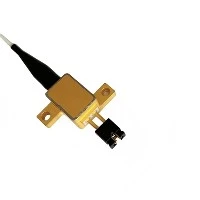
Visible Fiber Laser is a laser system that uses optical fiber as the gain medium, which can generate laser beams in the visible spectrum range. These lasers are usually based on optical fibers doped with rare earth ions, such as erbium (Er), neodymium (Nd) or titanium sapphire (Ti: sapphire), which amplify optical signals through the process of stimulated emission.
Specifically, when ions in the gain medium are excited to a high-energy state by an external energy source, such as a diode laser, they quickly return to a lower energy level and emit photons. If this process takes place within a resonant cavity, where mirrors ensure that the light waves propagate back and forth in the gain medium, a sustained light wave oscillation is formed. By precisely controlling the parameters of the resonant cavity and the characteristics of the gain medium, the specific wavelength of the output laser can be tuned.
Application and importance in industrial fields:
Materials processing: Visible lasers are commonly used for precision cutting, welding and marking. For example, green lasers are very effective at cutting certain non-metallic materials, such as plastics and glass, because of their higher absorption of light at these wavelengths.
Printing and Packaging: Green and red laser systems are used in the printing industry to correct printing plates, and in the packaging industry to mark and track products.
Application and importance in the medical field:
Eye surgery: Visible light lasers, especially green and blue light lasers, are used to treat certain eye diseases, such as glaucoma and macular degeneration.
Skin Treatment: Red and green light lasers can be used to treat acne, pigmentation, and other skin lesions because they can penetrate the skin's surface without causing much damage.
Photodynamic therapy: The use of specific wavelengths of visible light to activate drugs to treat cancer and other diseases.
Application and importance in the field of scientific research:
Fluorescence Microscopy: Visible light lasers are an important component of fluorescence microscopy and are used to excite fluorescent markers in samples to study cellular structure and function.
Spectroscopy: Visible lasers are used in techniques such as Raman spectroscopy and optical absorption spectroscopy to analyze the chemical composition and structure of materials.
Optical traps: Visible light lasers can be used to create optical traps to manipulate tiny particles or cells, which is very useful in biophysical research.
Industrially, blue-ray lasers are used in high-resolution Blu-ray disc recording and reading technology, promoting the development of data storage technology. In the medical field, red light lasers are often used for laser hair removal because red light can be absorbed by the melanin in the hair follicles, thereby destroying the growth ability of the hair follicles. In scientific research, green lasers have played a key role in the development of super-resolution microscopes, allowing scientists to observe details smaller than the resolution limit of traditional optical microscopes.
A. Basic composition and working principle of fiber laser
The core part of the fiber laser is a glass fiber doped with rare earth elements, such as erbium, neodymium or titanium sapphire, which can amplify the optical signal passing through the fiber. The basis of its work is that under the action of pump light (usually a semiconductor laser), a high power density is formed in the optical fiber, resulting in "particle number inversion" of the laser energy level of the laser working material. When a positive feedback loop is properly added (that is, a resonant cavity is formed), a laser oscillation output can be formed.
B. Technical difficulties in achieving different wavelength outputs
There are some technical difficulties in achieving laser output of different wavelengths. This often involves making fine adjustments to the fiber laser's design, such as changing the types and concentrations of rare earth elements in the fiber, or using special wavelength selectors and tuners to control the output wavelength. In addition, it is also necessary to accurately control the resonant cavity parameters of the laser, such as the reflectivity and dispersion characteristics of the cavity mirror, as well as possible nonlinear optical processes, such as frequency doubling, third-order harmonic generation, etc., to convert the fundamental frequency light to the required visible light band.
C. The generation mechanism of red, green and blue lasers
The generation of red, green and blue lasers often relies on nonlinear frequency conversion techniques. For example, infrared laser light can be converted into visible light by passing it through a nonlinear crystal, using the process of second harmonic generation (SHG) or third harmonic generation (THG). In this process, the energy of infrared photons is combined in the nonlinear medium to produce visible light photons with higher energy and shorter wavelength. Additionally, visible light of specific wavelengths can be produced through a parametric down-conversion process, which involves the splitting of a high-energy photon into two low-energy photons whose sum of energies is the same as the original photon.
The working principle of visible fiber lasers is based on stimulated emission and particle number inversion in the fiber, and achieving specific wavelength output requires complex design and technical means, including wavelength selection, resonant cavity control, and nonlinear frequency conversion. The application of these technologies enables fiber lasers to function in a wide range of fields, from industrial processing to medical treatment to scientific research, all of which require precisely controlled laser light sources.
The red fiber laser is a device that uses optical fiber doped with rare earth elements as the gain medium to generate laser light through the principle of stimulated emission. Through precise design and technology, red fiber lasers can provide efficient and precise light sources in multiple fields, thus promoting the development and application of related technologies.
A. Design and working principle of red laser
Red fiber lasers typically use fibers doped with specific rare earth elements, such as erbium or neodymium, as the gain medium. Under the action of pump light (usually a semiconductor laser), a high power density is formed in the optical fiber, resulting in "particle number inversion" of the laser energy level of the laser working material. When a positive feedback loop is added (to form a resonant cavity), a laser oscillation output can be formed. This kind of laser has the characteristics of small size, long life and stable power.
B. Key technologies for red light output
The key technologies to achieve red light output include multi-dimensional beam shaping and precision coupling technology. These technologies ensure that the laser can be efficiently coupled into the optical fiber and output a high-quality laser beam. In addition, advanced laser manufacturing processes and strict quality control are also key factors to ensure laser performance.
C. Application case analysis of red laser
Biomedical imaging and therapy: Red-light lasers are used in biomedical fields for imaging and therapy, such as to excite fluorescent markers in fluorescence microscopy or to activate specific photosensitizers in photodynamic therapy to treat diseases such as cancer.
Material processing: Red lasers are also widely used in the field of material processing, such as plastic welding, cutting and marking, especially in the field of micro-machining that requires high precision.
Data storage and reading: In the field of data storage, red light lasers can be used for reading and writing operations on information storage media such as optical discs to increase the density and speed of data storage.
The design, working principle and key technologies of green fiber lasers make them widely used in many fields. Through its unique design and working principle, combined with key technologies, green fiber lasers not only show great potential in the field of industrial precision processing, but also play an important role in environmental monitoring and scientific research. As technology continues to advance, we can expect green lasers to be used more widely in the future.
A. Design and working principle of green laser
Green fiber lasers usually use optical fibers doped with rare earth ions as the gain medium to generate laser light through the principle of stimulated emission. Green light generation methods mainly include upconversion pump emission and direct emission from semiconductor lasers. Up-conversion pump emission is to incorporate rare earth ions into solid materials, pump them with semiconductor lasers or other light sources, and directly use the energy level transition of rare earth ions to generate green laser. This method is based on the up-conversion effect, where the wavelength of the lasing light is smaller than the wavelength of the pump light.
B. Key technologies for green light output
The key technologies for green light output include the solution of all-fiber fundamental frequency plus extracavity frequency doubling, which can achieve high-power single-mode continuous green light output. For example, the GCL-500 green laser launched by OUDA Laser adopts this technology and achieves a single-mode continuous green light output of up to more than 500W.
C. Application case analysis of green laser
High-precision marking and engraving: Because of its short wavelength, green lasers can produce an extremely fine focus on the material surface, making them suitable for high-precision marking and engraving applications. For example, precision laser applications in solar cell chip and panel manufacturing.
Environmental monitoring: Green light lasers can be used in the field of environmental monitoring, such as detecting pollutants in the atmosphere or harmful substances in water.
Fluorescence excitation in scientific research: In scientific research, green lasers are often used to excite fluorescent markers in samples to study cell structure and function.
Through its unique design and working principle, combined with key technologies, blue-light fiber lasers not only show great potential in the field of medical treatment, but also play an important role in display technology and ocean research. As technology continues to advance, we can expect blue lasers to be used more widely in the future.
A. Design and working principle of blue laser
Blue fiber lasers usually use optical fiber doped with rare earth ions as the gain medium to generate laser light through the principle of stimulated emission. In order to achieve blue light output, it is usually necessary to frequency-double the infrared or near-infrared laser through a nonlinear optical crystal to generate light in the blue band. This process involves the interaction of light waves in a nonlinear medium, resulting in frequency multiplication.
B. Key technologies for blue light output
Key technologies for blue light output include efficient nonlinear frequency conversion technology and wavelength-selective filtering technology. These technologies ensure that the laser can produce high-power, high-quality blue light output. In addition, it is also necessary to precisely control the resonant cavity parameters of the laser, such as the reflectivity and dispersion characteristics of the cavity mirror, to optimize the production efficiency and stability of blue light.
C. Application case analysis of blue light laser
Photodynamic therapy: In the medical field, blue light lasers are used in photodynamic therapy to activate specific photosensitizers to treat diseases such as cancer. This treatment method uses the ability of photosensitizers to absorb light of specific wavelengths and triggers chemical reactions through light to achieve the purpose of treatment.
Blue laser display technology: In the field of display technology, blue lasers can be used to excite phosphors to produce white light, which can be used in laser display devices. This technology has the advantages of high color saturation and high brightness.
Marine and hydrological research: In marine and hydrological research, blue lasers can be used for underwater imaging and detection. Since water has less absorption of blue light, clearer underwater images and data can be obtained using blue lasers.
The current main achievements of visible fiber laser technology include technological progress, market growth and application expansion. Technological advances in this area have fueled the development of multiple industries including industry, medicine, and scientific research. In the future, technological innovation and market competition in this field will further promote industrial development and have a profound impact on related industries.
Major achievements:
Technological progress: Visible fiber lasers have successfully achieved laser output of different wavelengths such as red light, green light, and blue light through rare earth element-doped optical fibers and nonlinear frequency conversion technology. These technological advances provide the possibility for a variety of applications.
Market growth: The size of the fiber laser market has shown a growth trend in recent years, which shows that the market demand for visible light fiber laser technology is constantly expanding.
Application expansion: The application of visible fiber lasers in materials processing, biomedical imaging, environmental monitoring and other fields continues to expand, improving the work efficiency and accuracy of related industries.
Future trends:
Technological innovation: With the continuous advancement of technology, visible fiber lasers may achieve higher efficiency and wider wavelength range laser output in the future to meet the needs of more fields.
Market competition: The current market competition is fierce, and more companies may enter this field in the future to promote further development of technology and reduction of costs.
Industrial integration: The development of visible fiber laser technology may be integrated with other industries such as semiconductor manufacturing and biotechnology to promote the development of emerging industries.
Impact on related industries:
Industrial production: More efficient laser technology will improve the production efficiency of the manufacturing industry, reduce costs, and promote industrial upgrading.
Medical health: In the medical field, advances in laser technology will make surgeries more precise and treatment methods more diversified, helping to improve treatment effects and patients' quality of life.
Scientific research experiments: High-precision laser equipment will promote the in-depth scientific research, especially playing an important role in basic research in the fields of physics, chemistry and biology.
Environmental protection: The application of laser technology in environmental monitoring and governance will help improve environmental quality and promote sustainable development.
Contact information:
If you have any ideas, feel free to talk to us. No matter where our customers are and what our requirements are, we will follow our goal to provide our customers with high quality, low prices, and the best service.
 Email:info@loshield.com
 Tel:0086-18092277517
 Fax: 86-29-81323155
 Wechat:0086-18092277517


