



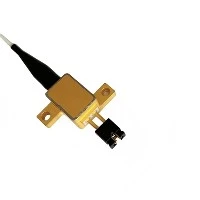
Single Wavelength Single Channel Optical Fiber Transmission Laser System refers to a laser communication system that uses a single wavelength light source to transmit data in a single optical fiber channel. The core of this system is to use lasers of specific wavelengths to generate optical signals and then transmit these signals through fiber optic lines. Since only one wavelength is used, the system design is relatively simple but has significant potential to improve communication efficiency.

In the modern information society, optical fiber communications play a vital role. With the explosive growth of Internet and data communication demands, optical fiber communication has become the backbone supporting global communication networks due to its advantages such as high bandwidth, low attenuation and resistance to electromagnetic interference. The use of optical fiber has spread to long-distance communications, metropolitan area networks, and even access networks and home broadband. It is an indispensable infrastructure for modern communications.
The simplified design of a single-wavelength, single-channel fiber-delivered laser system means lower cost, making it particularly attractive in resource-constrained applications. Additionally, such a system can simplify network management and operations in some cases because it reduces the need for complex multi-wavelength lasers and associated management equipment. Although single-wavelength single-channel systems may not provide the same total bandwidth as multi-wavelength systems, they can still meet efficient communications needs in certain applications.
The working principle of single-wavelength single-channel optical fiber transmission laser system is mainly based on the principle of total reflection of light, and improves communication efficiency and signal quality through specific design.
The single-wavelength single-channel optical fiber transmission laser system uses the phenomenon of total internal reflection of light in the optical fiber to transmit information. In such systems, a laser of a single wavelength is usually used as the light source, and the light source is modulated to produce light pulses of different intensities or phases, which represent the data to be transmitted. These light pulses then propagate along the optical fiber to the receiving end, where they are converted into electrical signals by a photodetector, and the original information is finally restored.
In order to improve communication efficiency and signal quality, the single-wavelength single-channel fiber transmission laser system takes a variety of measures:
Improve baud rate and spectrum usage efficiency: By improving the processing capabilities of the chip and adopting more efficient modulation formats, the single-channel transmission rate can be increased from 100G to 400G, 800G or even higher.
Optoelectronic sealing technology: This technology can eliminate critical impedance discontinuities, thereby increasing the bandwidth of the signal.
High-order modulation and digital coherent reception: The application of these technologies allows the system to operate at high baud rates, while compensating for damage to optical devices, improving the handling of nonlinear effects, bandwidth, IQ delay, crosstalk and other issues capabilities, thus improving transmission performance.
Application of advanced technologies such as machine learning: Optimizing system performance through machine learning and other methods further improves transmission efficiency and stability.
The technical innovation of the single-wavelength single-channel fiber transmission laser system is mainly reflected in the following aspects:
Design of new lasers: For example, the development of single-wavelength swept lasers, which have flexible wavelength tuning capabilities and can replace multiple fixed-wavelength lasers, thereby reducing the cost of the system. In specific fiber-optic sensing systems, such as trace gas detection, this laser can achieve high-sensitivity measurements by aligning the absorption peaks of different gas molecules.
Optimization of signal modulation methods: In some distributed optical fiber sensing systems, lasers are required to perform rapid periodic frequency sweeps to achieve high-precision coherent detection and demodulation. This requires the laser light source to have a high-speed modulation rate to meet the frequency sweep speed requirements.
Innovation in optical fiber technology: For example, the research team of the Shanghai Institute of Optics and Fine Mechanics of the Chinese Academy of Sciences used self-developed low-loss anti-resonant hollow-core optical fiber to achieve single-mode flexible transmission of high-power lasers. Due to its special structural design, this optical fiber can reduce nonlinear effects and laser damage during long-distance transmission, improving the efficiency and safety of laser transmission.
Progress in transmission algorithms: With the development of transmission algorithms, engineering capabilities are getting closer and closer to the theoretical limit, which makes single-wave speed-up technology face challenges. Therefore, developing new available spectrum has become an innovative direction for the optical network industry to expand transmission capacity.

These technological innovations not only improve the communication efficiency and signal quality of single-wavelength single-channel optical fiber transmission laser systems, but also open up new possibilities for the development of optical fiber communication technology. Through continuous technological iteration and innovation, single-wavelength single-channel optical fiber transmission laser systems are expected to play a more important role in future communication networks.
Single-wavelength single-channel fiber-optic transmission laser systems have a wide range of application potential in different fields, especially in fields such as long-distance communications and data center links. With its simplified design and continuously improving technological innovation, the single-wavelength single-channel optical fiber transmission laser system has shown significant potential in achieving efficient and stable communications, and is expected to play a more important role in future communication networks.
Long-distance communication: Single-wavelength single-channel optical fiber transmission laser system has huge application potential in long-distance communication. Because it uses a single wavelength, the system design is relatively simple and the cost is low, making it especially suitable for use in application scenarios with limited resources. In addition, this system has less signal attenuation and can maintain high signal quality during long-distance transmission, thereby achieving efficient communication.
Data center link: In terms of data center link, single-wavelength single-channel fiber transmission laser systems also have broad application prospects. As the amount of data continues to grow, the demand for connections between data centers is getting higher and higher, requiring higher bandwidth and faster transmission speeds. The single-wavelength single-channel optical fiber transmission laser system can meet these needs and provide efficient and stable data transmission services.
Other fields: In addition to the above fields, the single-wavelength single-channel fiber transmission laser system can also be applied to other scenarios that require high-speed and efficient communication, such as satellite communications, military communications, etc.
Single-wavelength single-channel optical fiber transmission laser systems are of significant importance in improving communication efficiency. With its simplified design and specific technical innovations, this system can maintain high signal quality over long distances, thereby achieving efficient communications. Especially in application scenarios with limited resources, its cost-effectiveness is more prominent.
However, continued research and development is still necessary. With the continuous growth of communication needs and the continuous advancement of technology, single-wavelength single-channel fiber transmission laser systems also require continuous technological iteration and innovation to adapt to more complex and diverse communication environments. Looking forward to the future, we expect that the single-wavelength single-channel fiber transmission laser system can exert its huge potential in more fields and make greater contributions to the development of global communication networks.
Contact information:
If you have any ideas, feel free to talk to us. No matter where our customers are and what our requirements are, we will follow our goal to provide our customers with high quality, low prices, and the best service.
 Email:info@loshield.com
 Tel:0086-18092277517
 Fax: 86-29-81323155
 Wechat:0086-18092277517


