



In recent years, the use of Laser Cutting Machine technology has become increasingly popular in the production and processing of semiconductor materials. The principle of this method is to use a focused laser beam to modify the substrate from the surface or inside the material, thereby separating it. Since this is a non-contact process, the effects of tool wear and mechanical stress are avoided. As a result, it greatly improves the roughness and accuracy of the wafer surface and also eliminates the need for subsequent polishing processes, reducing material loss, lowering costs, and reducing environmental pollution caused by traditional grinding and polishing processes. Laser cutting technology has long been used in cutting silicon ingots, but its application in the field of silicon carbide is not yet mature. At present, there are mainly the following technologies.
1. Water guide laser cutting
Water-guided laser technology (Laser MicroJet, LMJ), also known as laser microjet technology, its principle is to focus the laser beam on a nozzle when the laser passes through a pressure-modulated water cavity; a low-pressure water column is ejected from the nozzle, Due to the refractive index, an optical waveguide can be formed at the interface between water and air, allowing the laser to propagate along the direction of the water flow, thereby guiding the surface of the processed material for cutting through the high-pressure water jet. The main advantage of water-guided laser is the cutting quality. The water flow can not only cool the cutting area, reduce the thermal deformation and thermal damage of the material, but also take away the processing debris. Compared with wire saw cutting, its speed is significantly faster. However, because water absorbs laser light of different wavelengths to different degrees, the laser wavelength is limited, mainly 1064nm, 532nm, and 355nm.
In 1993, Swiss scientist Beruold Richerzhagen first proposed this technology. The company he founded, Synova, specializes in the research and development and industrialization of water-guided lasers. It is in a leading position in technology internationally. Domestic technology is relatively backward. Inno Laser and Shengguang Silicon Research Other companies are actively researching and developing.
2. Invisible cutting
Stealth Dicing (SD) focuses laser light on the inside of the wafer through the surface of silicon carbide to form a modified layer at the required depth, thereby peeling off the wafer. Since there are no cuts on the wafer surface, high processing accuracy can be achieved. The SD process with nanosecond pulsed lasers is already used in industry to separate silicon wafers. However, during nanosecond pulse laser-induced SD processing of silicon carbide, thermal effects will occur because the pulse duration is much longer than the coupling time between electrons and phonons in silicon carbide (picosecond order). High heat input to the wafer not only makes separation prone to deflection from the desired direction, but also creates large residual stresses that can lead to fractures and poor cleavage. Therefore, when processing silicon carbide, the SD process of ultra-short pulse laser is generally used, and the thermal effect is greatly reduced.

Japanese DISCO Company has developed a laser cutting technology called key amorphous-black repetitive absorption (KABRA). Taking the processing of silicon carbide ingots with a diameter of 6 inches and a thickness of 20 mm as an example, the carbonized Silicon wafer productivity increased fourfold. The KABRA process essentially focuses the laser inside the silicon carbide material. Through "amorphous black repeated absorption", the silicon carbide is decomposed into amorphous silicon and amorphous carbon, and forms a layer that serves as the base point for wafer separation, that is, black The amorphous layer absorbs more light, allowing the wafers to be easily separated.
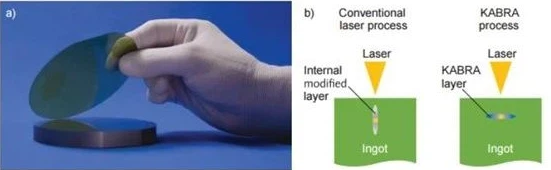
The Cold Split wafer technology developed by Siltectra, acquired by Infineon, can not only divide various types of ingots into wafers, but also reduce the loss of each wafer to as low as 80 μm, reducing material loss by 90%. The total final device production cost is reduced by up to 30%. Cold cutting technology is divided into two steps: first, the crystal ingot is irradiated with laser to form a peeling layer, which expands the internal volume of the silicon carbide material, thereby generating tensile stress and forming a layer of very narrow micro-cracks; and then the micro-cracks are cut through the polymer cooling step. The crack is processed into a main crack that ultimately separates the wafer from the remaining ingot. In 2019, a third party evaluated this technology and measured the surface roughness Ra of the wafer after segmentation to be less than 3µm, with the best result being less than 2µm.

Modified dicing developed by China JTBYShield Laser is a laser technology that separates semiconductor wafers into individual chips or dies. This process also uses a precision laser beam to scan inside the wafer to form a modified layer, so that the wafer can expand along the laser scanning path through external stress to complete precise separation.

At present, we have mastered the technology of mortar cutting silicon carbide, but mortar cutting has high losses, low efficiency and serious pollution. It is gradually being iterated by diamond wire cutting technology. At the same time, the performance and efficiency advantages of laser cutting are outstanding, which is different from traditional mechanical contact processing. The technology has many advantages, including high processing efficiency, narrow scribing path, and high chip density. It is a strong competitor to replace diamond wire cutting technology and opens up a new way for the application of next-generation semiconductor materials such as silicon carbide. With the development of industrial technology, the size of silicon carbide substrates continues to increase, silicon carbide cutting technology will develop rapidly, and efficient and high-quality laser cutting will be an important trend in silicon carbide cutting in the future.
Contact information:
If you have any ideas, feel free to talk to us. No matter where our customers are and what our requirements are, we will follow our goal to provide our customers with high quality, low prices, and the best service.
 Email:info@loshield.com
 Tel:0086-18092277517
 Fax: 86-29-81323155
 Wechat:0086-18092277517


