



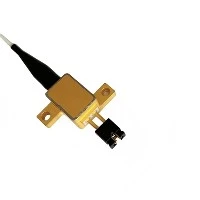
Laser barcode scanners use semiconductor lasers to emit a thin and long beam of light, and turn point lasers into line lasers through rotating prisms or swinging lenses. Its beam is thin and uniform, with a long scanning distance and fast speed, which is suitable for high-precision and long-distance barcode scanning.

Red light barcode scanners usually use LED as a light source. After the light is reflected by the barcode, it is captured by the CCD photosensitive element and converted into an electrical signal. Its scanning line is thicker and covers a large area, which is suitable for close-range and low-precision barcode scanning. Its advantage is that it has a strong recognition ability for barcodes with poor printing quality or damaged surfaces, and the equipment has high stability and low maintenance costs.
Features of laser barcode scanners
1. Working principle
Laser barcode scanners use laser diodes to emit a thin beam of light, and through a rotating prism or swinging lens, the point laser is turned into a line laser to illuminate the barcode. After reflection, the light is received by the sensor and converted into an electrical signal, which is then processed into digital information by the decoder to complete the barcode reading.
2. Advantages
Laser barcode scanners have the advantages of fast scanning speed, long scanning distance and strong adaptability to light environments. Its high precision and long-distance scanning capabilities make it suitable for a variety of industrial and commercial environments.
3. Disadvantages
Laser barcode scanners are relatively expensive and may not be very sensitive to low-quality or damaged barcodes. In addition, its structure is relatively complex and susceptible to physical damage.
Features of red light barcode scanners
1. Working principle
Red light barcode scanners usually use LED as a light source to capture barcode images through CCD or CMOS image sensors. After the light is emitted from the LED, it shines on the barcode, and the reflected light is received by the image sensor and converted into an electronic signal, which is then processed into readable data by the decoder.
2. Technical features
Red light barcode scanners have the advantages of low cost, simple maintenance, and strong recognition of low-quality barcodes. The LED light source it uses has low power consumption, and the equipment structure is relatively simple, easy to operate and maintain. In addition, the red light barcode scanner performs well when scanning at close range.
3. Advantages
Red light barcode scanners have strong recognition capabilities for barcodes with poor printing quality or damaged surfaces. Due to the large coverage area of its light source, it can effectively read blurred or incomplete barcode information.
4. Disadvantages
The scanning distance of the red light barcode scanner is short, and it is usually suitable for close-range scanning. In addition, it has high requirements for the light environment, and recognition difficulties may occur in strong light environments, affecting scanning efficiency and accuracy.
The main difference between red light barcode scanner and laser barcode scanner
1. Difference in working principle
Red light barcode scanner usually uses LED light source to capture images for decoding through CCD sensor. Laser barcode scanner uses laser diode to emit light beam and uses reflected light to identify barcode. These two different technical paths determine their different performances in scanning performance and application environment.
2. Difference in performance
Laser barcode scanner has faster scanning speed, longer distance and higher accuracy, which is suitable for high-precision and long-distance scanning scenarios. Although the scanning speed of red light barcode scanner is relatively slow, it performs well in close-range and low-precision applications and has low cost.
3. Difference in applicable environment
Red light barcode scanner is suitable for scenes with good light environment and high barcode quality, such as retail supermarkets and warehouse management. Laser barcode scanner is more suitable for environments with complex light or damaged barcode, such as industrial manufacturing and logistics transportation.
4. Difference in price
The cost of laser barcode scanner is relatively high, but its high performance and long life make it more cost-effective in long-term use. Red light barcode scanner is low-priced and suitable for application scenarios with limited budget, but may require more frequent maintenance and replacement.
5. Differences in maintenance and usage requirements
Laser barcode scanners have a more complex structure and require regular maintenance and calibration, but their drop resistance is poor. Red light barcode scanners have a simple structure, are easy to operate and maintain, and have a strong tolerance to physical damage, making them suitable for use in harsh environments.
Comparison of application scenarios
Red light barcode scanners are suitable for environments such as retail and supermarkets where paper barcodes need to be scanned frequently. It has strong recognition capabilities for barcodes with poor printing quality and low cost, which is suitable for application scenarios with limited budgets. In addition, the red light barcode scanner has a simple structure and is easy to operate and maintain.
Laser barcode scanners are suitable for scenarios such as industrial manufacturing and logistics transportation that require high-precision and long-distance scanning. It has fast scanning speed, long distance, high accuracy, and can adapt to complex light environments and various barcode qualities, but the cost is relatively high and requires regular maintenance and calibration.
Choose the appropriate type of barcode scanner according to the actual application scenario. If you need to use it in an environment with close distance, good light and high barcode quality, you can choose a red light barcode scanner; if you need to use it in an environment with long distance, complex light or damaged barcode, a laser barcode scanner is a better choice.
Red light barcode scanners and laser barcode scanners each have their own unique advantages and limitations. Red light barcode scanners use LED light sources and capture images for decoding through CCD photosensitive elements. They have the advantages of strong recognition capabilities for barcodes with poor printing quality, relatively low cost, and suitable for close-range scanning, but have the disadvantages of short scanning distance, high requirements for light environment, and relatively slow scanning speed. Laser barcode scanners use laser diodes to emit light beams and use reflected light to identify barcodes. They have the advantages of fast scanning speed, long scanning distance, and strong adaptability to light environment, but their cost is relatively high and they may not be very sensitive to low-quality or damaged barcodes.
According to different application requirements, it is crucial to choose the right type of barcode scanner. For example, in environments such as retail supermarkets where paper barcodes need to be scanned frequently, red light barcode scanners are ideal because of their close-range and efficient scanning capabilities; while in scenarios such as industrial manufacturing and logistics transportation that require high-precision and long-distance scanning, laser barcode scanners are more suitable. Therefore, when choosing a barcode scanner, you should decide which type of barcode scanner to use based on the actual application scenario and needs.
Contact information:
If you have any ideas, feel free to talk to us. No matter where our customers are and what our requirements are, we will follow our goal to provide our customers with high quality, low prices, and the best service.
 Email:info@loshield.com
 Tel:0086-18092277517
 Fax: 86-29-81323155
 Wechat:0086-18092277517


