




RGB laser module is a three-in-one module integrating red, green and blue lasers, which can produce multiple colors of light or white laser. Its advantages include high brightness, rich colors and good directionality. It is widely used in display, lighting, scientific research, medical and other fields, such as improving display brightness and color, used for efficient lighting, assisting scientific research experiments, serving disease diagnosis and treatment, etc., and is playing an increasingly important role.
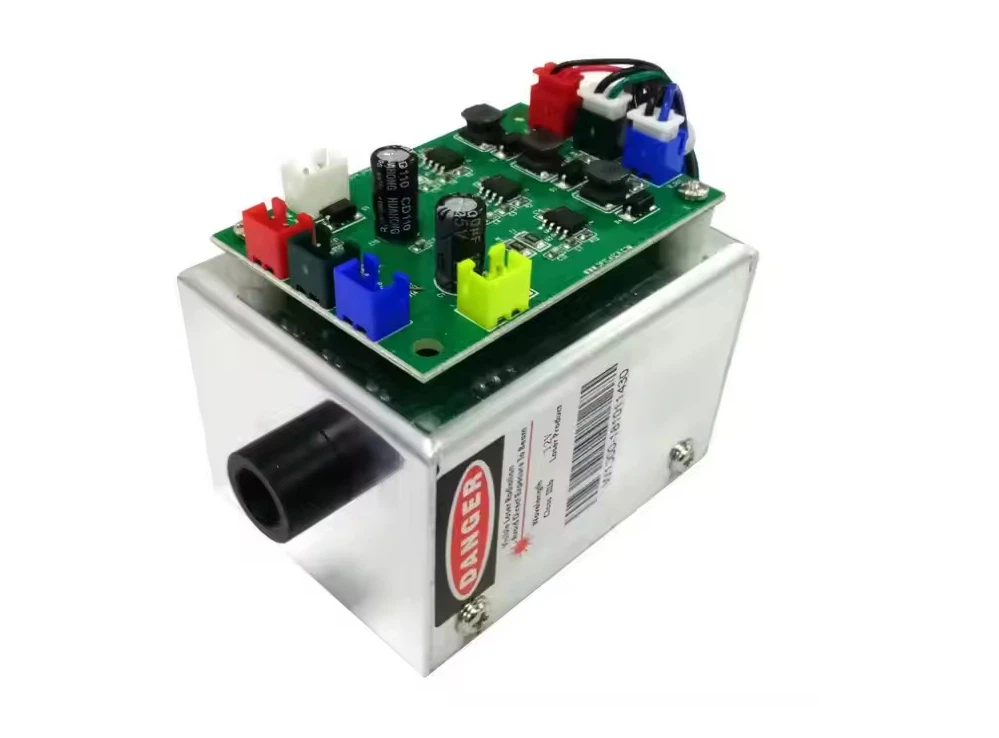
Working principle of RGB laser module
1. Principle of RGB three-color laser
(1) Wavelength range and color characteristics
Red light (R): Typical wavelength 635-660nm (such as 635nm, 650nm), semiconductor laser has high efficiency and low cost.
Green light (G): Wavelength 520-532nm (such as 520nm direct diode, 532nm DPSS laser), green light has high human eye sensitivity, but the technology is difficult (frequency doubling crystal is required).
Blue light (B): Wavelength 445-465nm (such as 450nm gallium nitride laser diode), the efficiency has been significantly improved in recent years.
(2) Additive color mixing principle
By adjusting the intensity ratio of the three-color laser, any color in the visible spectrum can be mixed (such as red light + green light = yellow light, all three colors = white light).
Advantages: Color gamut coverage >150% NTSC (far exceeding LED or LCD), extremely high color saturation.
2. Types of laser light sources
(1) Semiconductor laser diode (LD)
Direct light emission: Red/blue LD is mature, and green LD (such as 520nm) has been gradually commercialized in recent years.
Features: small size, high efficiency (electric-to-optical conversion rate 30-50%), but the power and stability of green LD still need to be optimized.
(2) Solid-state laser (DPSS, diode-pumped solid-state laser)
Common in Green light (532nm): Infrared LD pumps Nd:YVO₄ crystal, and produces green light through frequency doubling (KTP crystal).
Features: Good beam quality, but complex structure, high cost, and problems of heat generation and efficiency loss.
(3) Fiber laser (optional)
Suitable for high-power scenarios (such as laser projection), amplifying lasers through rare earth-doped optical fibers, but large in size and less used in civilian applications.
3. Optical synthesis technology
(1) Beam splitter/beam combiner (Dichroic Mirror)
Function: Selectively reflect/transmit specific wavelengths (such as reflecting red light and transmitting green and blue light).
Synthesis path: Three laser beams are synthesized into a single path through multiple layers of lenses to ensure that the optical axes coincide.
(2) Beam collimation and focusing
Collimation lens: Corrects the laser divergence angle (usually <1mrad) to form a parallel beam.
Diffuser: Used for uniform light (such as projection applications) to avoid laser speckle (graininess caused by coherent interference).
4. Modulation and control
(1) Brightness modulation
PWM (pulse width modulation): Adjusts the average brightness by quickly switching the laser on and off (duty cycle control) to avoid the nonlinear problem of analog modulation.
Analog modulation: Directly adjusts the drive current, which has a faster response, but requires linear calibration.
(2) Color calibration and white balance
Calibration process:
Measure the output power of each laser wavelength;
Match the three-color intensity (such as the D65 white point standard) through the drive current or PWM duty cycle;
Store calibration parameters in the control chip (such as the lookup table LUT).
Dynamic adjustment: temperature compensation (wavelength drift) and aging compensation (power attenuation).
Application areas of RGB laser modules
1. Laser display and projection
(1) Laser TV and home theater
Technical features:
Adopting RGB three-primary color laser light source, the color gamut coverage is **>150% DCI-P3**, far exceeding the traditional LED backlight.
High brightness (3000-5000 lumens), support HDR, suitable for large-screen immersive viewing.
Representative products: Sony laser projector, Hisense laser TV.
(2) Digital cinema projection
Advantages:
Long life (more than 20,000 hours), no need to frequently replace lamps.
Support 8K resolution, such as Barco laser cinema system.
(3) AR/VR near-eye display
Application:
Micro RGB laser modules are used in VR headsets to achieve high contrast and low latency (such as Magic Leap's laser scanning display technology).
Solve the "screen door effect" problem of traditional OLED.
2. Stage lighting and entertainment
(1) Laser shows and concerts
Technical solution:
High-speed galvanometer scanning (over 30kpps) generates dynamic patterns (text, geometric shapes).
RGB laser + smoke medium to form a three-dimensional beam effect (such as the Coachella Music Festival laser show).
Safety standards: Must comply with IEC 60825 laser safety level (usually Class 3B/4).
(2) Architectural projection and theme parks
Case:
Disneyland's "Castle Light Show" uses high-power RGB laser modules (over 10W) to achieve a projection distance of kilometers.
Combined with 3D Mapping technology, dynamically cover architectural surfaces.
3. Industry and scientific research
(1) Laser measurement and sensing
Application:
Laser interferometers (such as Zygo) use monochromatic lasers, and RGB expands multi-wavelength measurements to improve accuracy.
RGB laser scanning in LiDAR is used for autonomous driving environment modeling.
(2) Holographic imaging
Principle:
RGB laser provides coherent light source to record the three-dimensional light field information of the object (such as Holoxica's holographic display).
In the field of scientific research, it is used for microscopic imaging of biological cells.
(3) Spectral analysis
Advantages:
Narrow line width (<0.1nm) laser improves detection sensitivity (such as Raman spectroscopy to detect pollutants).
4. Medical and beauty
(1) Laser therapy
Clinical applications:
Red light (635nm): promotes wound healing and anti-inflammatory (LLLT low-intensity laser therapy).
Blue light (405nm): sterilization (such as acne treatment).
Equipment example: Alma laser medical platform.
(2) Skin beauty
RGB phototherapy:
Red light stimulates collagen, green light dilutes pigments, and blue light controls oil and inhibits bacteria.
Home devices such as Foreo UFO mask instrument integrate RGB laser modules.
5. Other emerging applications
(1) 3D printing
Technical route:
Laser sintering (SLS) uses RGB multi-wavelengths to match different materials (such as metal/ceramic powders).
Harvard University developed the "multi-color light curing" technology to achieve full-color 3D printing.
(2) Laser communication (LiFi)
Principle:
RGB laser replaces LED to increase data transmission rate (the laboratory has reached 100Gbps).
The US Soraa company develops a visible light communication prototype.
(3) Smart lighting
Scenario:
Museum lighting: RGB laser accurately restores the true color of cultural relics (such as the lighting of Louvre oil paintings).
Emotional lighting: Dynamically adjust color temperature and hue (such as the Philips Hue laser version concept product).
RGB laser modules are widely used in laser display (such as cinema projection, AR/VR), stage entertainment (laser show, architectural projection), industrial research (holographic imaging, spectral analysis), medical cosmetology (phototherapy, skin repair) and emerging fields (3D printing, laser communication) due to their advantages of high brightness, wide color gamut and precise control. Its core technology lies in the synthesis and modulation of RGB three-color lasers. In the future, with the reduction of green laser costs and miniaturization, it will further promote the popularization of the consumer market, but it still needs to break through technical bottlenecks such as heat dissipation and safety standards.
Contact information:
If you have any ideas, feel free to talk to us. No matter where our customers are and what our requirements are, we will follow our goal to provide our customers with high quality, low prices, and the best service.
 Email:info@loshield.com
 Tel:0086-18092277517
 Fax: 86-29-81323155
 Wechat:0086-18092277517


