



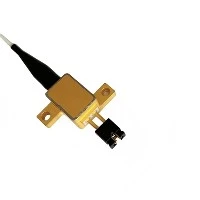
589nm Yellow Lasers with a wavelength of 589 nm can be used in optogenetics, sodium laser beacons, temperature and wind laser radars, laser Raman, dynamic nuclear polarization, urban landscape, scientific research, and national defense and military fields. Obtaining yellow lasers with high efficiency, high beam quality, high stability, and narrow linewidth is an inevitable requirement for high-end applications
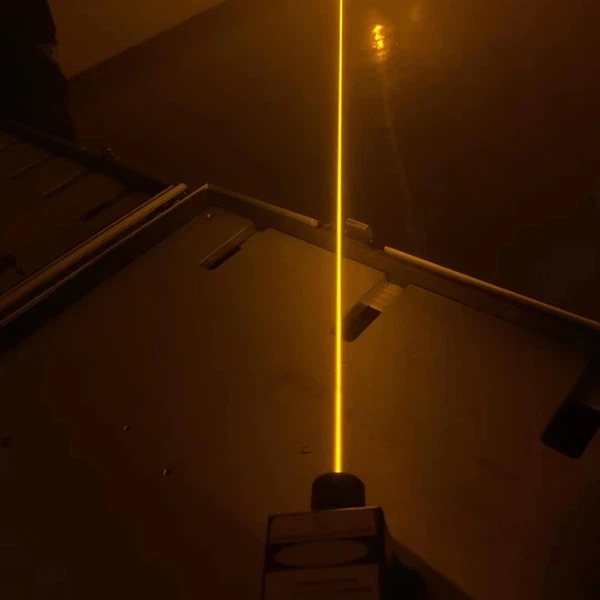
Physical principles of 589nm laser
1. Relationship between sodium D line and 589nm wavelength
The core physical basis of 589nm laser is the energy level transition of sodium atoms. The outer electrons (3s→3p) of sodium atoms will produce two characteristic spectral lines when deexcited, namely sodium D lines:
D₁ line: 589.6nm (3p¹P₁/₂ → 3s¹S₁/₂)
D₂ line: 589.0nm (3p¹P₃/₂ → 3s¹S₁/₂)
Since these two spectral lines are very close (only 0.6nm difference), they are usually collectively referred to as 589nm sodium yellow light. The resonance characteristics of this wavelength with sodium atoms make it an ideal choice for applications such as laser guide stars (LGS) and cold atom experiments.
2. Basic conditions for laser generation
To generate stable 589nm laser, three elements of laser must be met:
Stimulated emission: sodium atoms or electrons in gain media (such as Nd:YAG) are made to jump to high energy levels through external pumping (such as light or current).
Particle inversion: the number of high-energy level particles is greater than the number of low-energy levels in the laser medium (such as neodymium-doped crystal or dye) to amplify light of a specific wavelength.
Resonant cavity: an optical feedback system composed of reflectors (such as DPSS laser or dye laser) that screens and enhances modes near 589nm.
3. Frequency conversion technology (nonlinear optical method)
Since it is difficult to directly generate 589nm laser, nonlinear frequency conversion technology is usually used:
Nd:YAG laser emits 1064nm fundamental frequency light.
Frequency doubling (SHG): converted to 532nm (second harmonic) through nonlinear crystals (such as LBO).
Raman Shift: Use Raman media (such as high-pressure hydrogen or solid crystals) to shift the 532nm light frequency to 589nm.
Technical realization of 589nm laser
Currently, 589nm laser is mainly realized by the following three technical solutions, each with its own advantages and disadvantages:
(1) Solid-state laser (Nd:YAG + nonlinear frequency conversion)
Principle:
First, the Nd:YAG laser generates 1064nm fundamental frequency light.
It is converted to 532nm green light through a frequency doubling crystal (such as LBO, BBO).
Then use Raman frequency shift (such as high-pressure hydrogen cell or solid-state Raman crystal) to convert 532nm to 589nm.
Advantages:
High power (up to tens of watts), good stability, suitable for high-power applications such as sodium guide stars.
The technology is mature and widely used in observatories (such as Keck and VLT telescopes).
Disadvantages:
The system is complex and requires precise temperature control and optical alignment.
The Raman frequency shift efficiency is low (usually <50%) and the energy loss is large.
(2) Dye laser (tunable to 589nm)
Principle:
Use organic dye (such as rhodamine 6G) as gain medium, and output 589nm through grating tuning.
Advantages:
The wavelength is continuously adjustable, suitable for laboratory spectral research.
Can accurately match the sodium D line (589.0/589.6nm).
Disadvantages:
The dye is easy to degrade and needs to be replaced regularly, and the maintenance cost is high.
The output power is low (usually <1W), and the stability is greatly affected by the pump source.
(3) Semiconductor laser (direct emission or external cavity feedback)
Principle:
Use specially designed semiconductor gain chips (such as GaInP/AlGaInP) combined with volume Bragg grating (VBG) to lock the wavelength of 589nm.
Advantages:
Small size, high efficiency, suitable for portable applications (such as medical equipment).
No complex frequency conversion is required, and the power consumption is low.
Disadvantages:
The wavelength is easily affected by temperature and requires active frequency stabilization (such as saturation absorption spectroscopy technology).
The power of a single tube is limited (usually <500mW), and high power requires multiple tubes to be combined.
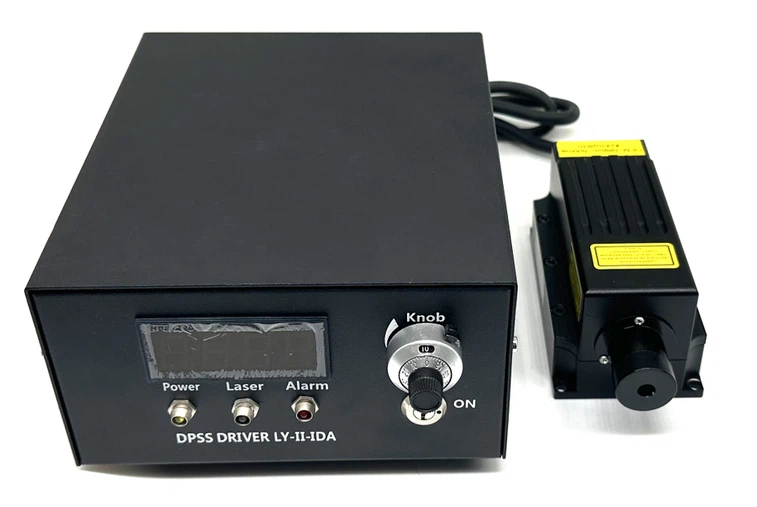
Application fields of 589nm laser
1. Adaptive optics and astronomical observation
(1) Sodium guide star (LGS)
Principle:
589nm laser excites the sodium atomic layer (middle atmosphere) 90-100km above the earth's surface to produce artificial guide stars.
Function:
Provide real-time wavefront correction for large ground-based telescopes (such as Keck and VLT) to offset the influence of atmospheric turbulence.
Significantly improve observation resolution (close to the diffraction limit).
Advantages:
Compared with natural guide stars, sodium guide stars can be generated on demand and have flexible positions.
Applicable to observation areas without bright stars (such as dark areas of the Milky Way).
(2) Extended applications
Multi-laser guide star system: multiple 589nm lasers work together to correct larger field of view distortion.
Space debris tracking: Sodium layer reflected laser assists in monitoring debris in low-Earth orbit.
2. Biomedical applications
(1) Photodynamic therapy (PDT)
Principle:
589nm can be selectively absorbed by biological molecules such as hemoglobin and is used for targeted treatment of vascular diseases.
Case:
Port wine stains: The laser penetrates the epidermis and is absorbed by hemoglobin, destroying abnormal blood vessels.
Macular degeneration: Auxiliary treatment of retinal diseases.
(2) Fluorescence imaging
Sodium ion labeling:
589nm excites sodium ion fluorescent probes to study cellular sodium ion dynamics (such as neuronal electrical activity).
Advantages:
Low phototoxicity, suitable for long-term observation in vivo.
3. Research and industry
(1) Cold atom physics and Bose-Einstein condensation (BEC)
Function:
589nm laser is used for sodium atom laser cooling (Doppler cooling) to achieve ultra-low temperatures of μK level.
It is a key step in the preparation of BEC (quantum state matter).
Cases:
Laboratories such as MIT and Harvard use 589nm lasers to study superfluidity and quantum simulation.
(2) Precision measurement
Spectral calibration:
Used as a standard wavelength to calibrate spectrometers (such as astronomical spectrometers).
Gravitational wave detection:
Assists in the optical path debugging of interferometers (such as LIGO).
4. Other applications
(1) Laser display and lighting
Sodium lamp replacement:
The high monochromaticity of 589nm lasers can be used for high color rendering lighting or art projection.
Laser cinema:
Combined with RGB lasers to expand the color gamut coverage.
(2) Industrial processing
Special material processing:
Selective processing of certain polymers/films (such as OLED repair).

Application Summary Table
| Field | Typical Applications | Key Requirements | Technical Solutions |
|---|---|---|---|
| Astronomy | Sodium guide star, AO correction | High power (>20W), narrow linewidth | Solid-state (Nd:YAG + Raman) |
| Biomedicine | PDT, fluorescence imaging | Wavelength precision (±0.1nm), low noise | Semiconductor/dye lasers |
| Research | Cold atoms, BEC | Frequency stability (<1MHz drift) | External-cavity diode lasers |
| Industry | Spectral calibration, displays | Cost-effectiveness, compactness | Direct diode lasers |
Future Trends
Astronomy: Development of higher-power (100W-class) sodium guide star lasers for 30m telescopes (e.g., TMT).
Medicine: Integration with nanoprobes for enhanced precision in targeted therapy.
Quantum Tech: Applications in sodium atomic clocks or quantum memory.
The interdisciplinary potential of 589nm lasers continues to expand, particularly in quantum technologies and extreme-environment sensing.
The 589nm laser, leveraging sodium D-line emission (589.0/589.6nm), is a versatile tool with critical applications in astronomy (sodium guide stars for adaptive optics), biomedicine (photodynamic therapy and cellular imaging), quantum research (cold atom cooling and BEC studies), and industry (precision metrology and displays). Its unique resonance with sodium atoms enables high-precision tasks, while ongoing advancements aim to boost power, stability, and miniaturization for next-generation technologies like extreme-scale telescopes and quantum computing. This wavelength bridges fundamental science and cutting-edge engineering, driving innovation across disciplines.
Contact information:
If you have any ideas, feel free to talk to us. No matter where our customers are and what our requirements are, we will follow our goal to provide our customers with high quality, low prices, and the best service.
 Email:info@loshield.com
 Tel:0086-18092277517
 Fax: 86-29-81323155
 Wechat:0086-18092277517


