



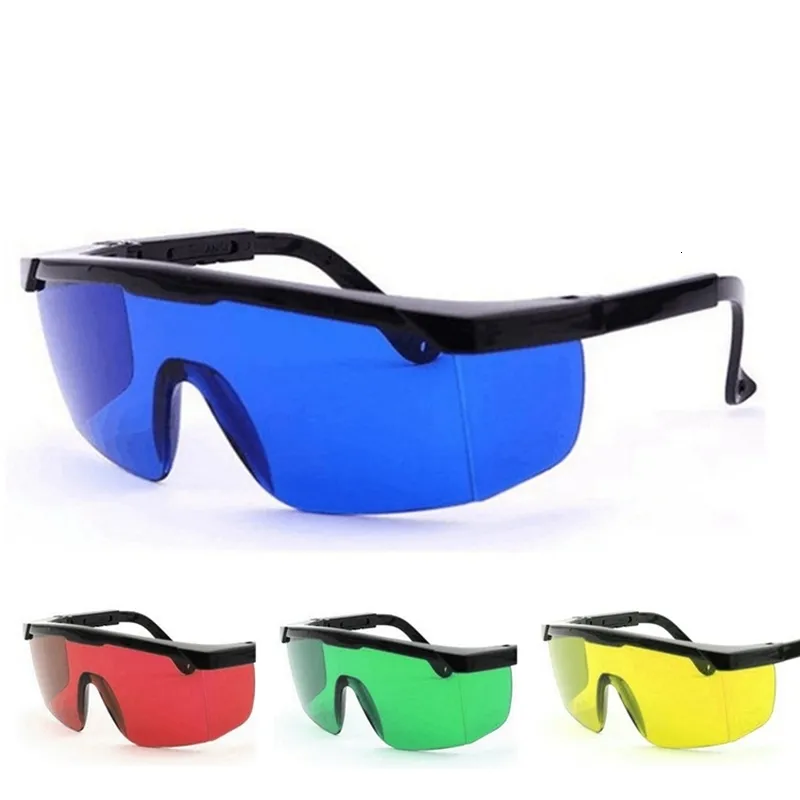
Laser safety glasses aren't just colored plastic – their hue is a direct visual indicator of the specific laser wavelengths they block. Choosing the wrong color can render protection useless, leading to catastrophic eye injury. This guide decodes the physics, standards, and critical selection strategies for global professionals.
I. The Physics: Why Lens Color = Protected Wavelength
Laser protection relies on selective light absorption or reflection, governed by material science. Color emerges from which wavelengths are blocked vs. transmitted.
1. Absorptive Lenses (Most Common)
Embedded dyes absorb laser energy, converting it to heat. Color depends on dye's molecular structure:
| Lens Color | Target Wavelength (nm) | Transmitted Light |
|---|---|---|
| Orange/Amber | 190-540 (Blue/Green) | Enhanced reds/yellows |
| Green | 600-700 (Red) | Greens, limited blues |
| Deep Red | 800-1100 (NIR) | Deep reds, blocks IR |
| Gray | Multi-wavelength | Neutral attenuation |
🔬 Science Note: Deeper tints (e.g., OD6+) absorb more energy but reduce visible light transmission (VLT). Exceeding power limits causes thermal lensing (distortion) or coating burnout.
2. Reflective/Interference Lenses
Dielectric coatings reflect lasers via thin-film interference. Colors appear metallic:
Gold: Reflects 532nm (Green) & 1064nm (IR)
Blue-Silver: Blocks CO₂ lasers (10,600nm)
⚠️ Critical Risk: Reflected beams create secondary hazards – never use near untrained personnel.
II. When Color Choice Becomes Critical: 4 High-Risk Scenarios
1. Multi-Laser Environments
Example: Biotech lab (405nm diode + 1064nm Nd:YAG)
Wrong Choice: Green lenses (block red, transmit IR → IR burns retina).
Solution:
Use stacked filters (e.g., orange outer + gray inner).
Verify dual certification (e.g., "OD7+ @ 405nm & OD6+ @ 1064nm").
2. Precision Visual Tasks
Example: Ophthalmic surgery (532nm laser + tissue color differentiation)
Wrong Choice: Deep red lenses (obscures blood vessels).
Solution:
Choose high-contrast yellow (VLT >50%) with OD4+ at 532nm.
Opt for coated polycarbonate – lighter than glass.
3. High-Power/Pulsed Lasers
Example: Industrial cutting (kW-class fiber lasers)
Wrong Choice: Absorptive dark lenses – melt under peak power.
Solution:
Reflective gold coatings (handles >10 MW/cm²).
Confirm pulse duration rating (ns/ps/fs).
4. Variable Ambient Light
Example: Outdoor LIDAR maintenance (905nm laser + sunlight)
Wrong Choice: Static gray lenses – too dark at dusk.
Solution:
Photochromic lenses (e.g., adapts from OD3 to OD7).
Auto-darkening filters (ADF) with laser detection.
III. Beyond Color: 5 Non-Negotiable Selection Criteria
OD Rating Calculation
Formula: OD Required = log₁₀(Incident Power Density / MPE)
(MPE = Maximum Permissible Exposure per ANSI Z136.1)
Compliance Standards
| Region | Standard | Certification Mark |
|---|---|---|
| EU | EN 207:2018 | CE + Wavelength/Scale # |
| USA | ANSI Z87.1-2025 | "Z87+" stamp |
Material Durability
Polycarbonate: Impact-resistant, lightweight (good for OD<6).
Glass: Higher OD stability, scratch-resistant.
Peripheral Protection
Wrap-around designs block side reflections.
Goggle seals for UV/IR environments.
Usability Factors
VLT (%) for task clarity
Anti-fog coatings
Prescription compatibility

IV. Deadly Myths vs. Facts
| Myth | Fact | Consequence |
|---|---|---|
| "All red lenses block IR" | Some only block 650nm, transmit 800nm+ | Retinal burns |
| "Darker = Safer" | Over-darkness masks low OD flaws | False security |
| "Colorless lenses = No protection" | Clear dielectric coatings block IR/UV | Unprotected exposure |
🚨 Real Incident (2023): A researcher using "green" glasses with 1064nm laser suffered permanent vision loss – later testing showed OD=0 at 1064nm.
The 5-Step Selection Protocol
Audit Lasers: List all wavelengths, powers, pulse modes.
Calculate OD: Use OSHA/ANSI online calculators.
Filter by Standards: Require EN 207 or MIL-STD-31000.
Test Usability: Check VLT, weight, and field of view.
Validate: Demand 3rd-party test reports