


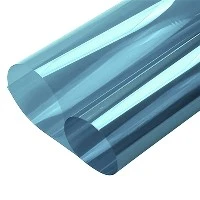

IR laser protective film is a functional optical material designed to reduce the transmission of infrared (IR) laser radiation, typically in the 700–2500 nm range. It operates through selective absorption, where the film material captures laser energy at specific wavelengths and converts it into heat, thereby attenuating the amount of radiation that passes through.
Unlike reflective coatings, IR protective film does not redirect laser beams, minimizing the risk of secondary reflections. This makes it suitable for integration into various industrial systems where visual access and optical safety are both required.
Below are the primary applications of IR laser protective film in real-world industrial environments.

1. Observation Windows in Laser Processing Equipment
In fiber laser cutting, welding, and marking systems, operators need visual access to the work area through transparent windows. These windows are commonly made of polycarbonate (PC) or PMMA, which are transparent to visible light but may allow significant transmission of IR laser radiation.
Applying an IR protective film to the inner surface of the window enhances absorption of key wavelengths such as 1064 nm, reducing the intensity of scattered or diffused laser light that could otherwise escape the enclosure.
The film is applied directly onto the substrate without altering the mechanical structure.
It can be cut to size for custom window shapes and equipment layouts.
Maintains visibility while adding a layer of optical attenuation.
2. Protection for Optical Sensors and Cameras
Many laser systems use vision systems or photodetectors for monitoring, alignment, or feedback control. These sensors can be exposed to stray IR laser light, which may degrade performance or damage sensitive components over time.
Placing an IR protective film in front of camera lenses or sensor apertures helps reduce incident IR radiation while maintaining sufficient visible light transmission for imaging.
Note: Since the film absorbs energy, localized heating may occur. It is not recommended for direct, continuous exposure to high-power laser beams.

3. Integration into Laser Safety Enclosures
Semi-open or modular laser workstations often use transparent barriers for operator access and monitoring. Adding an IR protective film to acrylic or glass panels increases their ability to absorb infrared radiation.
This approach is useful in environments where full enclosure is impractical, and provides an additional layer of passive protection when combined with interlocks and beam shrouds.
4. Multi-Wavelength Compatibility
Some industrial processes involve multiple laser sources - for example, a 1064 nm laser for material processing and a 1550 nm laser for distance sensing. IR protective films with broad absorption characteristics can provide attenuation across several IR wavelengths, reducing the need for multiple specialized filters.
How It Works: Absorption-Based Attenuation
The function of IR laser protective film relies on the intrinsic or doped absorption properties of its material:
Organic dyes, metal oxide nanoparticles, or polymer matrices are selected for their ability to absorb specific IR wavelengths.
When IR light passes through the film, photons are absorbed by the material's molecular or electronic structure.
The absorbed energy is converted into thermal energy (heat), which dissipates laterally through the substrate.
Key factors affecting performance:
Film thickness
Wavelength match between laser output and material absorption peak
Angle of incidence
Duration and intensity of exposure
Because the mechanism is absorptive rather than reflective, there is no risk of creating new beam paths, enhancing overall system safety.

Important Usage Notes
IR laser protective film is a passive component and is not intended to block direct, high-power laser beams.
Prolonged exposure may lead to material degradation, discoloration, or reduced effectiveness. Regular visual inspection is recommended.
Performance depends on actual operating conditions, including laser power density, exposure time, and environmental factors.
This product does not replace engineering controls such as fully enclosed housings, safety interlocks, or beam dumps. It serves only as a supplementary optical management solution.
Conclusion
IR laser protective film provides a practical method for reducing infrared laser transmission in industrial systems. By leveraging material absorption, it helps attenuate scattered or diffused laser radiation in applications such as equipment viewports, sensor protection, and partial enclosures.
Its non-reflective nature, ease of integration, and compatibility with common optical materials make it a useful component in laser safety design. However, due to the thermal effects of absorption, proper installation and periodic inspection are essential.
Always evaluate performance under actual operating conditions. This product functions as an auxiliary measure and should be used in conjunction with comprehensive laser safety practices.