


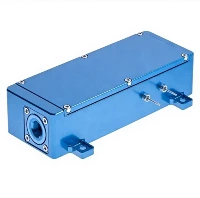
DOE Laser Module produces energy-adjustable point-ring spots that can be used for laser welding. But how to use it? Let's learn the knowledge together!
The laser welding speed can be adjusted by using the point Gaussian ring laser energy distribution, and the point ring laser welding effect can be achieved by adjusting the point ring spot energy process, so as to improve the welding speed and effect. Here is a novel and simple concept based on laser diffraction to realize the point ring spot shaping of standard fiber lasers. The Gaussian ring laser shaping method based on DOE consists of only two DOE lenses. It is easy to use and can accurately control the energy ratio between points and ring light spots to help users quickly find the optimal welding effect. The module can be rotated between 100% energy of the center spot and no energy of the center spot, can work with single-mode and multi-mode lasers, is highly compact (less than 20 mm long), and has a high Laser-induced damage threshold (LDT) of passive diffractive elements. This concept avoids the need for a special Gaussian ring laser fiber laser and makes the design of the welded laser head much simpler.
Laser welding is a technology widely used in many industrial processes in automotive, shipbuilding, battery pack, and other industries, in which welding speed becomes one of the most critical process limiting factors in many laser welding applications. The laser's high welding speed will be limited by various physical phenomena during the welding process, such as spatter, hump, and increased porosity of the weld. Limitations to these welding processes can be greatly reduced when using the point-ring laser welding method. For different process parameters of welding materials (such as metal thickness, metal type, and geometry), point-ring laser welding requires different adjustable point-ring energy ratios in order to provide the best process at high welding speeds. Therefore, for many optical systems, a controlled, adjustable beam power shaping solution is a comparative advantage.
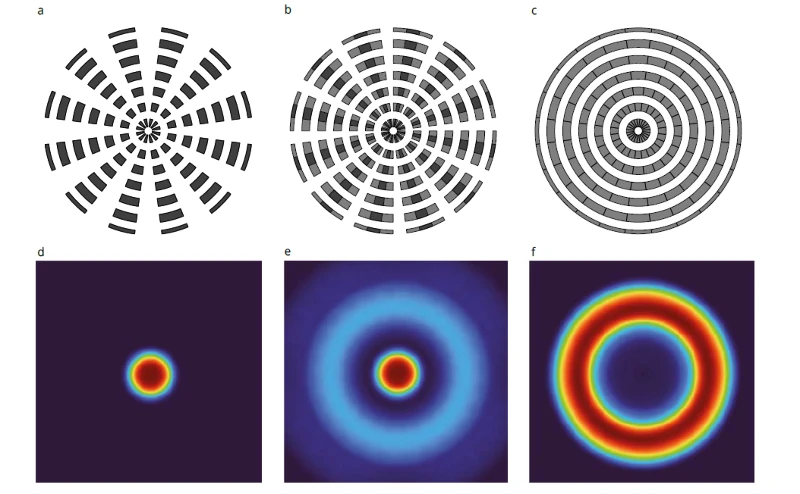
As shown in Figure 1, in this point-ring spot shaping scheme, three relative positions (a, b, and c) of two DOE are shown upward: the relative rotation angles of the two DOE are 0, 7.5, and 15 degrees respectively. The down shows the intensity distribution associated with each direction of rotation in the up: (d) in which all power is concentrated at the center point, (f) in which all power is concentrated at the ring, while (e) is the location where an adjustable point ring energy is distributed proportionally, with some of the energy being part at the center point and part at the surrounding ring.
In Gaussian ring laser shaping, based on the scheme of adjustable point ring spot energy ratio of fiber, the more common method of point ring spot shaping is to use a special multi-mode fiber laser, which has a double or three core, the center core is surrounded by one or two concurrent ring cores, and each core can set its laser power separately. Thus, the power of the central light spot and the surrounding ring light spot can be adjusted. Compared with common multi-mode high-power fiber lasers, this laser system has higher complexity and cost. Secondly, the high Numerical Aperture (NA) of such a Gaussian ring laser-shaped fiber implies the need for a special collimator, often requiring a larger optical component than the standard welded optical component of fiber lasers currently in use. Finally, there is often a limit to the ratio between the central and annular spots. In point-ring laser welding, in order to get more power at the solder joint, it is generally necessary to increase the power inside the ring. Most of the power goes into the central spot and only a small part goes into the ring spot, so full laser power cannot be used in this case unless a custom fiber core ratio is used.
This figure describes an alternative method of point-ring spot based on fiber Gaussian ring laser shaping, which achieves a point-ring laser welding effect, enables complete power ratio adjustment, and is also a simple, economical, and direct optical system. Based on diffractive optics, this method has provided a good solution to the system space size of a multi-kilowatt fiber laser system and overcomes the disadvantage of adding another component to the optical system.
The diffraction shaping scheme consists of two identical diffraction elements DOE, also known as phase plates, placed on the same optical axis. By rotating one phase plate to the other, the phase delay between the ring and the center point can be obtained. When the rotation between phase plates is zero and between full segments, the total phase overlaps in part, as shown in Figure 1b, resulting in part of the energy entering the ring, while the rest of the energy entering the center point, the proportion of which can be adjusted continuously.
The overall efficiency of the energy transfer of a point-ring spot varies from 100% for a single central point to 80% for a single ring. Efficiency is lost to higher diffraction transmission orders and appears as a second-order ring at higher angles. The whole range of variation occurs at one rotation Angle, equal to one Angle segment. The power variation of the center point is shown in Figure 2, which has a nonlinear relationship with the rotation Angle.

The optimization of adjustable point-ring spot energy is very important in point-ring laser welding. Once the process parameters are determined, the adjustable toroidal and point-shaped modules can be replaced by a single passive DOE, whose customized toroidal to point-shaped power ratio is considered to be the best choice for a particular welding process. This provides a more compact and economical orthopedic solution. This class of Do-based diffraction-based methods offers full control over the power ratio between spot rings compared to fiber-optic solutions currently on the market, unlike fiber-optic solutions with more limited tunability. This module can be adapted for large beams (15-22 mm in diameter) normally used for multi-kilowatt lasers, i.e. the optical element can be mounted to an off-the-shelf manual or electric rotating stand to form an optical module. Such modules can be placed on the optical axis behind the laser collimator, or even better, directly at the entrance of the laser head or scanning system. These configurations allow the welded optics to be consistent with those used in standard multimode fiber lasers without the need to account for larger NA and the larger, more expensive optics required as in ring-mode fiber lasers. The full range of adjustment only needs to be achieved by maneuvering the rotary table for a few seconds to complete the adjustment of the adjustable point annular spot energy ratio. In addition, it is particularly useful for micro welding using a single-mode incident beam, since the factors that limit machining speed tend not to be the power of the single-mode fiber, but rather the hump, porosity, and other problems that can be reduced by transferring part of the laser power to the annular region around the spot. Also, the ring Angle of its diffraction solution is insensitive to the size of the input beam, providing more flexibility for shaping. Therefore, the diffraction-based point-ring spot shaping mode provides many benefits for laser welding, and at the same time, it is simple, low cost, and strong.
Contact information:
If you have any ideas, feel free to talk to us. No matter where our customers are and what our requirements are, we will follow our goal to provide our customers with high quality, low prices, and the best service.
 Email:info@loshield.com
 Tel:0086-18092277517
 Fax: 86-29-81323155
 Wechat:0086-18092277517


