



1. Understanding MPE and Its Dependency on Wavelength
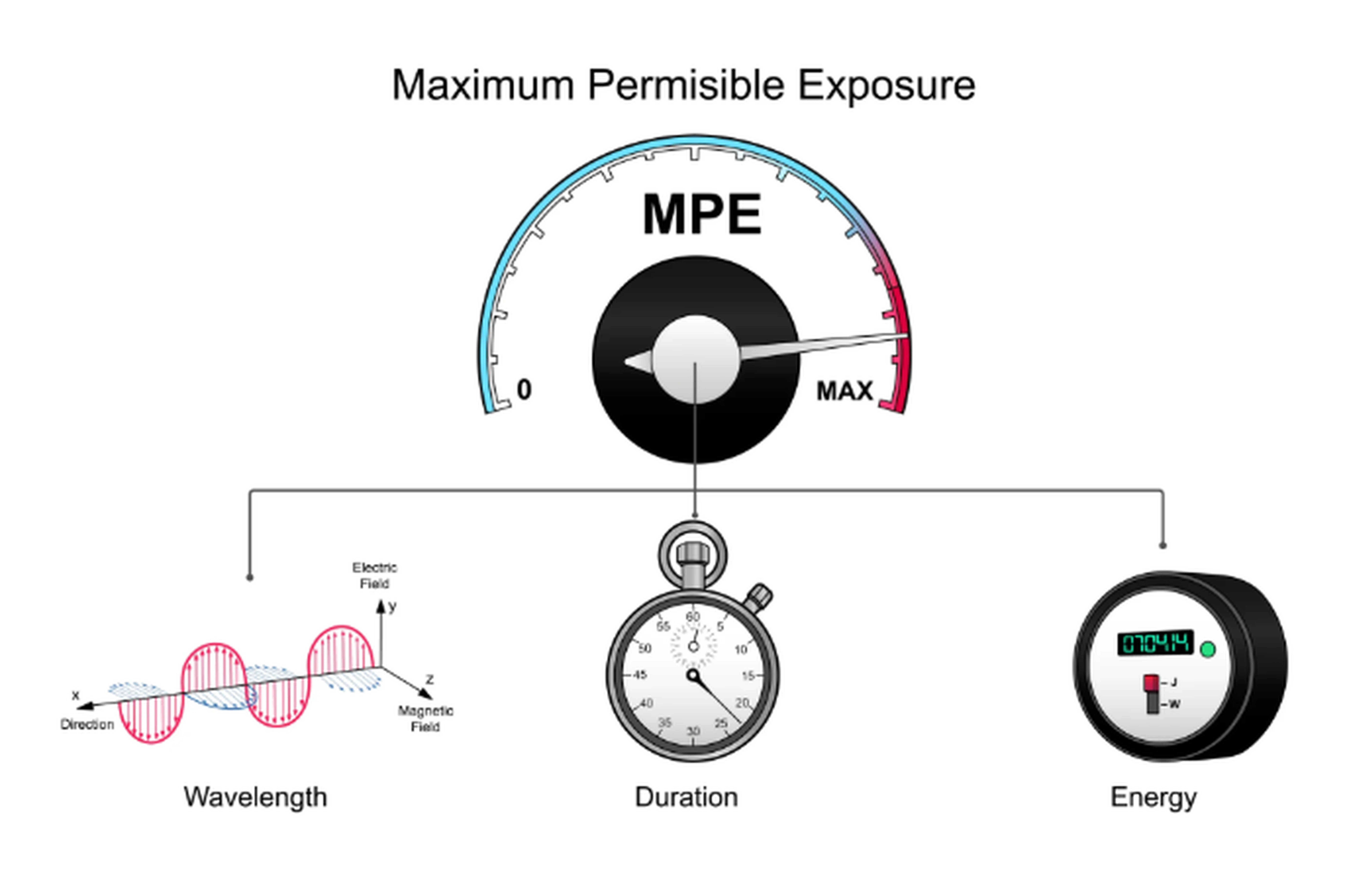
Maximum Permissible Exposure (MPE) defines the highest laser radiation level to which a human can be exposed without immediate or long-term harm. For Class 4 lasers (output >500mW), MPE values vary significantly across wavelengths due to differences in biological tissue absorption and optical penetration depth. Key factors include:
Exposure Duration: Shorter pulses (nanoseconds) often allow higher MPEs than continuous waves.
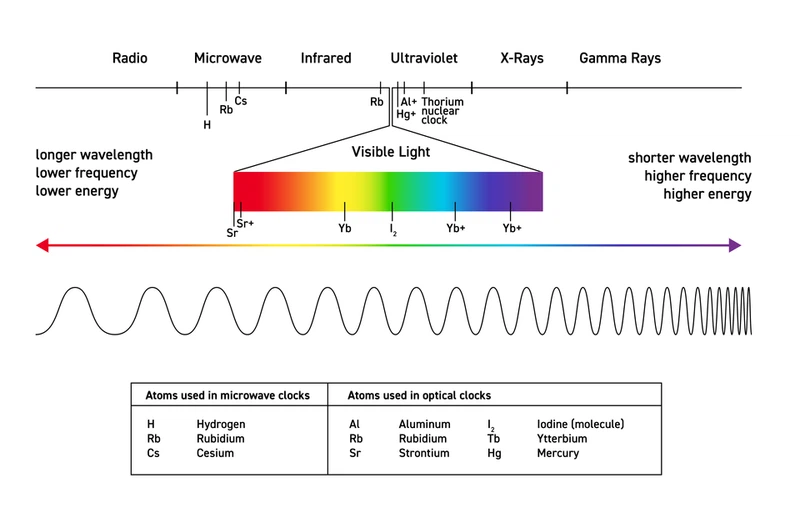
Wavelength Range: Ultraviolet (UV), visible, and infrared (IR) bands interact differently with skin and eyes.
2. MPE Variations Across Wavelengths
(a) Ultraviolet (180–400 nm)
Primary Risk: Skin burns, corneal damage, and cataracts.
MPE Example:
UV-C (180–280 nm): 3 mJ/cm² for 1-second exposure (highest hazard due to DNA damage risk).
UV-A (315–400 nm): 1 J/cm² for 10-second exposure.
Protection Focus: Use UV-blocking materials (e.g., polycarbonate lenses with OD≥4) and full-body coverage to prevent skin exposure.
(b) Visible Light (400–700 nm)
Primary Risk: Retinal burns (laser light focuses onto the retina).
MPE Example:
532 nm (Green): 2.5 mW/cm² for 0.25-second exposure.
650 nm (Red): 10 mW/cm² for 10-second exposure.
Protection Focus: High-OD goggles (OD≥5) with narrowband filtering to block specific wavelengths.
(c) Infrared (700 nm–1 mm)
Near-IR (700–1400 nm)
Primary Risk: Retinal and lens damage (invisible beam, no blink reflex).
MPE Example: 100 mW/cm² for 1-second exposure at 1064 nm.
Protection Focus: Use IR-specific coatings (e.g., germanium lenses) and beam enclosures.
Far-IR (>1400 nm)
Primary Risk: Skin burns and corneal dehydration.
MPE Example: 10 W/cm² for 10-second exposure at 10,600 nm (CO₂ lasers).
Protection Focus: Zinc selenide (ZnSe) windows and thermal-resistant barriers.
3. Protective Equipment Selection Guidelines
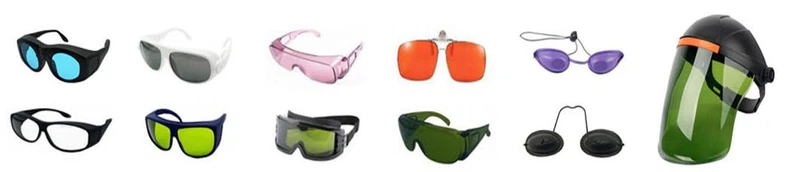
Wavelength Compatibility: Match the laser's emission spectrum (e.g., 190–540 nm for argon lasers).
OD Requirements: Calculate using OD=log10(Laser Power Density MPE)OD=log10(MPELaser Power Density).
Example: For a 10 W/cm² Class 4 CO₂ laser, OD=log10(10/0.1)=2OD=log10(10/0.1)=2, but add safety margin (use OD≥3).
Material Durability: Ensure lenses withstand peak power (e.g., EN 207's "L6" rating for 1×10⁶ W/m²).
(b) Engineering Controls
Beam Enclosures: Use non-reflective, wavelength-absorbing materials (e.g., anodized aluminum for IR).
Interlocks: Automatically shut off lasers if doors/openings are breached.
Ventilation: Required for UV/IR lasers to remove ozone or heat.
(c) Administrative Measures
Training: Emphasize wavelength-specific risks (e.g., invisible IR beams).
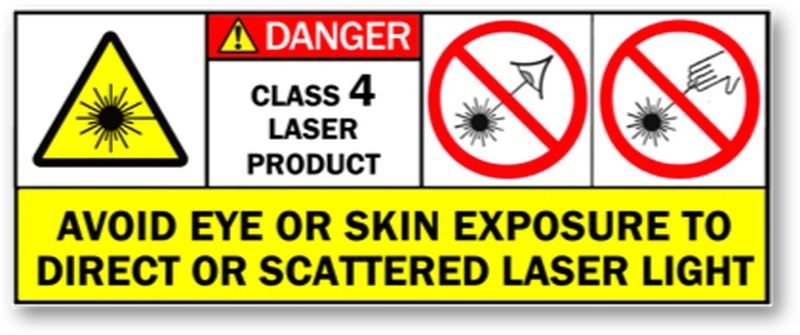
Signage: Label zones with laser parameters (wavelength, power, MPE).
4. Standards Compliance
IEC 60825-1/EN 60825: Mandates MPE-based classification and device labeling (e.g., "Class 4" and wavelength).
ANSI Z136.1: Requires OD calculations and hazard analysis for mixed-wavelength environments.
EN 207: Certifies protective eyewear for both OD and material resistance (e.g., "D" for continuous wave, "R" for pulsed).
5. Practical Application Example
Scenario: A 200 W fiber laser (1070 nm) used in metal cutting.
MPE Calculation: 100 mW/cm² for 0.25-second exposure → Required OD = log10(200,000/0.1)≈6.3log10(200,000/0.1)≈6.3.
Protection:
Glasses: OD≥7 @ 900–1100 nm, EN 207 "R" rating for pulsed operation.
Engineering: Enclosed beam path with IR-viewing windows.
Training: Highlight invisible beam risks and emergency shutdown protocols.
6. Common Pitfalls to Avoid
Mismatched Filters: Using 1064 nm glasses for 1550 nm lasers reduces protection.
Overlooking Reflected Beams: Class 4 IR lasers can reflect off metallic surfaces, requiring full-room shielding.
Ignoring Pulse Effects: Pulsed lasers (e.g., femtosecond) may require higher OD despite lower average power.