





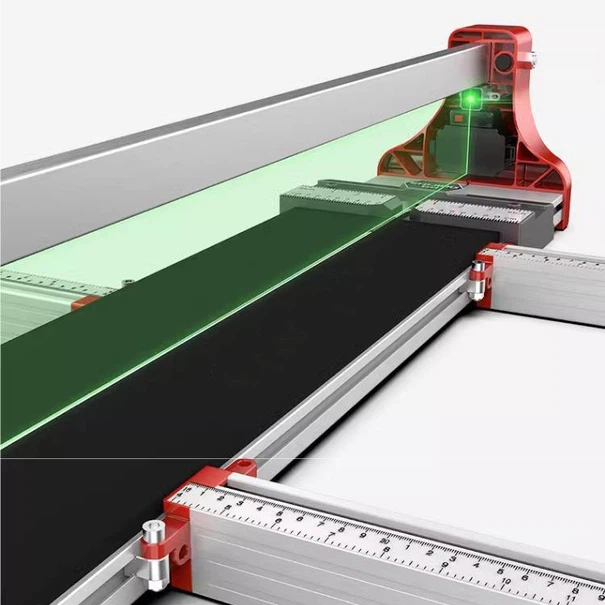
Line Lasers is a device used to generate a straight laser beam and is widely used in various positioning and marking applications. The line laser is a convenient and practical positioning tool. It can be widely used in machine vision laser positioning, structured light source positioning, cloth cutting machine auxiliary marking, wood cutting laser marking positioning, weld tracking/flatness detection/gap detection/electronic components and other auxiliary marking positioning detection.

Line Laser uses specific optical elements such as cylindrical mirrors, wave mirrors, Powell prisms or DOE diffraction elements to disperse and refract light to form a linear laser mode. The materials for these devices are usually plastic or glass, and each optical component has its own unique advantages and limitations.
One line lasers can be divided into models commonly used for marking line positioning and models used in the field of high-performance machine vision. In many fields such as industrial manufacturing, construction, and scientific research laboratories, line lasers are widely used because they provide precise linear reference.
Choosing the right in-line laser can ensure a successful project, save costs and increase efficiency. Technology selection relies on individual expertise, market insight, and project management capabilities. The correct selection of a line laser also needs to take into account factors such as the needs of the actual application scenario, the limitations of the operating environment, and the budget. Wrong selection can lead to poor equipment performance, increased maintenance costs or even project failure. Therefore, understanding the principles, performance indicators and application fields of line lasers is crucial to making a wise choice.
Lasers are produced by a process of stimulated emission light amplification, usually involving a gain medium (such as a gas, crystal, glass or semiconductor) and an energy supply source. Inside a laser, atoms or molecules are excited to a higher energy state by an external energy source, and when they return to their ground state, they release light of a specific wavelength. These photons bounce between the two mirrors, traveling in the same phase and direction as each other, creating highly coherent light.
The formation mechanism of the one-word line pattern is to use specific optical elements to spatially shape the laser light. These elements include cylindrical mirrors, aspherical lenses and Powell prisms, etc., which change the wavefront of the passing light beam and convert it into a plane wave, thereby forming a linear spot in space. The characteristic of this kind of spot is that it is very bright in the center and gradually becomes darker and thinner toward both ends. Therefore, special attention needs to be paid to selecting high-quality optical components to ensure the quality of the straight-line laser.

Key parameters required for line lasers selection:
Output power and brightness: Output power is a key measure of laser energy, usually measured in milliwatts (mW). Brightness is related to the visibility of the laser lines, especially under different ambient light conditions.
Wavelength selection: The wavelength (usually measured in nanometers) determines the color of the laser and affects the absorption and reflection characteristics of the laser on different materials.
Line Length and Width: Line length refers to the maximum extension distance of the laser line, while line width describes the thickness of the laser line. These two parameters directly affect the marking accuracy and application range.
Lens material and angle: The material of the lens affects the quality and durability of the laser beam, while the angle of the lens determines the ability of the laser to spread to form a straight line.
Housing material and size: The material and size of the housing are not only related to the durability and portability of the laser, but may also affect the heat dissipation capacity and the protection level of the overall device.
Working Distance and Range: Working distance refers to the farthest distance at which a laser line can be clearly seen without distortion, while range refers to the overall area size covered by the laser.
Stability and reliability: Stability involves the performance fluctuation of the laser during long-term operation, including the stability of light intensity, wavelength and linewidth. Reliability describes the laser's durability and low probability of failure over its expected life cycle.
The importance of line lasers selection:
Application adaptability: Different application scenarios have different requirements for the accuracy, brightness and color of the laser line. Choosing the right laser ensures it is suitable for the specific work environment and goals.
Performance optimization: A correctly selected in-line laser can provide the best performance, including straightness, stability and reliability, which are key factors to ensure work efficiency and accuracy.
Cost-Effectiveness: By selecting a laser that is suitable for a specific task, unnecessary costs can be minimized, such as overinvestment or additional expenses caused by mismatched equipment.
User safety: Different types of one-line lasers have different output powers and wavelengths. When selecting, you need to consider the safety of the operator and select the appropriate power and wavelength to reduce safety risks.
Maintenance and longevity: Proper sizing takes into account the maintenance needs and expected life of the laser, helping to reduce long-term operating costs and improve return on investment.
Environmental impact: Proper laser selection also takes into account environmental impact, including energy consumption and the impact of laser radiation on the surrounding environment.
Applications of line lasers:
Industrial manufacturing and processing: In industrial manufacturing, in-line lasers are often used for precision alignment and positioning to ensure the accuracy of component assembly. For example, in automated machinery, laser lines can be used to determine the correct position of a part so that a robotic arm or other automated equipment can accurately perform a task. In addition, line lasers are also used for material cutting and welding. By providing a straight line reference, they can ensure the linear accuracy of cutting or welding.
Building and Construction: In the building and construction industry, in-line lasers are used for horizontal and vertical alignment to help construction workers ensure that a building's structure is correct. They are also used for the measurement of large structures, such as ensuring the symmetry and straightness of large buildings or bridges.
Scientific research and laboratory applications: In scientific research and laboratory environments, in-line lasers are used for various optical experiments, as well as precise measurement and calibration equipment. In these applications, the accuracy and stability of a line are critical to the accuracy of experimental results.
The importance of line laser selection cannot be ignored because it is directly related to the performance and applicability of the equipment, as well as the effectiveness of the final application. Correct selection can ensure that the project can be completed efficiently and accurately, while wrong selection may lead to increased costs, reduced efficiency, or even project failure.
Reasonable selection should be made based on application requirements because different fields have different requirements for one-line lasers. For example, industrial manufacturing may require lasers with high stability and precision, while building construction may require equipment that can provide visible laser light over long distances. Understanding the specific work environment, target accuracy, and other relevant parameters is critical to making the right choice.
If you are not sure how to choose the right laser for you, you can contact JTBYShield for professional advice on the performance of different lasers. By communicating with our technical staff, we can help customers choose the most suitable one-line laser according to their specific needs.
Correct selection of a line laser is key to ensuring optimal performance in different applications. Therefore, buyers should invest time and effort, conduct careful research, and consult with professionals in order to make an informed decision.
Contact information:
If you have any ideas, feel free to talk to us. No matter where our customers are and what our requirements are, we will follow our goal to provide our customers with high quality, low prices, and the best service.
 Email:info@loshield.com
 Tel:0086-18092277517
 Fax: 86-29-81323155
 Wechat:0086-18092277517


