



Laser Processing refers to the use of the thermal effect generated by the laser beam projected on the surface of the material to complete the processing process, including laser welding, laser cutting, surface modification, laser marking, laser drilling and micromachining. Use laser beams to perform various processing on materials, such as drilling, cutting, scribing, welding, heat treatment, etc. Laser can be adapted to the processing and manufacturing of any material, especially in the processing and manufacturing of special occasions and special materials with special precision and requirements, and plays an irreplaceable role.

1. The Principle of Laser Processing
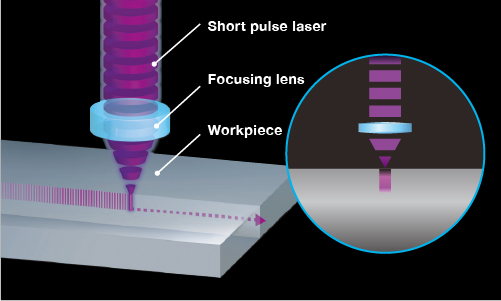
Laser processing is to irradiate the laser beam to the surface of the workpiece, and use the high energy of the laser to cut, melt the material and change the surface properties of the object. Since laser processing is non-contact processing, the tool will not directly rub against the surface of the workpiece to generate resistance, so the laser processing speed is extremely fast, the range of the processing object affected by heat is small, and no noise is generated. Since the energy of the laser beam and the moving speed of the beam can be adjusted, laser processing can be applied to different levels and ranges.
2. Features of Laser Processing
The precious characteristics of laser determine the advantages of laser in the field of processing:
①Since it is non-contact processing, and the energy of the high-energy laser beam and its moving speed can be adjusted, it can achieve a variety of processing purposes.
② It can process a variety of metals and non-metals, especially materials with high hardness, high brittleness and high melting point.
③There is no "tool" wear during laser processing, and no "cutting force" acts on the workpiece.
④During laser processing, the energy density of the laser beam is high, the processing speed is fast, and it is local processing, which has no or minimal effect on the non-laser irradiation parts. Therefore, the heat-affected zone is small, the thermal deformation of the workpiece is small, and the amount of subsequent processing is small.
⑤ It can perform various processing on the workpiece in the airtight container through the transparent medium.
⑥Because the laser beam is easy to guide and gather to realize the transformation in various directions, it is very easy to cooperate with the numerical control system to process complex workpieces, so it is an extremely flexible processing method.
⑦Using laser processing, the production efficiency is high, the quality is reliable, and the economic benefit is good.
Laser Technology
Use laser beams to perform various processing on materials, such as drilling, cutting, scribing, welding, heat treatment, etc. Laser processing has many advantages: ①The laser power density is high, and the temperature of the workpiece rises rapidly after absorbing the laser and melts or vaporizes. Even materials with high melting point, high hardness and brittleness (such as ceramics, diamond, etc.) can also be processed by laser; ②Laser head There is no contact with the workpiece, and there is no problem of wear and tear of the processing tool; ③The workpiece is not stressed and is not easy to be polluted; ④It can process the moving workpiece or the material sealed in the glass shell; ⑤The divergence angle of the laser beam can be less than 1 milliarc, and the spot The diameter can be as small as the order of microns, and the action time can be as short as nanoseconds and picoseconds. At the same time, the continuous output power of high-power lasers can reach the order of kilowatts to ten kilowatts. Therefore, the laser is suitable for both precision microprocessing and Large-scale material processing; ⑥The laser beam is easy to control, and it is easy to combine with precision machinery, precision measurement technology and electronic computers to achieve a high degree of automation and high processing accuracy; ⑦In harsh environments or places that are difficult for others to access, available Robots perform laser processing.

1. laser drilling
Holes can be drilled with a pulsed laser with a pulse width of 0.1-1 millisecond, which is especially suitable for drilling micro-holes and special-shaped holes, with a diameter of about 0.005-1 mm. Laser drilling has been widely used in the processing of jewel bearings, diamond wire drawing dies, chemical fiber spinnerets and other workpieces of watches and instruments.
2. Laser cutting, scribing and lettering
In industries such as shipbuilding and automobile manufacturing, hundreds of watts to 10,000 watts of continuous CO2 lasers are often used to cut large workpieces, which can not only ensure accurate spatial curve shapes, but also have high processing efficiency. Medium and low power solid-state lasers or CO2 lasers are commonly used for cutting small workpieces. In microelectronics, lasers are often used to cut silicon wafers or cut narrow slits, with fast speed and small heat-affected zone. The laser can be used to engrave or mark the workpiece on the assembly line without affecting the speed of the assembly line, and the engraved characters can be permanently maintained.
3. laser trimming
Use medium and low power lasers to remove some materials on electronic components to achieve the purpose of changing electrical parameters (such as resistance value, capacitance and resonance frequency, etc.). Laser trimming has high precision and high speed, and is suitable for mass production. Using similar principles can repair the mask of defective integrated circuits, repair integrated circuit memory to improve yield, and can also accurately adjust the dynamic balance of the gyroscope.
4. Laser welding
Laser welding has high strength, small thermal deformation, and good sealing. It can weld materials with different sizes and properties, as well as materials with high melting points (such as ceramics) and easy oxidation. The laser-welded cardiac pacemaker has good airtightness, long life and small size.
5. laser heat treatment
Irradiate the material with laser, select the appropriate wavelength and control the irradiation time and power density, so that the surface of the material can be melted and recrystallized to achieve the purpose of quenching or annealing. The advantage of laser heat treatment is that the depth of heat treatment can be controlled, the heat treatment part can be selected and controlled, the deformation of the workpiece is small, parts and components with complex shapes can be processed, and the inner walls of blind holes and deep holes can be treated. For example, the life of cylinder pistons can be extended after laser heat treatment; silicon materials damaged by ion bombardment can be restored by laser heat treatment.
6. Enhanced treatment
Laser surface strengthening technology is based on two processes of high energy density heating of laser beam and rapid self-cooling of workpiece. In laser surface strengthening of metal materials, when the energy density of laser beam is at the low end, it can be used for surface phase transformation strengthening of metal materials. When laser When the beam energy density is at a high level, the light spot on the surface of the workpiece is equivalent to a moving gap, which can complete a series of metallurgical processes, including surface remelting, surface carburization, surface alloying and surface cladding. The material substitution technology triggered by these functions in practical applications will bring huge economic benefits to the manufacturing industry.
The main application in the modification of tool materials is melting treatment. Melting treatment is that the surface of the metal material becomes molten under the irradiation of the laser beam, and at the same time solidifies rapidly to produce a new surface layer. According to the change of the surface structure of the material, it can be divided into alloying, cladding, remelting and refining, glazing and surface compounding.
Laser melting is a surface modification technology that irradiates the surface of a material with a laser with appropriate parameters to rapidly melt and condense the surface to obtain a more refined and homogeneous structure and desired properties. It has the following advantages:
1. Generally, no metal elements are added when the surface is melted, and the fused layer forms a metallurgical bond with the material matrix.
2. In the process of laser melting, impurities and gases can be excluded, and the impurities obtained by rapid cooling and recrystallization have higher hardness, wear resistance and corrosion resistance.
3. The molten layer is thin and the heat action zone is small, which has little effect on surface roughness and workpiece size. Can sometimes be used without further polishing.
4. Increase the solid solubility limit of solute atoms in the matrix, superfine the crystal grains and the second phase particles, form a metastable phase, and obtain a single crystal structure without diffusion or even an amorphous state, so that the new alloy produced can obtain the benefits of traditional methods. to the excellent performance.

The light beam can be guided through the optical path, so that the special position of the part and the surface of complex shape can be processed.
Combining the advantages of laser technology and the shortcomings of widely used technologies, applying laser technology to the surface strengthening treatment of tool materials will be one of the important ways to improve the wear resistance and service life of tools, especially for ceramics and hard alloys. The advantages of high hardness and good heat resistance of the tool are conducive to improving processing efficiency and processing accuracy, and can cut difficult-to-machine materials such as hardened steel under unfavorable processing conditions. Due to their relatively low strength and poor toughness, their application range is seriously limited. Therefore, it has profound research significance and broad application prospects to apply laser surface strengthening technology to ceramics and cemented carbide tools.
Contact information:
If you have any ideas, feel free to talk to us. No matter where our customers are and what our requirements are, we will follow our goal to provide our customers with high quality, low prices, and the best service.
 Email:info@loshield.com
 Tel:0086-18092277517
 Fax: 86-29-81323155
 Wechat:0086-18092277517


