


Discover why laser safety curtains with a PEL rating of 543.348 W/cm² @ 1070 nm are critical for protecting personnel, ensuring regulatory compliance, and enabling efficient industrial laser cleaning. Learn how they work, what the specs mean, and how to choose the right solution.
The Hidden Dangers of Industrial Laser Cleaning
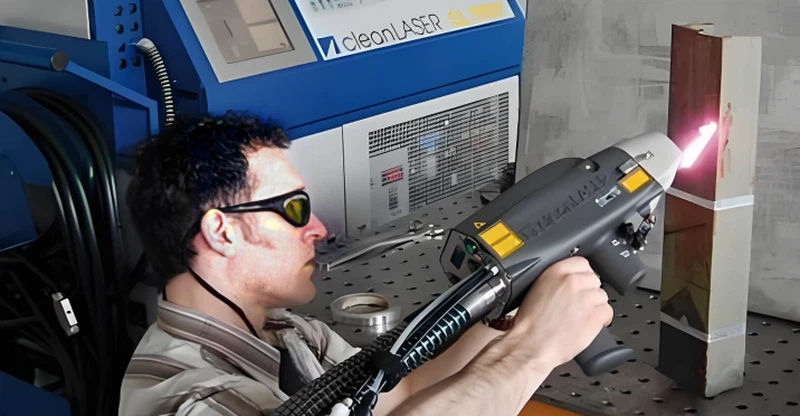
Laser cleaning has revolutionized surface preparation across aerospace, automotive, maritime, and heavy manufacturing industries. Offering a non-abrasive, chemical-free, and highly precise method to remove rust, paint, oxides, and contaminants, it's no wonder adoption is surging globally.
However, with great power comes great risk. Most industrial laser cleaning systems operate in Class 4 laser territory-the highest hazard classification under international safety standards like IEC 60825-1, EN 60825, and GB 7247.1. These lasers emit invisible near-infrared radiation (typically at 1070 nm) capable of causing permanent eye damage, skin burns, or even fire-even from diffuse reflections.
This is where high-performance laser safety curtains become non-negotiable. Specifically, curtains rated with a Protective Exposure Limit (PEL) of 543.348 W/cm² @ 1070 nm represent a critical engineering control that bridges operational efficiency and human safety. In this comprehensive guide, we'll explore why this specification matters, how it translates into real-world protection, and what you must consider when deploying laser safety barriers in your facility.
What Does "PEL = 543.348 W/cm² @ 1070 nm" Really Mean?
While often confused with the Maximum Permissible Exposure (MPE)-the safe exposure limit for humans-the term PEL (Protective Exposure Limit) in this context refers to the maximum incident laser power density a safety curtain can withstand while still ensuring transmitted radiation remains below MPE levels.
In practical terms:
Wavelength: 1070 nm is the standard emission line for high-power fiber lasers used in cleaning.
Power Density: 543.348 W/cm² represents an extremely intense energy flux-equivalent to focusing over 5 kW of laser power onto a 1 cm² spot.
Test Conditions: This rating typically assumes a defined beam diameter (e.g., ~5 mm) and exposure duration (e.g., 100 seconds), simulating worst-case scenarios like accidental beam deflection or prolonged reflection.
Crucially, a valid PEL rating implies two simultaneous guarantees:
Material Integrity: The curtain won't melt, ignite, or degrade under such conditions.
Radiation Safety: Transmitted laser energy on the protected side stays below the MPE threshold, ensuring personnel safety.
Without both, the barrier fails as a true safety device.
Why Laser Safety Curtains Are Non-Negotiable in Laser Cleaning
1. Mitigating Invisible but Lethal Hazards
The 1070 nm laser beam is invisible to the human eye. Unlike visible light, there's no blink reflex or natural aversion response. A worker could be exposed to hazardous radiation for seconds without realizing it-leading to irreversible retinal injury or corneal burns.
High-PEL safety curtains act as a passive, always-on shield that blocks these invisible threats before they reach personnel zones.
2. Compliance with Global Laser Safety Standards
Regulatory frameworks worldwide mandate engineering controls for Class 4 laser operations:
IEC 60825-1 / EN 60825: Requires physical barriers to limit access and contain radiation.
ANSI Z136.1 (U.S.): Emphasizes controlled areas with interlocks and shielding.
GB 7247.1 (China): Aligns with IEC standards and enforces similar containment rules.
Using a certified laser safety curtain with documented PEL performance isn't just best practice-it's often a legal requirement to avoid fines, shutdowns, or liability in case of accidents.
3. Enabling Flexible, On-Site Protection
Unlike fixed enclosures, portable laser safety curtains offer rapid deployment for:
Large-scale structures (ship hulls, aircraft wings, pipelines)
Temporary maintenance zones on factory floors
Field service operations in remote locations
A curtain rated at 543.348 W/cm² @ 1070 nm ensures this flexibility doesn't compromise safety-even when working with multi-kilowatt cleaning systems.
4. Preventing Secondary Hazards
Laser-material interaction generates:
Intense plasma flashes
Hot particulates and metal vapors
Ozone and volatile organic compounds (VOCs)
While not a fume extractor, a well-sealed safety curtain slows the dispersion of airborne hazards, giving local exhaust ventilation (LEV) systems more time to capture contaminants-enhancing overall workplace hygiene.

How PEL Relates to Optical Density (OD): Bridging Technical Specs
Many engineers are more familiar with Optical Density (OD) than PEL. Fortunately, the two are mathematically linked:
OD = log₁₀ (Incident Power Density / MPE)
For 1070 nm and a 100-second exposure, the skin MPE is approximately 1.77 W/cm². Using your PEL value:
OD = log₁₀ (543.348 / 1.77) ≈ log₁₀(307) ≈ 2.49
Thus, a curtain rated at PEL = 543.348 W/cm² @ 1070 nm provides at least OD 2.5 of attenuation-sufficient to reduce a dangerous 500 W/cm² reflection to a safe ~1.6 W/cm².
✅ Key Takeaway: High PEL = High Effective OD + Material Durability.
Always request third-party test reports that validate both attenuation performance and thermal resilience.
Choosing the Right Laser Safety Curtain: Key Considerations
| Factor | Recommendation |
|---|---|
| Wavelength Match | Ensure curtain is tested specifically at 1070 nm (not just "broadband") |
| Certification | Look for compliance with IEC 60825-1, EN 60825, GB 7247.1 |
| Transparency Needs | Opt for integrated laser-safe viewing windows (OD-rated polycarbonate) |
| Portability | Choose lightweight, foldable designs with modular frames for quick setup |
| Durability | Material should be flame-retardant, anti-static, and resistant to oils/chemicals |
| Documentation | Demand full test data: PEL, OD, beam size, exposure time, and transmission results |
Avoid generic "blackout curtains" or uncertified fabrics-they may block visible light but offer zero protection against 1070 nm radiation.
Real-World Applications Where High-PEL Curtains Save Lives
Aerospace: Protecting technicians during in-situ turbine blade cleaning.
Automotive: Isolating robotic laser stations on production lines.
Marine: Creating safe zones on open decks during ship hull decontamination.
Nuclear Decommissioning: Containing laser ablation of radioactive surfaces.
Cultural Heritage: Safely removing soot from historical monuments without endangering conservators.
In each case, the 543.348 W/cm² PEL rating ensures the curtain can handle the intense, unpredictable reflections common in real-world cleaning scenarios.

Conclusion: Safety Is the Foundation of Advanced Manufacturing
Laser cleaning is a powerful tool-but its benefits vanish the moment someone gets hurt. The specification "PEL = 543.348 W/cm² @ 1070 nm" is far more than a technical footnote; it's a quantifiable promise of protection.
By investing in certified, high-PEL laser safety curtains, companies demonstrate commitment to:
Worker well-being
Regulatory compliance
Operational continuity
Corporate responsibility
As laser adoption grows, so does the need for intelligent, engineered safety solutions. Don't treat laser curtains as an afterthought-integrate them from day one as a core component of your laser safety management system.
Remember: You can't see 1070 nm laser light-but a properly rated safety curtain ensures you'll never feel its consequences.