


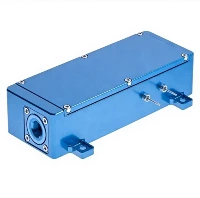
Laser modules used in machine vision have extremely high requirements, driven entirely by their core mission: to provide a stable, precise, and predictable "structured" light source for the vision system.
While conventional lighting merely illuminates objects, laser modules in machine vision actively participate in measurement and judgment. They emit not ordinary light but a "light ruler," a "light knife," or a "precise reference model." Any slight imperfection can directly lead to measurement and judgment errors.

Key Reasons:
1. To achieve extremely high measurement accuracy
Laser modules are used for non-contact 3D measurement:
Laser triangulation: A laser beam is illuminated onto an object's surface, and a camera captures the deformation of this beam from another angle. Subtle changes in the laser beam's position, width, and shape are directly interpreted by algorithms as information about the object's surface height and contour.
Structured light 3D scanning: A laser module projects a specific pattern (such as a dot matrix, grid, or coded stripes) onto the surface of an object, reconstructing the 3D model by analyzing the pattern's deformation.
Laser Module Requirements:
Linear Straightness: An ideal laser line should be absolutely straight. Any curvature or distortion will directly introduce measurement errors. High-quality line laser modules require excellent optical lenses to ensure perfect straightness.
Line Width Uniformity: The width and energy distribution of the entire laser line must be highly uniform. If the center is bright and the ends are dark, or the width varies, the edge detection algorithm will err.
Beam Profile: For point lasers, the spot must be a perfect circle (Gaussian distribution), with concentrated energy at the center to ensure precise center location.
2. Ensuring System Stability and Reliability
Industrial environments are often challenging: vibration, temperature fluctuations, and continuous operation for long periods of time. Vision systems must maintain stable output in such environments.
Laser Module Requirements:
Power Stability: The laser output power must not drift over time or temperature. Even slight variations require real-time compensation using a closed-loop feedback circuit (such as APC mode). Power fluctuations can cause variations in the brightness received by the camera, affecting the binarization threshold and measurement results.
Temperature Drift Control: Temperature fluctuations can cause slight shifts in the laser wavelength (temperature drift). More seriously, this can cause the mechanical structure that secures the laser module to expand and contract, shifting the position of the laser line or spot. High-precision modules require excellent thermal management and temperature drift compensation technology.
Mechanical Stability: The module structure must be robust and able to withstand industrial site vibrations to prevent loosening or misalignment of internal optical components.
3. Meeting the Physical Property Requirements of Specific Applications: Different objects and scenes require different laser characteristics.
Wavelength: To combat ambient light interference (such as sunlight), specialized wavelengths (such as 808nm, 850nm, and 905nm) are often used, combined with a narrowband filter in the camera to allow only the laser light to pass. For certain materials (such as transparent glass and certain plastics), selecting the appropriate wavelength is crucial for optimal contrast.
Depth of Field: A laser line is not infinitely sharp; it has a range of "depth of focus." High-quality laser modules have a greater depth of focus, ensuring that the laser line remains sharp and clear over a range of distances and heights, extending the measurement range.
4. To improve the efficiency and robustness of image processing algorithms
A high-quality laser module lays a solid foundation for subsequent image processing.
High contrast: The high brightness and directionality of laser light create features on the surface of an object that stand out against the background. A high-quality module produces images with extremely high contrast and extremely low noise, greatly simplifying algorithms such as image segmentation and edge extraction, and improving processing speed and accuracy.
No/low speckle: Laser light is coherent and produces speckle noise on rough surfaces, which can severely affect edge location accuracy. High-quality line laser modules employ special technologies (such as vibrating lenses and rotating optical elements) to actively eliminate or reduce speckle.

Summary Analogy:
- A regular light is like a flashlight, illuminating an object for your viewing pleasure.
- A machine vision LED light source is like a professional photography light, highlighting features through specific angles and diffused light.
- A machine vision laser module is like a precision vernier caliper or a projector. It is a high-precision measurement tool or reference generator. Naturally, you have the highest expectations for caliper accuracy and projector clarity and stability.
Thus, the high demands placed on machine vision laser modules are essentially a result of the unwavering pursuit of accuracy, speed, and reliability in industrial inspection, precision measurement, and automation. Any compromise in the laser module will be magnified in the final measurement results and system performance.
Contact information:
If you have any ideas, feel free to talk to us. No matter where our customers are and what our requirements are, we will follow our goal to provide our customers with high quality, low prices, and the best service.
 Email:info@loshield.com
 Tel:0086-18092277517
 Fax: 86-29-81323155
 Wechat:0086-18092277517


